
Reviewed · WALKING TOURS
Paris Marais Quarter 2-Hour Private Walking Tour
The Marais is Paris in several different centuries at once. In two hours, this private walk links a former swamp, a medieval market district, a royal square, the historic Jewish quarter, and the modern Centre Pompidou. The changing identity of the neighborhood is the real attraction here, not simply a checklist of pretty streets.
I like the tour’s focused route from Les Halles to Place de la Bastille, and I like having a private guide who can adjust the explanation to your group. Guides including Alexandre, Caroline, Boris, and Fabienne have been praised for clear storytelling and for making the walk work for groups ranging from children to older adults.
The main drawback is the price: $176 per person is a serious spend for two hours, especially for one or two people. You are paying for a private guide and a history-centered walk, not food, museum admission, or a long half-day outing.
Key points at a glance
- A neighborhood with many past lives: Follow the Marais from drained marshland to aristocratic quarter, slum, Jewish center, and fashionable district.
- A private two-hour route: Your guide can shape the pace and explanations around your group rather than a large crowd.
- Important Jewish history: See the Pletzl, Rue Pavée, and the synagogue connected with the area’s long-standing Jewish community.
- Parisian landmarks with context: Visit Hôtel de Ville, Hôtel de Sully, Place des Vosges, and Place de la Bastille.
- A useful modern connection: Learn how the medieval fabric of the district relates to the Centre Pompidou.
- Strong guide feedback: Alexandre, Caroline, Boris, Anja, Fabienne, and Yvana are singled out for clear, personable, and engaging presentations.
Why the Marais makes a good two-hour walk
Many Paris walks focus on one grand monument. This one works differently. The Marais gives you a compact lesson in how Paris changed over time, and the guide’s job is to connect those changes as you move from one street or square to the next.
The area began as marshland. Once the land was drained, it became suitable for settlement and gradually drew residents, institutions, merchants, aristocrats, and royal connections. Later, the neighborhood fell out of fashion and gained a reputation as a rough area to avoid. Today, it is again one of Paris’s most sought-after districts.
That rise, fall, and return gives the walk a useful shape. You are not just looking at old buildings. You are seeing how the same quarter served very different purposes at different points in Parisian life.
The private format matters here. A guide can explain a façade, pause for a question, or adjust the level of detail for your group. One particularly useful strength is the range of ages the guides have handled. Alexandre led a group with participants from age six to 75, adapting the presentation so everyone could follow along.
More walking tours in Paris:
- Paris Top Sights Half Day Walking Tour with a Fun Guide
★ 5.0 · 2,893 reviews - Montmartre Hidden Gems and Scenic Highlights Walking Tour
★ 5.0 · 2,684 reviews - Montmartre Hill French Gourmet Food and Wine Tasting Walking Tour
★ 5.0 · 2,588 reviews
Starting at Étienne Marcel and the old Les Halles
The meeting point is at Metro Étienne Marcel. Look for a guide carrying a red canvas tote bag. This is a practical meeting arrangement, though you should allow enough time to locate the correct Metro exit and find the guide before the two-hour clock begins.
The walk opens near Les Halles, once the biggest open market in Paris. That fact gives the first part of the tour a strong sense of place. Les Halles was not merely a shopping area. It was part of the daily machinery of the city, bringing food, workers, sellers, and customers together in the center of Paris.
Your guide also takes you to the Fontaine des Innocents. This stop helps connect the market quarter with older Paris and gives you a chance to see how public fountains once served practical urban needs as well as decorative ones.
I like this opening because it begins with ordinary city life rather than royal ceremony. Markets are a good way to understand how a city functioned. The drawback is that the tour does not spend hours in Les Halles, and food is not included, so this is not a market tasting experience. It is a historical introduction to the district.
The Centre Pompidou and the meeting of old and new
The Centre Pompidou brings a modern note into a neighborhood better known for historic buildings. The tour uses it to explain the connection between the Middle Ages and modern Paris, an idea that gives the route more depth than a simple old-town walk.
This pairing is especially useful if you find architectural contrasts interesting. The Marais is not frozen in one period. Its older streets and buildings exist beside one of the city’s most unmistakably modern cultural centers. Your guide explains that relationship as part of the district’s continuing story.
The Centre Pompidou itself is included as a sight on the route, not as a museum visit. The two-hour schedule is built around outdoor walking and explanation, so you should not expect time for an interior art visit.
Hôtel de Ville and the public face of Paris
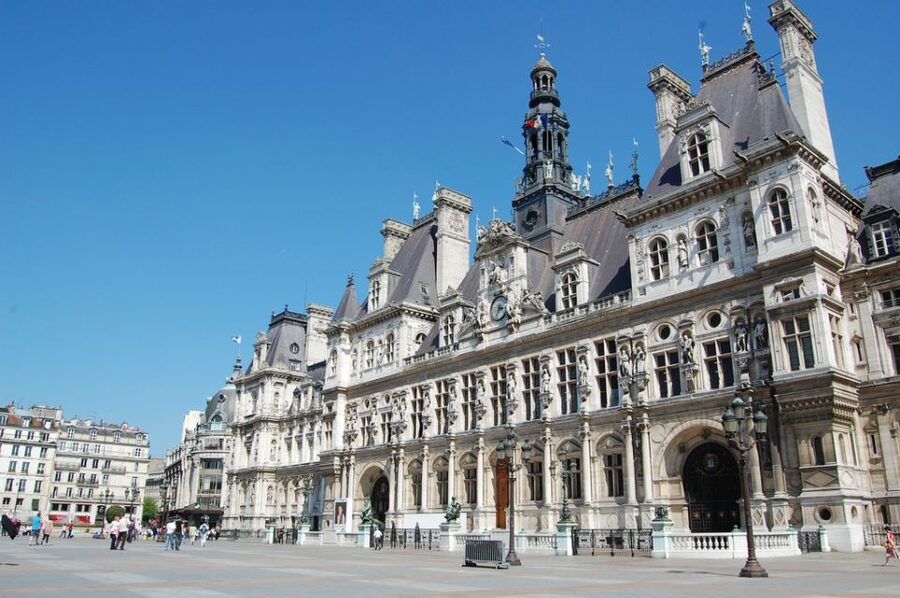
From the market district, the walk continues toward Hôtel de Ville, Paris’s opulent Renaissance City Hall. This is one of the route’s grander sights and a useful contrast to the tighter streets of the Marais.
The building represents the official, public face of the city. Your guide can place it within the larger story of Paris rather than leaving it as a decorative photo stop. The contrast between civic grandeur and the neighborhood’s more intimate lanes is part of what makes this walk work.
This is also a good point for questions. With a private group, you can ask about the building, the district, or the way Paris’s municipal life fits into the wider history of the city. A large group walk often has to keep moving, while a private walk gives you more room for that kind of exchange.
Same base, a different kind of day:
- Paris: Louvre Museum Timed-Entrance Ticket
★ 4.6 · 71,977 reviews - Disneyland® Paris 1-Day Ticket
★ 4.6 · 49,412 reviews - Paris: Versailles Palace and Gardens Full Access Ticket
★ 4.6 · 41,579 reviews - Paris: Evening River Cruise with Music
★ 4.4 · 22,721 reviews
The Pletzl and Rue Pavée
The Pletzl is the historic center of Paris’s Jewish community, and it is one of the most important sections of the tour. The Marais remains closely associated with Jewish life, and the route gives you a way to understand that connection through streets, buildings, and local history.
You will see the synagogue on Rue Pavée. The itinerary does not promise an interior visit, so treat this as an exterior sight and a point for explanation. The value comes from learning how the surrounding area became and remained a center of Jewish community life.
This section deserves attention because it adds social history to the grand architecture. Paris is often presented through kings, churches, monuments, and boulevards. The Pletzl shifts the focus to community, faith, migration, and everyday neighborhood life.
The guide’s role is especially important here. This is a place where brief facts can easily become a confusing list of dates and events. The strongest guides on this tour are described as clear, engaging, and able to adapt their explanation to the people in front of them. Caroline, Boris, and Fabienne are among the guides praised for making the history easy to follow.
Hôtel de Sully and the road to Place des Vosges
Hôtel de Sully is another reminder of the Marais’s period as a fashionable district for aristocrats. The neighborhood once attracted wealthy residents and even a royal court, and this section of the route shows why the area had such status.
The name Hôtel can be confusing if you expect a modern hotel. Here, it refers to a grand private mansion, part of the architectural vocabulary of old Paris. Your guide helps you read these buildings as signs of wealth and power rather than simply as attractive façades.
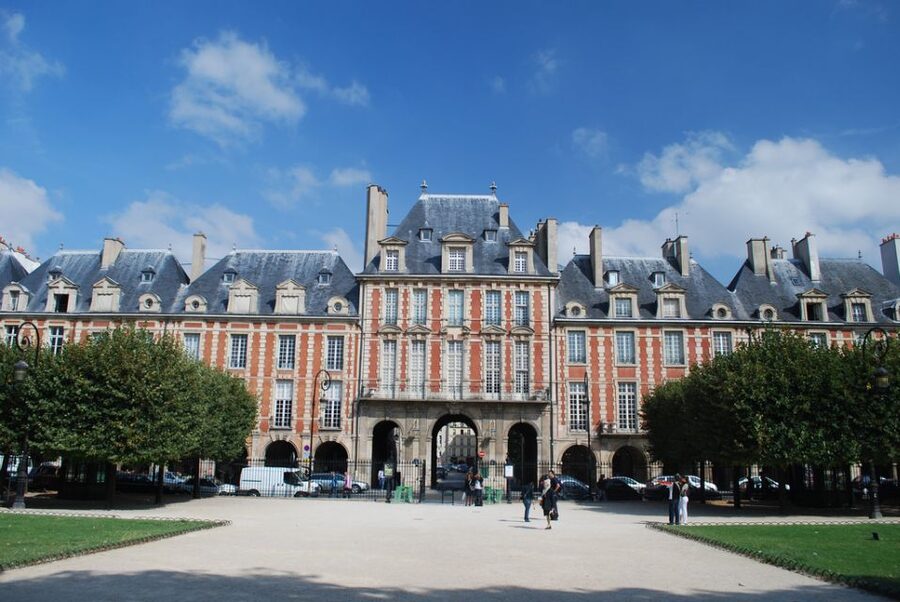
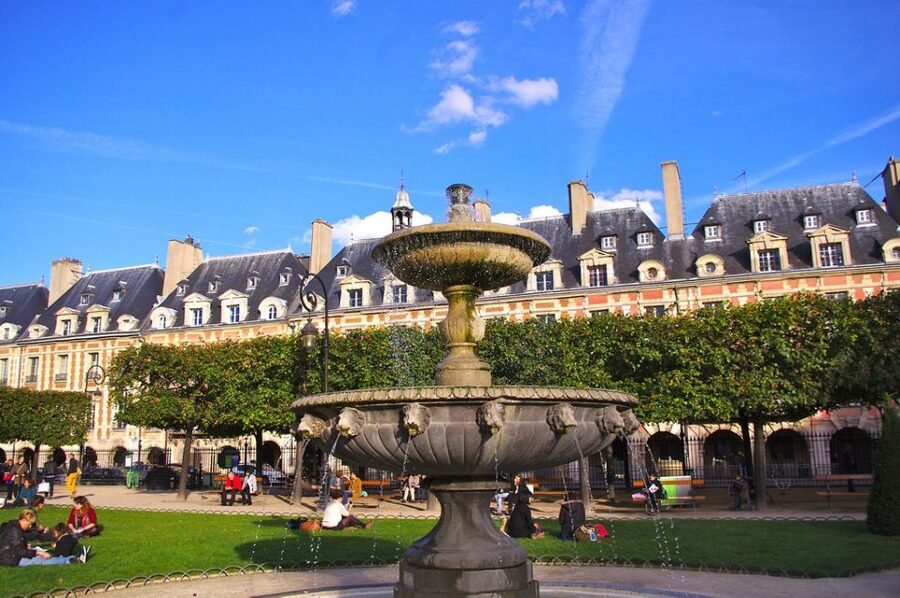
From Hôtel de Sully, the walk leads to Place des Vosges. This is often described as one of the most beautiful squares in the world, and it is easy to understand the appeal. Its regular design and elegant buildings create a calm, ordered space after the narrower streets around it.
Place des Vosges is also valuable because it shows the Marais at its most polished. Yet the guide should keep the larger story in view. The neighborhood’s later decline makes the earlier elegance more interesting. You see not just a lovely square, but one part of a district that moved through changing fortunes.
Place de la Bastille and the neighborhood’s second renaissance
The route finishes at Place de la Bastille. This gives the walk a clear endpoint and ties the Marais to one of the most recognizable sites in French political history.
The square marks a transition between the historic Marais and the wider eastern side of central Paris. By the time you reach it, the guide has taken you through market life, city government, Jewish community history, aristocratic architecture, royal connections, and modern culture.
The Marais is now enjoying what can fairly be called a second renaissance. That does not erase its difficult periods. Instead, the contrast helps you understand why the neighborhood feels so layered. It was once fashionable, later regarded as a shady slum, and now once again draws attention for its architecture, culture, and central location.
A useful question to ask at the end is which parts of the area are best explored on your own afterward. The walk gives you a framework, and you can then return to the streets or squares that caught your interest.
What the private format is worth at $176 per person
At $176 per person, this is not a budget introduction to Paris. The value depends heavily on the size of your group and how much you want personal guidance.
For a small private group splitting the cost, the price can make sense if you want a tailored history walk and the chance to ask questions freely. It is also useful for families or mixed-age groups. The experience has been adapted for participants from six to 75, which suggests that the guide can avoid making the talk too academic or too childish.
For one or two people, the cost is harder to justify. You are receiving two hours of live guiding, but there are no included snacks, drinks, museum tickets, or other admissions. If you mainly want a quick orientation, a less expensive group walk may be better value.
The private format does offer something a standard route cannot: flexibility in explanation. If your group cares most about Jewish Paris, architecture, royal history, or the Marais’s modern revival, you can give the guide a clear preference at the start.
Timing, language, and practical details
The walk lasts two hours and operates rain or shine. Wear shoes suitable for city walking and bring clothing that works for the forecast. Since the experience is outdoors, unpleasant weather can affect your enjoyment even though the tour still goes ahead.
The guide can lead in English, French, or Serbo-Croatian. The listed guides include Alexandre, Caroline, Boris, Anja, Fabienne, and Yvana. The feedback about these guides repeatedly points to a pleasant manner, clear explanations, and strong command of the neighborhood’s history and architecture.
Food and drinks are not included. That is not a problem for a two-hour walk, but plan your own café stop before or after the tour. The route begins at Metro Étienne Marcel and includes several major sights, ending at Place de la Bastille.
You can cancel up to 24 hours before the tour for a full refund, and the reserve-now, pay-later option gives you some flexibility while finalizing your Paris plans.
Who will get the most from this Marais walk
I would choose this tour if you want a compact introduction to the Marais with a strong historical thread. It suits first-time visitors who want more context than a self-guided stroll provides, and it works well for families who need a guide to keep different ages interested.
It is also a good choice if you care about Jewish Paris, aristocratic architecture, or the way old and modern Paris meet. The route includes enough variety to prevent the walk from becoming a long explanation of a single building type.
You may want something else if your priority is shopping, food, nightlife, or museum interiors. The tour passes through areas connected with those interests, but it is fundamentally an outdoor history walk.
The two-hour length is both a strength and a limit. It is short enough to fit into a busy Paris schedule, but the guide must cover a lot of ground and history. If you want a leisurely pause at every site, you may find the pace brisk.
Should you book the Paris Marais Quarter walking tour?
Book it if you value a private guide who can connect the Marais’s many eras and adjust the talk to your group. The best reasons are the route’s variety, the focus on the Pletzl and Rue Pavée, and the clear progression from Les Halles to Place de la Bastille.
I would be more cautious at $176 per person if you are traveling alone or mainly want inexpensive sightseeing. But for a family, a small group, or anyone who wants a well-organized introduction to one of Paris’s most layered quarters, this is a worthwhile use of two hours. Ask at the start to emphasize the subjects you care about most, then use the final stop as a springboard for exploring the Marais on your own.
FAQ
Where does the Paris Marais walking tour meet?
The meeting point is at Metro Étienne Marcel. Your guide will be carrying a red canvas tote bag.
How long does the walking tour last?
The tour lasts two hours.
Is this a private tour?
Yes. The tour is offered for a private group.
What languages can the guide speak?
Guiding is available in English, French, and Serbo-Croatian.
What places are included on the route?
The route includes Les Halles, Fontaine des Innocents, Centre Pompidou, Hôtel de Ville, the Pletzl area, the synagogue on Rue Pavée, Hôtel de Sully, Place des Vosges, and Place de la Bastille.
Does the tour include a visit inside the synagogue on Rue Pavée?
The synagogue on Rue Pavée is included as a sight on the route. An interior visit is not specified.
Is food or drink included?
No. Food, snacks, and beverages are not included.
Does the tour operate in bad weather?
Yes. Tours operate rain or shine.
Can I cancel for a refund?
You can cancel up to 24 hours in advance for a full refund.
Can I reserve now and pay later?
Yes. The reserve-now, pay-later option allows you to book without paying immediately.
Just added in Paris
- Private Transfers in Paris★ 5.0 · 75 reviews
- Disneyland® Paris 1 Day Ticket with Transport from Paris★ 3.5 · 302 reviews
- Personalized Transport service from Disneyland to Paris★ 5.0 · 63 reviews
- CDG – Euro Disney – CDG Two Way Private Shuttle Transfer★ 5.0 · 233 reviews
- Monet’s Gardens & House-Private Giverny Tour From Paris★ 4.5 · 137 reviews
- Giverny Monet House and Gardens Skip the line Walking tour★ 4.0 · 217 reviews
- Guided tour Monet’s house and gardens/small group★ 4.5 · 68 reviews
- Monet’s House and Garden & Giverny Village★ 4.5 · 39 reviews
Walking Tours, compared.

Paris Top Sights Half Day Walking Tour with a Fun Guide
Read our review →
Montmartre Hidden Gems and Scenic Highlights Walking Tour
Read our review →
Montmartre Hill French Gourmet Food and Wine Tasting Walking Tour
Read our review →
Paris Île de la Cité and Notre-Dame Walking Tour With Crypt
Read our review →
Montmartre Cheese, Wine & Pastry Guided Walking Tour
Read our review →
Paris in a Day: Louvre or Orsay, Eiffel Tower, City Walk & Cruise
Read our review →
Montmartre Highlights Walking Tour with a Local Guide
Read our review →
Browse the lists this tour appears in