
Reviewed · LOUVRE MUSEUM TOURS
Paris Louvre Exclusive Semi Private Guided Tour Max 6 People
The Louvre is easier to appreciate when someone helps you cut through its enormous collection. This small-group Louvre tour takes you from Greek sculpture to Renaissance painting and French Romanticism, with the Mona Lisa as the grand finale or centerpiece, depending on how your guide shapes the route.
I like the cap of six people, which gives you a better chance to hear the guide and ask questions. I also like that your ticket lets you remain inside after the guided portion, so you can return to rooms you passed quickly or explore parts of the collection at your own pace.
The main drawback is the price: $199 per person for roughly two to two and a half hours is a serious outlay. The tour also moves through a very busy museum, and one poor experience involved a guide ending the visit early after a disagreement, so the quality of the individual guide matters.
Key points at a glance
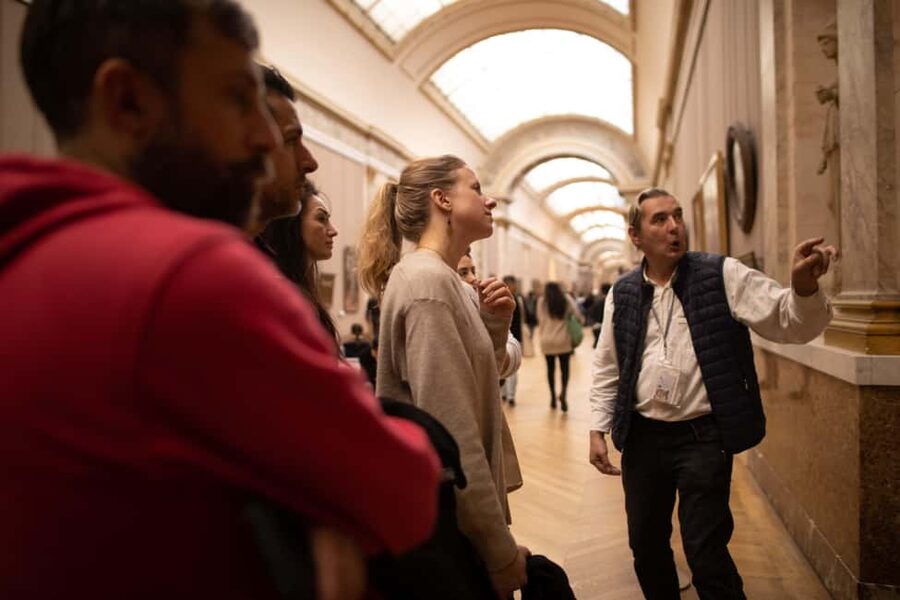
- Six-person maximum: A very small group makes it easier to stay with the guide and ask about works that catch your eye.
- Major Louvre masterpieces: The route includes the Mona Lisa, Venus de Milo, Great Sphinx of Tanis, Canova, Delacroix, and other famous works.
- A guide gives the museum shape: You learn how the Louvre developed from fortress to royal palace to public museum.
- Extra museum time included: After the guided tour, you can remain inside and continue visiting with your ticket.
- Several guide languages: Tours are offered in English, French, Portuguese, Spanish, Russian, and Swedish.
- A premium price: At $199, this makes the most sense if focused interpretation and a very small group matter to you.
Why a six-person group changes the Louvre visit
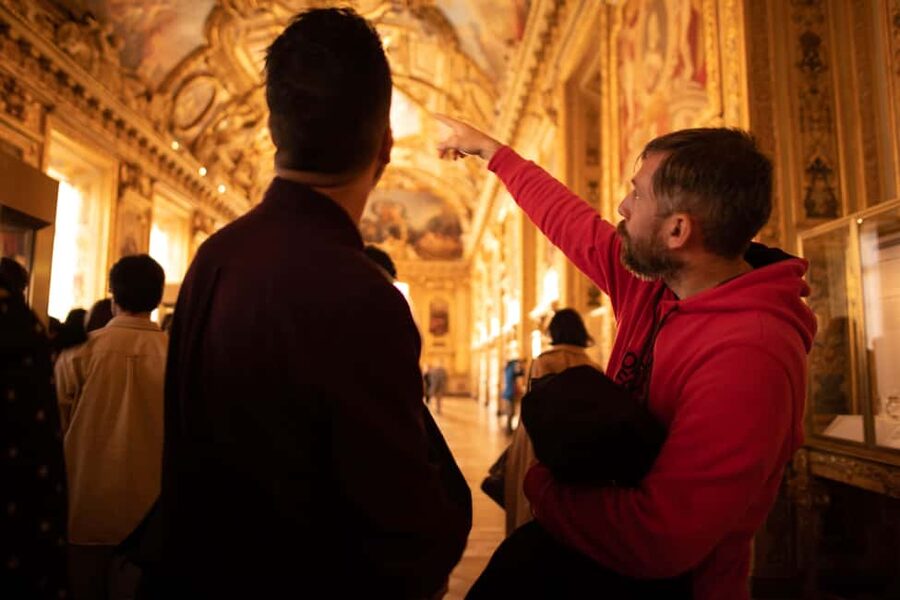
The Louvre can be tiring even before you reach the art. The building is enormous, the collection covers thousands of years, and the famous rooms can become packed. A guide cannot show you everything in a short visit, but a carefully chosen route can give you a useful framework.
A group of six is a real advantage here. You are not standing at the back of a crowd trying to catch every word. You can ask why a sculpture matters, point out a detail in a painting, or tell the guide that you want more time with a particular artist.
This is still a shared tour, not a fully private visit. The route must suit the group, and the Louvre’s crowds can slow everyone down. Still, six people is small enough to feel personal without paying the much higher cost of a one-to-one guide.
The experience is offered in private or small-group formats. The advertised price of $199 applies to the experience described here, with a maximum of six people. Check the exact format when booking if you are comparing it with a private option.
Other ways into the Louvre from Paris:
- Paris: Louvre Museum Timed-Entrance Ticket
★ 4.6 · 71,977 reviews - Paris: Louvre Guided Tour with Reserved Access & Boat Cruise
★ 4.3 · 16,353 reviews - Louvre Museum Masterpieces Guided Tour with Access
★ 4.5 · 12,023 reviews
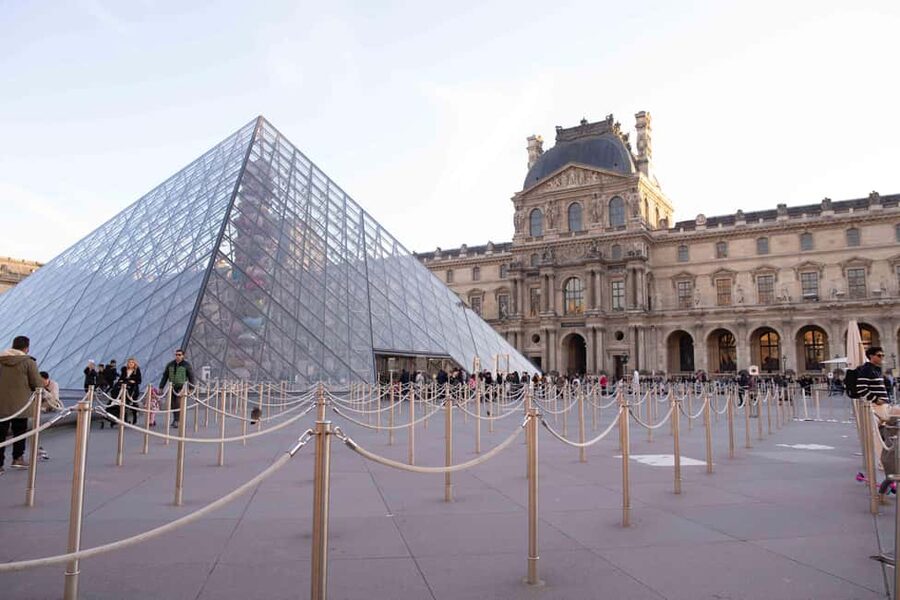
Meeting beneath Louis XIV by the Pyramid
You meet under the Louis XIV statue on horseback in front of the Louvre’s glass Pyramid. The guide carries a LivTours sign, which gives you a clear visual marker in a crowded area.
Arrive 10 to 15 minutes early. This is not a place where you want to arrive at the last second. The Pyramid area has a steady flow of people, and your guide may need to gather the group before moving toward the museum entrance.
The statue depicts Louis XIV as Marcus Curtius, and it is a fitting starting point. The Louvre was not created as a museum from the beginning. It began as a fortress, later became a royal palace, and eventually turned into the public collection you visit today. The opening stop gives the tour a useful sense of place before the art begins.
One practical point: bring your passport or ID card. The supplied information specifically lists this as something to carry. Non-folding wheelchairs and electric wheelchairs are not allowed on the activity, so anyone with mobility needs should check the arrangements before reserving.
The Louvre Pyramid and the first sense of scale
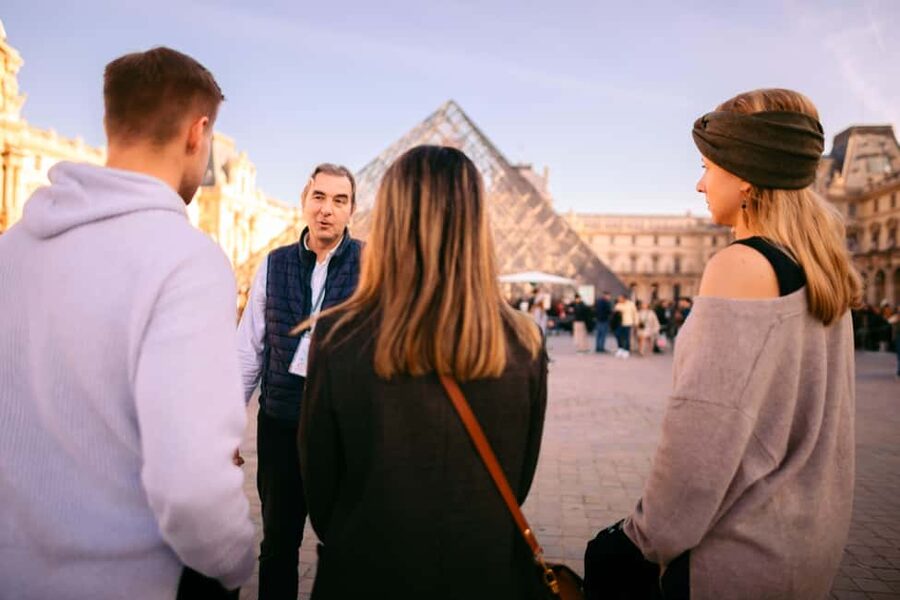
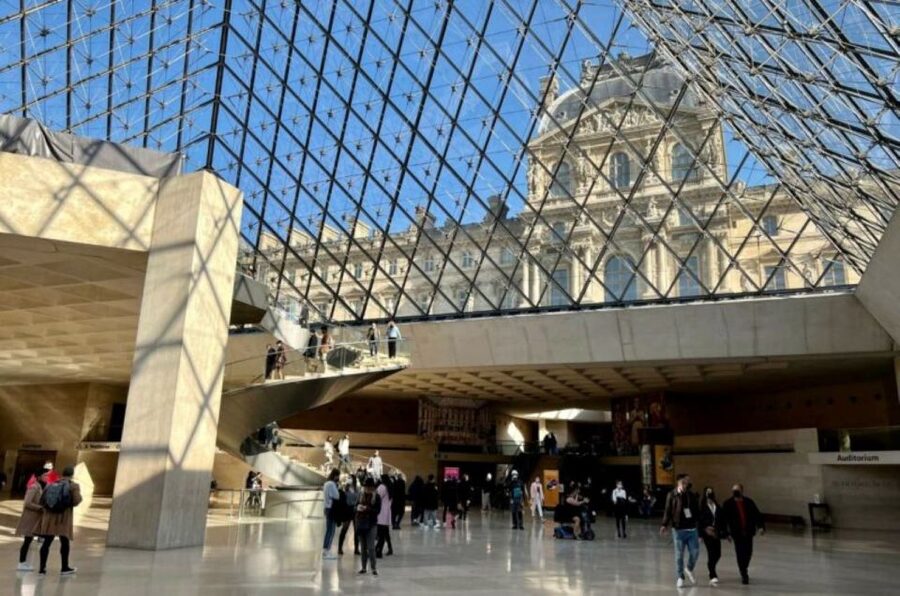
You pass by the Louvre Pyramid rather than taking part in a separate architectural visit. Even so, the glass structure helps you understand the museum’s modern entrance and the contrast between the contemporary pyramid and the palace around it.
The Pyramid is also where many people begin to realize the scale of the Louvre. The visible entrance is only one part of a much larger complex. Once inside, it helps to let your guide handle the broad route. Without a plan, you can spend a large share of your time walking between departments.
The guide’s job is most useful here as a filter. Instead of treating the museum like a checklist, you get a route through major works with explanations of why they are important. You still see famous names, but you also receive enough background to connect one room to the next.
Venus de Milo and the language of Greek sculpture
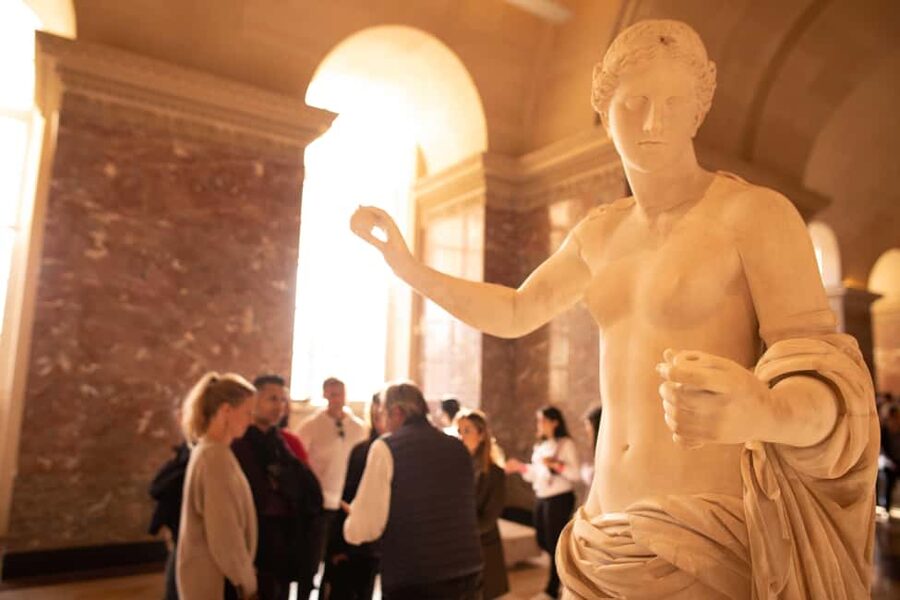
The Venus de Milo is one of the tour’s key stops. This ancient Greek sculpture is famous even to people who do not normally spend much time in art museums, and seeing it in person gives you a chance to look beyond the missing arms and the familiar outline.
A guide can explain what to look for in the figure’s pose, proportions, and surface. That kind of help matters because the sculpture can be surrounded by people taking quick photographs. You may have only a short moment at the front, so a clear explanation helps turn a famous object into an actual work of art rather than a name on a list.
The same is true of the Great Sphinx of Tanis. Its scale and age offer a change of pace after the Greek sculpture. Including both pieces gives the tour a broader reach across the Louvre’s ancient collections instead of treating the museum as a parade of paintings.
Same base, a different kind of day:
- Disneyland® Paris 1-Day Ticket
★ 4.6 · 49,412 reviews - Paris: Versailles Palace and Gardens Full Access Ticket
★ 4.6 · 41,579 reviews - Paris: Evening River Cruise with Music
★ 4.4 · 22,721 reviews - Paris: Eiffel Tower Entry Ticket with Optional Summit Access
★ 4.4 · 20,035 reviews
Leonardo, Canova, and Delacroix in one short route
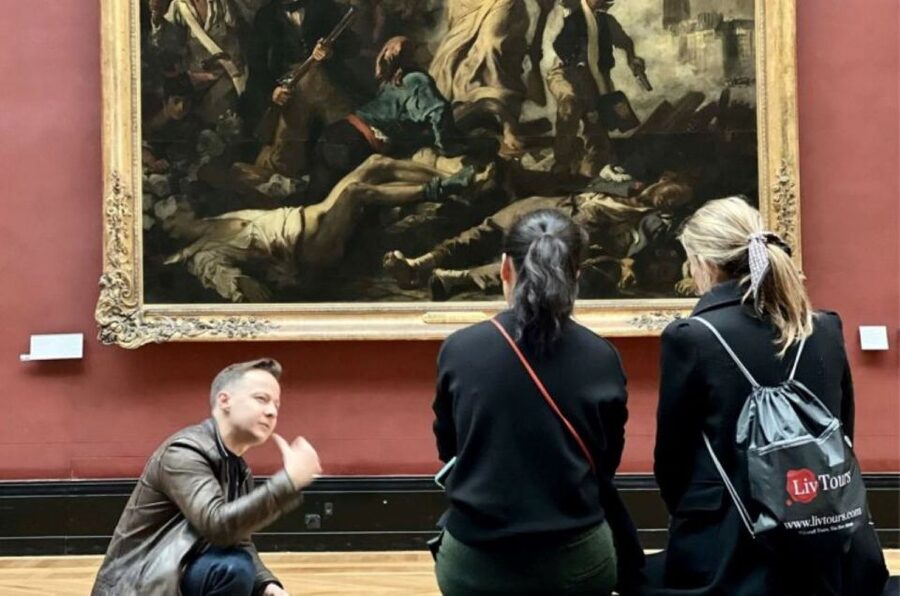
The tour covers works associated with Leonardo da Vinci, Antonio Canova, and Eugène Delacroix. These artists belong to different periods and artistic traditions, which gives the guide room to compare how artists handled the human body, movement, expression, and drama.
Leonardo brings the Renaissance and the museum’s most famous portrait. Canova represents a later ideal of classical beauty in sculpture. Delacroix brings emotional force and movement to French Romantic painting. You are not simply seeing three celebrated names. You are moving across different ideas about what art should do.
The stated route includes dozens of major works, though the exact selection can vary with crowd levels, museum access, and the guide’s judgment. That is a sensible approach. A rigid list would be less useful if one gallery is difficult to reach or a room is especially crowded.
The strongest guides use the museum’s works to answer basic questions: What was the artist trying to show? What makes this piece technically difficult? Why did the work become famous? One recent departure with guide Zach was praised for linking artistic technique with history, which is exactly the balance you want from a short museum tour.
The Mona Lisa, famous for good reason and difficult to see
The Mona Lisa is the obvious headline. You get to stand in front of Leonardo’s portrait, though you should expect a busy setting rather than a quiet appointment with the painting.
The work’s fame can make the moment feel slightly strange. You may spend more time managing the crowd than studying the details. A guide helps by giving the portrait context and pointing out what deserves your attention beyond the familiar smile.
Do not expect a long private viewing. The point is to see the painting with a guide who can explain its place in the Louvre and in popular culture, then move you onward to other works. The Mona Lisa is important, but it should not become the only reason you judge the whole museum.
This is also where a small group helps. A guide handling six people can keep the group together more easily than someone leading a large crowd. You will still need patience and awareness of others around you.
What the guide adds to a famous museum
A Louvre guide needs more than a list of dates. The best part of this format is the interpretation: stories about the building, links between artists, and short explanations that help you see why one object deserves your attention.
The experience is led by a professional local guide, with English, French, Portuguese, Spanish, Russian, and Swedish available. Recent guides associated with the tour include Nazli, Sara, Zach, and others. The feedback connected to those guides highlights several traits worth seeking: clear explanations, strong command of the subject, passion, and the ability to adjust to the group’s interests.
That last point matters. One guide, Sara, was credited with navigating a packed summer day while still taking the group’s interests into account. At the Louvre, flexibility is useful. A guide who can adjust the pace may create a better visit than one who insists on following a fixed script.
Guide quality can vary, as it can on any guided activity. One incident involved a guide becoming frustrated with a group member and ending the tour abruptly. It appears to be an isolated but serious warning. At this price, you are paying partly for the human element, so the guide’s attitude matters as much as the entry ticket.
Staying inside after the guided tour
One of the best practical features is the ability to remain in the museum after the tour. You do not have to leave as soon as the guide finishes.
Use this time to revisit a work that went by quickly, explore another collection, or simply slow down. The guided portion gives you a route and context. Your remaining time lets you choose what matters most to you.
This is especially helpful because two hours cannot cover the Louvre in any meaningful sense. The stated duration ranges from two hours to 150 minutes, so confirm the precise start time and duration for your booking. Either way, you are getting an introduction, not a full museum day.
If you plan to continue on your own, consider choosing one or two areas before the tour begins. The museum is too large for aimless wandering to work well. A small personal target gives your extra time some structure.
Is $199 good value?
At $199 per person, this is not a budget Louvre entry. You can see the museum for less through a standard admission ticket, but you would not receive the same small-group guidance or built-in route through the major works.
The price makes more sense for you if:
- You have limited time in Paris.
- You want the main highlights explained rather than simply photographed.
- You dislike large groups.
- You are visiting the Louvre for the first time.
- You value staying inside afterward to continue alone.
It makes less sense if you already know the collection well, prefer to set your own route, or want a full day at the museum. You may also find the cost hard to justify if the Mona Lisa is your only goal.
One recent participant called the tour expensive but worth it, which is a fair way to view the value. You are paying for time saved, a route through a confusing building, entry, and access to a guide with art and museum context. You are not paying for exclusive access to the artworks or a quiet museum.
Timing, comfort, and practical limits
The activity lasts between two hours and 150 minutes, depending on the selected departure. That is enough for a focused highlights tour, but not enough to see the Louvre’s full collection.
Wear comfortable shoes. The information does not specify a dress code or a particular amount of walking, but a museum of this size naturally involves movement and standing. On a warm summer day, one group member noted that the heat added discomfort, so consider the season when choosing your time.
The tour offers free cancellation up to 24 hours before the start for a full refund. You can also reserve now and pay later, which helps if your Paris schedule is still shifting.
Meet early, bring your ID, and keep your expectations realistic. The Louvre will probably be busy, and the Mona Lisa will not be a quiet experience. The reward is a well-shaped introduction to a huge museum, not solitude.
Who should book this Louvre tour?
I would consider this tour for a first visit when you want the museum’s famous works but do not want to spend hours planning a route. Families, couples, and small groups of friends can benefit from the six-person limit, especially if they want to ask questions without competing with a crowd.
It also suits art lovers who want a guide to connect technique, history, and storytelling. Zach’s approach, described as combining history with artistic methods, is a good example of what makes a museum tour useful rather than merely informative.
I would be more cautious if you need a completely private pace, have strict accessibility requirements, or want to examine only one department in depth. The group format and museum crowds place limits on how long you can linger.
Should you book it?
Book this experience if you want a focused first look at the Louvre, prefer a group capped at six, and value an expert guide who can explain the Mona Lisa, Venus de Milo, Great Sphinx of Tanis, Canova, Delacroix, and the museum’s changing role from fortress to palace to museum.
Skip it if $199 feels too high for a short visit or if you prefer independent exploration. For many first-time visitors, the strongest value is not the ticket alone. It is the route, the context, and the extra time inside after the guide leaves.
FAQ
How long does the Louvre tour last?
The stated duration is between two hours and 150 minutes. Check the available start times and exact duration when booking.
How many people can join the small group?
The group is limited to a maximum of six people. Private options are also available.
What works of art will I see?
The tour includes the Mona Lisa, Venus de Milo, Great Sphinx of Tanis, works connected with Leonardo da Vinci, Canova, and Delacroix, plus dozens of other major Louvre masterpieces.
Can I stay in the Louvre after the guided tour?
Yes. Your ticket allows you to remain in the museum and continue exploring the collection on your own after the guided portion.
Where is the meeting point?
Meet under the Louis XIV statue with the horse, in front of the Louvre’s glass Pyramid. Your guide will hold a LivTours sign.
How early should I arrive?
Plan to arrive at the meeting point 10 to 15 minutes before the tour begins.
Which languages are available?
Live guiding is available in English, French, Portuguese, Spanish, Russian, and Swedish.
What should I bring?
Bring your passport or ID card.
Can I cancel for a refund?
You can cancel up to 24 hours in advance for a full refund. Reserve now and pay later is also available.
Just added in Paris
- Private Transfers in Paris★ 5.0 · 75 reviews
- Disneyland® Paris 1 Day Ticket with Transport from Paris★ 3.5 · 302 reviews
- Personalized Transport service from Disneyland to Paris★ 5.0 · 63 reviews
- CDG – Euro Disney – CDG Two Way Private Shuttle Transfer★ 5.0 · 233 reviews
- Monet’s Gardens & House-Private Giverny Tour From Paris★ 4.5 · 137 reviews
- Giverny Monet House and Gardens Skip the line Walking tour★ 4.0 · 217 reviews
- Guided tour Monet’s house and gardens/small group★ 4.5 · 68 reviews
- Monet’s House and Garden & Giverny Village★ 4.5 · 39 reviews
Louvre Museum Tours, compared.

Louvre Guided Tour with Reserved Access & Boat Cruise
Read our review →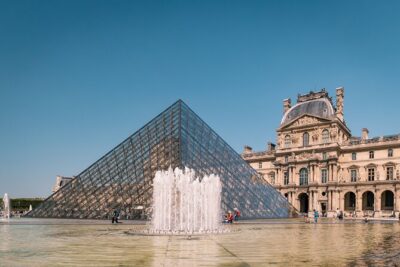
Louvre Museum Masterpieces Guided Tour with Access
Read our review →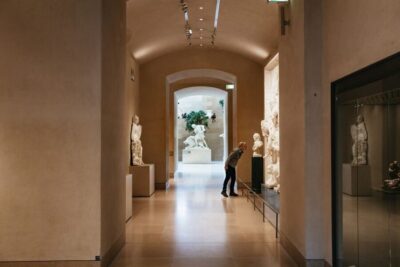
Louvre Museum Entry Ticket With Host and River Cruise
Read our review →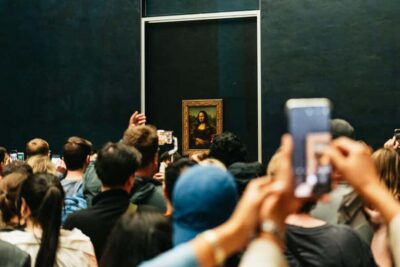
Priority Access Louvre with Host -Direct to Mona Lisa
Read our review →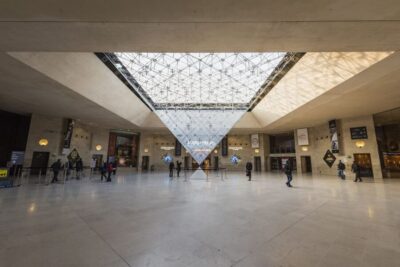
Mona Lisa & Louvre Masterpieces Tour with Reserved Access
Read our review →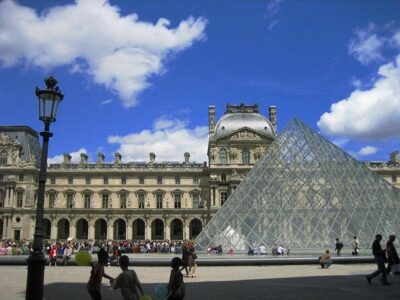
Louvre Museum – Exclusive Guided Tour (Entry Included)
Read our review →
Louvre Reserved Ticket and River Cruise Combo
Read our review →Browse the lists this tour appears in