
Reviewed · TOURS IN AVIGNON
Visit Avignon and Villeneuve lez Avignon aboard a Double-Decker Bus
Avignon’s most useful sightseeing ride is not really a hop-on hop-off bus. It is an outskirts circuit that takes you beyond the city walls, across the Rhône, and into Villeneuve lez Avignon, where medieval fortifications and papal connections give the trip its purpose. The English audio commentary fills in the story as the bus moves along.
I like the wide view from the double-decker and the chance to see places you might otherwise skip, especially Fort Saint-André and the Île de la Barthelasse. I also like the price, about $16.30 per person, if you use it to get your bearings. The catch is important: the route can feel rushed, some stops are not designed for a long visit, and the service has had confusing schedules and pickup information.
Key points to know before you board
- A sightseeing loop, not a classic hop-on hop-off bus: The route is best for seeing Avignon and Villeneuve from the road rather than building a full day around repeated boarding.
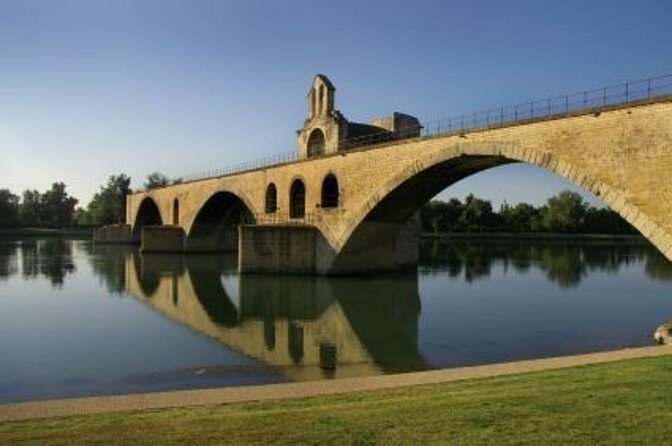
- The Pont d’Avignon is the star: You pass the famous incomplete bridge, but entry is not included.
- Villeneuve adds the medieval contrast: Philippe le Bel Tower, Fort Saint-André, the abbey gardens, and the Chartreuse show the power struggle between French royalty and the papal court.
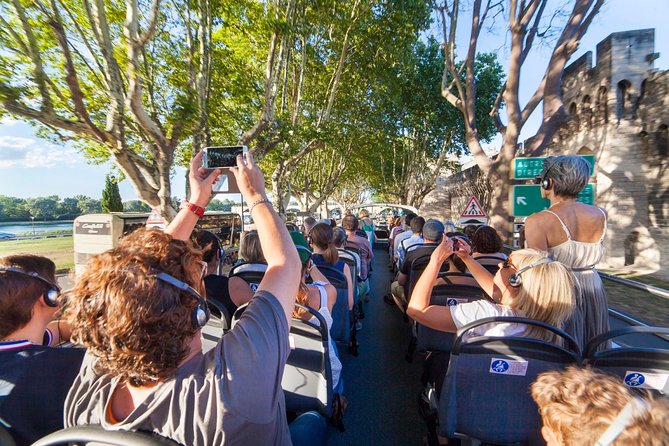
- The audio system matters: Commentary is offered in English, but check your headset early because faulty connections have been reported.
- Île de la Barthelasse offers the best pause: The route includes a 10 to 15 minute stop with a direct view back toward Avignon.
- Check the operating day and meeting point carefully: The start is listed at 40 Cours Jean Jaurès, and past scheduling information has caused confusion, particularly on Sundays and Mondays.
What this Avignon bus tour actually does
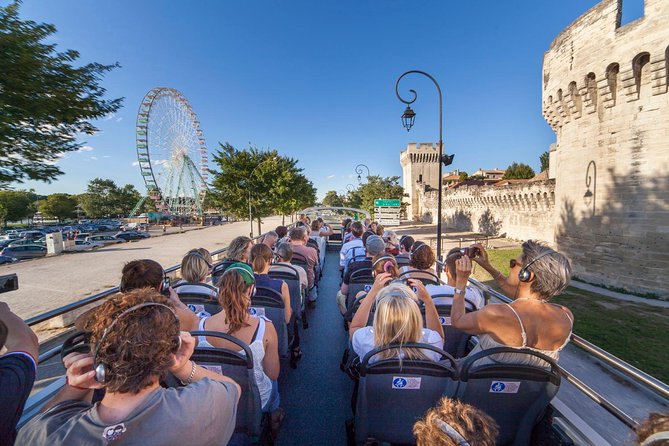
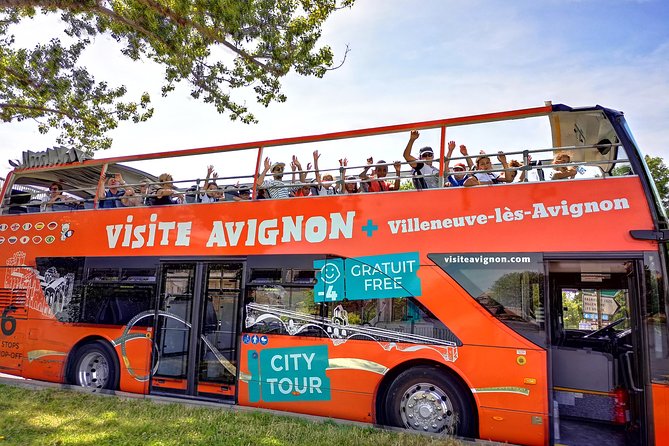
This experience gives you a one-hour circuit at its quickest, though the advertised duration can stretch from about one hour to a full day depending on how you use the stops. The bus starts at 40 Cours Jean Jaurès in Avignon and returns there.
The important distinction is the route design. You are not simply circling the old town and stepping off every few minutes. The bus skirts the walls, crosses the Rhône, enters Villeneuve lez Avignon, and reaches the island of Barthelasse before returning.
That makes the ride useful on your first day. You can see how Avignon, the river, and Villeneuve fit together before choosing where to spend more time. If you expect a classic city bus with frequent, clearly marked hop-on and hop-off points, you may find the service disappointing.
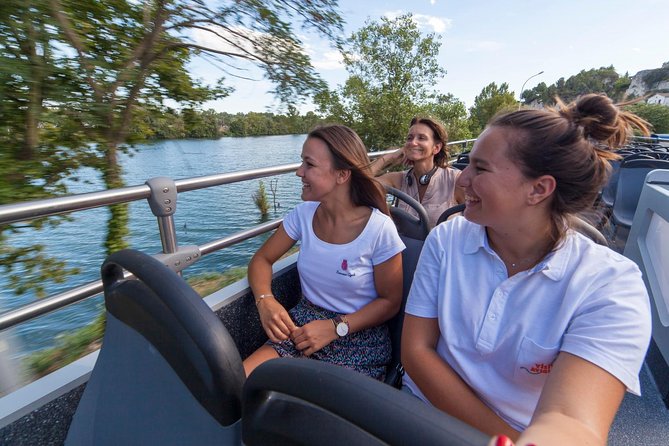
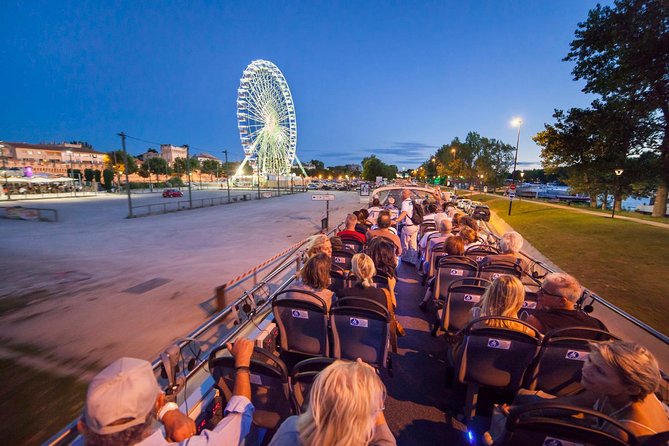
The vehicle is a standard double-decker bus, with an upper level that gives you a better view. The route is shared with up to 73 people, so boarding and finding a preferred seat may take some patience. The audio commentary is in English, and the bus has been described as clean and well maintained, though the quality of individual audio connections can vary.
Other trips people book in Avignon:
- From Arles: Half-Day 4×4 Camargue Safari
★ 4.7 · 1,772 reviews - Provence Highlights Full-Day Tour from Avignon
★ 5.0 · 499 reviews - Chateauneuf du Pape wine tour
★ 5.0 · 484 reviews
Pont Saint-Bénézet and the broken bridge
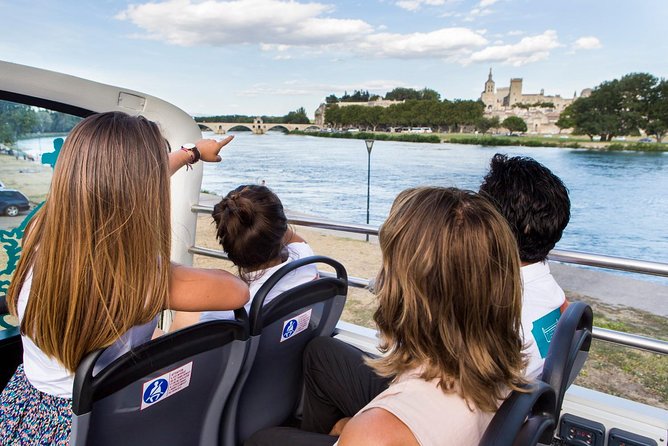
The Pont Saint-Bénézet, better known as the Pont d’Avignon, is the most recognizable sight on the route. Its famous song has turned the bridge into a piece of popular culture, but the real story is more dramatic than a tune about dancing on it.
Construction began in 1177. The original bridge reached about 920 meters and had 22 arches. Floods, war, and repeated damage left only four arches standing today. The remaining stone reaches into the Rhône like a fragment of a much larger idea.
In the Middle Ages, the bridge connected important pilgrimage routes between Italy and Spain. It also became a practical link between the papal court inside Avignon’s walls and the cardinals’ residences in Villeneuve.
The bridge was paved in 1377 after frequent slips caused accidents and drownings. Popes reportedly stopped at the Bénezet chapel during crossings, prayed, and left a florin as an offering. Louis XIV was among the last monarchs to cross before the bridge’s decline in the seventeenth century.
The bus gives you context and a view, but admission to the bridge is not included. If you want to walk on the surviving arches and see the chapel, plan that separately. The bus is a good introduction, not a replacement for the visit.
Crossing the Rhône into Villeneuve lez Avignon
The ride becomes more interesting once the bus leaves Avignon and crosses the river. Villeneuve lez Avignon was not just a pleasant suburb for wealthy residents. It grew in close connection with the papal court.
Cardinals moved across the Rhône partly to escape the crowded and unhealthy conditions of medieval Avignon. The poet Petrarch described Avignon in harsh terms, and the cardinals’ new residences in Villeneuve offered more space and distance while remaining close to the papal center.
From the bus, you get a useful sense of the two towns as opposing sides of the same medieval power network. Avignon held the papal palace and its fortified center. Villeneuve held royal authority, military defenses, religious houses, and cardinals’ residences.
The route does not turn every stop into a guided walking visit. You should think of the commentary as orientation. Once you understand the geography, you can decide which places deserve a separate ticket.
Philippe le Bel Tower and royal control
The Philippe le Bel Tower was built in the thirteenth century under the Capetian king Philippe le Bel. Its purpose was direct and strategic: control access to the Pont d’Avignon.
That makes the tower more than another medieval stone building. It represents royal power facing the authority of the papacy across the Rhône. The bus helps you see why this position mattered. Whoever controlled the bridge controlled movement, trade, pilgrims, and access between the two banks.
The stop is part of the wider Villeneuve circuit, but the amount of time available for getting off and exploring can be limited. If the tower is high on your list, check the operating pattern and plan for a separate visit rather than assuming the bus will give you a long stop.
Same base, a different kind of day:
- 4×4 Camargue Safari 4h – Departure from Arles
★ 4.5 · 467 reviews - From Avignon: Châteauneuf du Pape Half-Day Wine Tour
★ 4.7 · 365 reviews - From Avignon: Full-Day Best of Provence Tour
★ 4.7 · 338 reviews - From Avignon: Half-Day Great Vineyards Tour
★ 4.7 · 321 reviews
Fort Saint-André and the abbey gardens
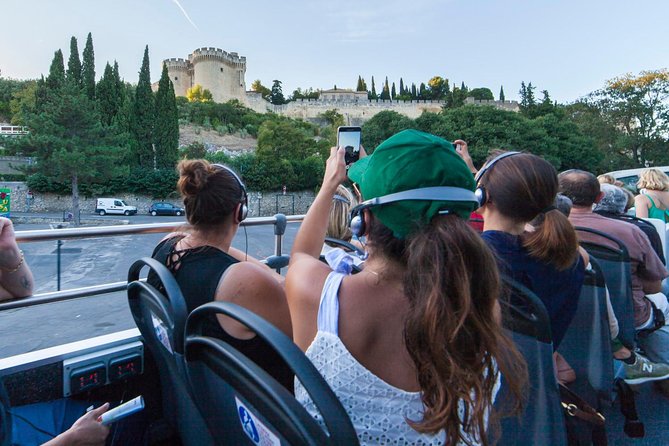
Fort Saint-André began in the late twelfth century and later defended the Benedictine abbey of the same name. Its walls and position show the military importance of Villeneuve, particularly during the period when the papal court made the region a center of European power.
The fort is also paired with one of the most attractive stops on the route: the gardens of the Abbey of Saint-André. The gardens carry the Remarkable Gardens label and combine Romanesque remains, Renaissance Tuscan-style details, roses, and Mediterranean plants.
This is one of the strongest reasons to take the bus beyond Avignon’s walls. The route gives you access to a part of the area that is easy to overlook if you spend all your time around the Palais des Papes and the old center.
Admission to Fort Saint-André is listed as free, while other attractions on the route may charge separately. Do not assume every site visit is included in the bus fare. The bus ticket is mainly transportation and commentary.
Chartreuse de Villeneuve lez Avignon
The Chartreuse of the Val de Bénédiction was built from 1353 under the direction of Pope Innocent VI. It served as a cardinal’s residence and religious foundation, reflecting the importance of Villeneuve during the papal period.
The complex occupies a former fourteenth-century mansion associated with several cardinals. Its appeal comes from the combination of quiet religious spaces, residential rooms, and the scale of a place built for powerful church officials.
Like the Pont d’Avignon, the Chartreuse requires a separate admission ticket. The bus can get you close and explain why it matters, but the experience is not the same as walking through its rooms and courtyards.
I would treat this stop as a choice point. If you have only an hour in Avignon, stay on the bus and use the route for orientation. If you have a full day, return to the Chartreuse with enough time to explore properly.
Île de la Barthelasse and the best city view
The stop on Île de la Barthelasse gives the tour a welcome change of pace. This large green island sits in the Rhône, directly opposite Avignon, and the bus pauses for about 10 to 15 minutes.
Here you can look back toward the city of the Popes, its walls, towers, and church roofs gathered across the water. This is one of the better places for a clear overall view of Avignon, particularly if you want a photograph showing the city in relation to the river.
The stop is short, so have your camera ready and do not wander far. The information also notes a free river shuttle, which can take you toward the historic center, and the possibility of continuing by bicycle. Those options make Barthelasse more than a photo stop if you have extra time.
For a quick orientation ride, this pause is a real strength. It breaks up the traffic and gives you a moment to take in the setting rather than watching the city through a bus window.
The Lambert Collection and modern Avignon
The Lambert Collection adds a modern-art stop to an otherwise medieval route. It opened in 2000 during Avignon’s year as European Capital of Culture.
Collector and gallerist Yvon Lambert placed his collection in an eighteenth-century mansion. The collection began with about 350 works from the 1960s onward and later grew to more than 1,200 pieces. The museum includes exhibition areas, conservation spaces, activities for younger audiences, an art bookstore, artists’ editions, and a restaurant in the courtyard.
This stop will appeal most if you want a break from fortresses, bridges, and religious buildings. It also reminds you that Avignon is not only a medieval pilgrimage town. The city has a continuing arts life, with contemporary work housed in an old setting.
The bus route does not make the museum admission part of your ticket. Check the time available before getting off, especially if your goal is to see a particular exhibition rather than simply note the building.
Audio commentary, speed, and practical comfort
The audio commentary is a key part of the experience. When it works, it gives you the names, dates, and connections that make the route useful. You do not have a live guide walking you through each site, so the ride depends on the recorded information and your view from the bus.
Bring up any audio problem immediately to the driver. Some headset connections may not work, and waiting until the end means losing much of the explanation. The best seat is not always the most scenic one if its audio jack is faulty.
The bus can also move quickly through parts of the route. That is fine for seeing the overall shape of Avignon and Villeneuve, but it makes photography difficult and can make a one-hour circuit feel rushed. Traffic may take a large share of the ride.
I would not book this as a slow sightseeing experience. Book it to cover ground, learn the basic story, and decide what deserves a later visit on foot.
Price, timing, and who gets good value
At about $16.30 per person, the fare is reasonable if you use the bus as a first look at two towns and the Rhône corridor. It becomes poor value if you expect every major attraction to be included or plan to ride only a short distance.
The strongest value comes when you are short on time, have limited mobility, or want to see Villeneuve without arranging separate transport. The bus takes you across the river and provides commentary without asking you to navigate each road yourself.
It is less useful for someone who already knows Avignon well or wants a fully guided walking tour. It is also not ideal if your main goal is a sequence of long stops. The route includes points of interest, but admission fees and exploration time are separate matters.
The published booking pattern says the experience is often reserved about 20 days ahead. That does not remove the need to check the exact operating day. Service has not always run on Sundays or Mondays, and the start point has caused confusion in the past. Confirm the meeting place at 40 Cours Jean Jaurès and check the current schedule before setting out.
Free cancellation is available up to 24 hours before the start time. A cancellation inside that window is not refunded. Poor weather or failure to reach the minimum number of participants may lead to a new date, another experience, or a full refund.
Should you book this Avignon bus ride?
Book it if you want a quick overview of Avignon, Villeneuve lez Avignon, and the Rhône without committing to a full day of walking. The best parts are the crossing into Villeneuve, the view from Barthelasse, and the chance to understand how the bridge, papal court, royal tower, and fortified abbey fit together.
Skip it if you want a true hop-on hop-off service with frequent stops and flexible returns. In that case, a walking route, the local trolley, or separate visits to the bridge, Fort Saint-André, and Chartreuse may suit you better.
My practical choice would be to take the bus early in your stay, remain alert about the meeting point and audio equipment, then return on foot to one or two places that catch your interest. At this price, it earns its keep as a geography lesson with good river views, not as a complete substitute for exploring Avignon.
FAQ
Where does the bus tour start?
The tour starts at 40 Cours Jean Jaurès, 84000 Avignon, France.
Where does the tour finish?
The activity returns to the starting meeting point.
How long does the experience last?
The stated duration ranges from about one hour to one day, depending on how you use the route and stops. A basic circuit takes about one hour.
Is the tour a traditional hop-on hop-off service?
No. The route is better understood as a sightseeing circuit. The bus visits Avignon, crosses the Rhône, reaches Villeneuve lez Avignon, and returns to the starting point.
Is the commentary available in English?
Yes. The experience is offered in English through audio commentary.
Is the Pont d’Avignon entrance included?
No. Admission to the Pont Saint-Bénézet is not included.
Is admission to Fort Saint-André included?
The stop information lists admission to Fort Saint-André as free. Other attractions on the route, including the Chartreuse and Pont d’Avignon, list admission as not included.
How long is the stop on Île de la Barthelasse?
The stop is about 10 to 15 minutes.
How many people can join the bus?
The maximum group size is 73 participants.
Can I cancel for a full refund?
Yes, if you cancel at least 24 hours before the experience start time. Cancellations made less than 24 hours before departure are not refunded.
Just added in Avignon
- Rando Aqua – “Le Pont de Tusset” – Discovery Course★ 5.0 · 92 reviews
- Rafting Verdon – “Explor Verdon” – Family Course★ 5.0 · 51 reviews
- Wines from Châteauneuf-du-Pape and surrounding areas in 1/2 day★ 5.0 · 96 reviews
- In the footsteps of Van Gogh in Provence from Avignon★ 4.5 · 102 reviews
- Wine Tasting Tour at Châteauneuf du Pape★ 5.0 · 36 reviews
- Lavender Route – Small-Group Day Trip from Avignon★ 5.0 · 120 reviews
- Van Gogh & Carrières de Lumières Half-Day Tour from Avignon★ 4.5 · 29 reviews
- Truffle Hunting in Provence★ 5.0 · 55 reviews
Tours in Avignon, compared.

Provence Highlights Full-Day Tour from Avignon
Read our review →



Provence Cru Wine Small-Group Half-Day Tour from Avignon
Read our review →Browse the lists this tour appears in