
Reviewed · TOURS IN LILLE
Private battle of Dunkirk Operation Dynamo Tour
The most moving part of this Dunkirk tour is the way it links three ordinary-looking places to the desperate evacuation of 1940. At the cemetery, beach, and port, a guide such as Emmanuel, Elise, Fred, or Onno explains how the British and French forces held on long enough for hundreds of thousands to escape.
I like the private format, since you can ask questions and the guide can adjust the pace for your family. I also like the supplied maps and photographs used by some guides, which help turn a broad military story into something you can follow on the ground. The main drawback is the short length: two hours covers the key sites, but not the Dunkirk museum or the wider defensive battle around Gravelines and the Aa Canal.
Key points at a glance
- See the evacuation from three angles: a war cemetery, the long beach at Malo-les-Bains, and Dunkirk’s East Mole.
- Travel privately by car or minivan: the advertised price is $193.50 per group, with vehicle capacity limits to check before booking.
- Expect strong personal guiding: Emmanuel, Elise, Fred, Freddy, Onno, and Alyce are among the guides praised for clear explanations and flexible service.
- Bring the Dunkirk museum into your plan: it is not part of the tour, but it adds useful background before or after your drive.
- Allow for wind and weather: the beach is exposed, and the experience depends more on interpretation than on indoor attractions.
- Use the tour for questions: the private setting is especially useful if your group wants French, British, family, or film-related context.
Why these three Dunkirk sites matter
Operation Dynamo was not one single scene on a beach. It was a large, tense evacuation spread across beaches, harbor facilities, roads, defensive lines, and ships. This tour gives you a compact way to understand that movement.
You begin at the Commonwealth War Graves cemetery, then go to Malo-les-Bains beach, and finish at the Grand Port Maritime of Dunkirk. That order works well. You start with individual names and memorials, move to the mass of soldiers waiting on the shore, then finish at the port where the evacuation system was organized.
I find this more useful than simply driving around Dunkirk and pointing out locations. The guide provides the connecting story. You can ask how the evacuation functioned, why the beach mattered, and how French and British forces fit into the larger picture.
The tour is offered in English and lasts about two hours. That makes it a practical choice if you have a short stop in Dunkirk, a ferry connection, or only part of a day for military history.
Other trips people book in Lille:
- Entrance Ticket Nausicaa, the biggest aquarium in Europe
★ 3.5 · 1,135 reviews - Lille Driving Tour by Convertible Citroen 2CV
★ 4.9 · 711 reviews - Nausicaá National Sea Center: Full-Day Entry Ticket
★ 4.5 · 541 reviews
Commonwealth War Graves cemetery: begin with individual stories
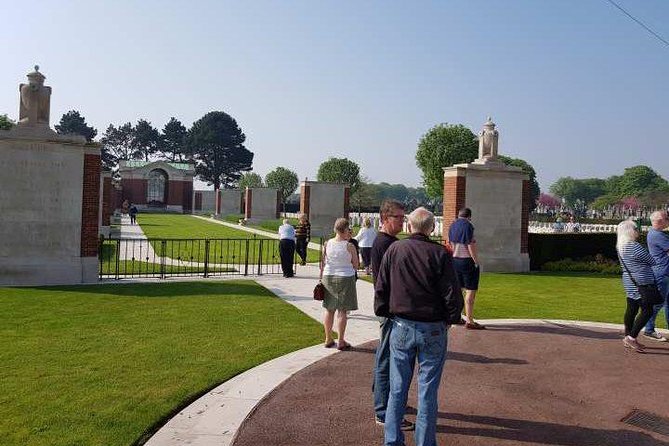
The first stop takes about 20 minutes at the Commonwealth War Graves site. You enter through the columns of the Dunkirk Memorial and begin with the etched glass inside the memorial before walking to several graves in the Second World War plot.
This is a quiet start. The memorial can feel formal and large, while the graves bring the scale down to individual service members. A good guide helps you read the site rather than simply photograph it. You can ask about the memorial, the soldiers represented there, and what happened to the men who did not make it home.
Admission is free, and the stop is short. That is both a strength and a limit. You get a focused introduction rather than a long cemetery visit. If you want time to read names or reflect privately, you may need to tell your guide that this matters to you.
The guides are often the main value here. Fred has been praised for making individual stories and events feel vivid, while other guides have been noted for answering family questions and adapting their explanations. You are not left to guess why this cemetery belongs in an Operation Dynamo tour.
Malo-les-Bains beach: see the scale of the evacuation
The second stop is Plage de Malo-les-Bains, with about 25 minutes at the beach. This is where many soldiers waited for days under German attack, hoping to be evacuated. From the shore, you can look along roughly 20 kilometers of beach connected with the movement of about 100,000 soldiers toward England.
The beach is the emotional center of the route. It is wide, open, and exposed. That physical openness helps explain the danger. Soldiers waiting on the sand had little shelter, while aircraft and artillery made the delay frightening and unpredictable.
Your guide’s narration matters here because the modern beach does not explain itself. Elise has been praised for presenting both French and British perspectives, while Emmanuel and other guides have used photographs and maps to show how the shore looked and functioned during the evacuation.
Bring a coat even in mild weather. Dunkirk can be windy, and the beach is not a place where you want to spend 25 minutes unprepared. One visit took place in poor weather, yet the guide still made the stop worthwhile. On a clear day, the beach can look completely different, which makes it easier to understand how much conditions affected the evacuation.
The beach is also useful if you have seen Christopher Nolan’s film Dunkirk. Guides may connect the location to the film, and one guide has taken visitors to a street used in the movie’s opening scene. Film references are a bonus, though the tour is built around the real events rather than cinema trivia.
Dunkirk’s East Mole: the evacuation becomes a system
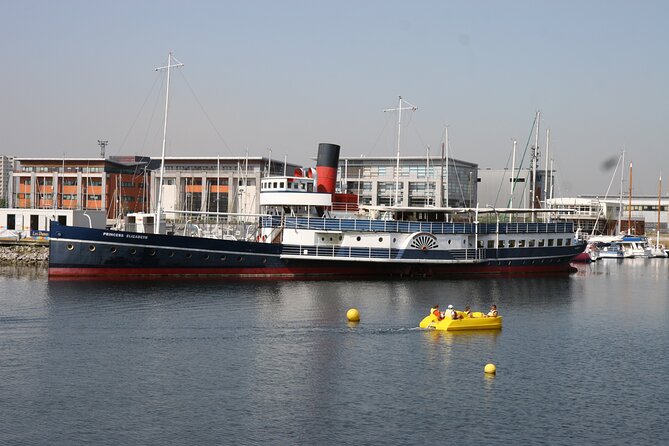
The final scheduled stop is at the Grand Port Maritime of Dunkirk, where you see the East Mole. You spend about 20 minutes learning how the port evacuation was organized.
This stop gives structure to the story. At the beach, you see soldiers waiting. At the port, you begin to understand how people were moved out. The guide explains the East Mole as a main point of evacuation and describes the practical work behind the operation.
That matters because the popular image of Dunkirk often focuses on small civilian boats crossing the Channel. The port, piers, ships, and military planning were also vital. A private guide can explain those parts in a way that fits your interests, whether you want the naval side, the British experience, the French defense, or the role of local civilians.
The East Mole is not a museum exhibit with a long row of labels. You are looking at a working port setting and using the guide’s story to understand what happened there. If you prefer indoor displays and objects, visit the museum as well.
Same base, a different kind of day:
- Unique Tour of Lille by Convertible 2CV – 1h00
★ 5.0 · 470 reviews - Lille: 24, 48 or 72-Hour City Pass & 24-Hour Transportation
★ 4.3 · 205 reviews - Private Round Trip Transfer to Vimy Ridge from Arras
★ 5.0 · 164 reviews - Musee Somme 1916 Admission Ticket
★ 4.5 · 105 reviews
Add the Dunkirk museum before or after
The Dunkirk museum is not included in the two-hour tour. I would treat that as an important planning note, not a flaw in the route itself.
The museum can give you basic background before you see the sites. One visitor found that visiting the museum first made the later narration especially useful. That is a sensible plan if you are new to Operation Dynamo. You get the overview indoors, then use the private drive to place the story on the ground.
You can also visit the museum afterward, when the cemetery, beach, and East Mole have given you questions to take inside. Either order works. Just allow separate time and check its opening arrangements for your date, since admission is not part of this experience.
The tour itself is strongest when you want interpretation at the locations. The museum is stronger for displays and a more structured introduction. Combining both gives you a fuller visit without expecting the short private drive to do everything.
What the guides add to a short tour
The guide is the heart of this experience. The route is compact, and the three sites are relatively close together, so the difference between a basic drive and a worthwhile tour comes from the explanation.
Emmanuel is repeatedly praised for his enthusiasm, flexibility, and ability to keep families involved. He has guided groups with teenagers and younger children, and he has adjusted timing when guests needed special arrangements. Elise is noted for explaining both French and British viewpoints and for tying the sites to the film without losing the historical focus.
Fred and Freddy are praised for military detail, clear storytelling, and a real interest in the subject. Onno is described as personable and fun, with useful film connections. Alyce has also been praised for explaining the French perspective and adapting the route during poor weather.
Guide assignments can vary, so you should not book on the assumption that a specific person is guaranteed unless the provider confirms it. Still, the range of guide comments points to a consistent strength: the tour is designed around conversation, not a fixed speech.
Some guides use a binder of photographs and maps. That is a valuable aid at the beach and port, where wartime scenes are difficult to picture from present-day views. Ask questions freely. The private format gives you far more room to stop and clarify than a large group tour.
Private transport, group size, and the real price
The listed price is $193.50 per group, with private transport, a guide or driver-guide, bottled water, and hotel pickup and drop-off at selected hotels. For a couple or family, that can be fair value because the price is not charged per person.
There is an important capacity detail to check. The general description refers to groups of up to 15, but the additional information specifies a maximum of three people for the car tour or eight for the minivan tour. If your party is larger, confirm the correct vehicle and pricing before booking.
For two or three people, the cost is easier to justify if you value door-to-door transport and a private guide. You are paying for the vehicle, fuel, guide time, and the ability to shape the conversation around your group. Bottled water is a small but useful touch, especially on a warm or windy beach stop.
The value is less convincing if you want a full-day military tour with many sites, long walks, or museum admission. One person felt the tour was expensive for a short history lesson because the three stops are close together and there are few included extras. That is a fair caution.
I would book it for access to interpretation, not for the number of miles driven. If you already have strong knowledge of the evacuation and mainly want transport, you may find the price high. If you want the places to make sense, the private guide is the product.
What the tour does not cover
The route concentrates on the evacuation itself. It does not include the Dunkirk museum, food, drinks beyond the supplied water, or a larger tour of the defensive battles around the town.
One useful suggestion is to extend the historical picture to Gravelines, the Aa Canal, and the shrinking defensive perimeter that helped protect the evacuation. Those locations are not part of the scheduled route, so do not expect them to appear unless you arrange something separately.
You also should not expect a long walking tour. The experience uses private transportation and short visits at each stop. That makes it accessible for most participants, and service animals are allowed. It is near public transportation, though the stated meeting point is at 1874 Rue des Chantiers de France in Dunkerque.
Hotel pickup and drop-off are available at selected hotels. If you are not staying at one of those properties, the activity ends back at the meeting point. Check this detail before booking so you know exactly where your day begins and finishes.
Who will get the most from this Dunkirk tour
I would recommend this experience to families, couples, and small groups with a clear interest in the Second World War. It works particularly well for parents with older children, since guides have successfully involved teenagers and younger visitors through stories, maps, and questions.
It is also a good choice if you are arriving in Dunkirk without a car. Private transport removes the need to connect the cemetery, beach, and port yourself. The short duration fits neatly into a larger northern France itinerary.
Film fans will enjoy the links to Dunkirk, but you should not book it as a film-location tour. The movie is one thread in the explanation, not the main subject.
I would be more cautious if your main goal is a broad battlefield study. You will need extra time and perhaps another guide for the defensive positions beyond the city. I would also think twice if you dislike outdoor stops in wind or want extensive museum time.
Should you book the Operation Dynamo tour?
Book it if you want a compact, private explanation of Dunkirk’s evacuation and you value asking your own questions. The cemetery, Malo-les-Bains beach, and East Mole form a sensible progression, and guides such as Emmanuel, Elise, Fred, Freddy, and Onno bring strong subject knowledge and personal energy to the route.
Before booking, check the vehicle size for your group, confirm hotel pickup, and plan a separate museum visit. If you do that, the two-hour tour makes a useful, human-scale introduction to one of the Second World War’s most dramatic evacuations. If you want a longer military study, add more time for Gravelines and the canal defenses rather than expecting this short visit to cover them.
FAQ
How long does the private Operation Dynamo tour last?
The tour lasts approximately two hours.
What sites are included?
The route includes the Commonwealth War Graves cemetery in Dunkirk, Plage de Malo-les-Bains, and the East Mole at the Grand Port Maritime of Dunkirk.
Is the Dunkirk museum included?
No. The museum is not included in the tour, but it is recommended for people interested in Operation Dynamo.
How much does the tour cost?
The listed price is $193.50 per group. Vehicle capacity details state a maximum of three people for a car tour or eight people for a minivan tour.
Is hotel pickup available?
Yes, hotel pickup and drop-off are offered at selected hotels. Otherwise, the meeting point is 1874 Rue des Chantiers de France in Dunkerque, and the activity ends there.
Can I cancel for a refund?
Yes. You can cancel at least 24 hours before the start time for a full refund. Cancellations or changes made less than 24 hours before the start time are not accepted for a refund.
Just added in Lille
- Lille Scavenger Hunt and Highlights Self Guided Audio Tour★ 4.0 · 32 reviews
- Rallye “Discoveries and Surprises”★ 5.0 · 52 reviews
- 1 Hour Private Lille Tour by Convertible 2CV with a Local Products Tasting★ 5.0 · 78 reviews
- Private Lille Tour by Classic Convertible 2CV with Champagne★ 5.0 · 49 reviews
- 30-Minutes Private Guided Tour of Lille by Convertible 2CV★ 5.0 · 79 reviews
- Lille Scavenger Hunt and City Highlights Walking Tour★ 4.5 · 47 reviews
- Lille Old Town Walking Tour With A Guide★ 4.5 · 40 reviews
- Private Round Trip Transfer to Vimy Ridge from Arras★ 5.0 · 164 reviews
Tours in Lille, compared.
Entrance Ticket Nausicaa, the biggest aquarium in Europe
Read our review →

Nausicaá National Sea Center: Full-Day Entry Ticket
Read our review →
24, 48 or 72-Hour City Pass & 24-Hour Transportation
Read our review →

Browse the lists this tour appears in