
Reviewed · TOURS IN MARSEILLE
Marseille Guided Tour for 4 Hours with a Bilingual Local Guide
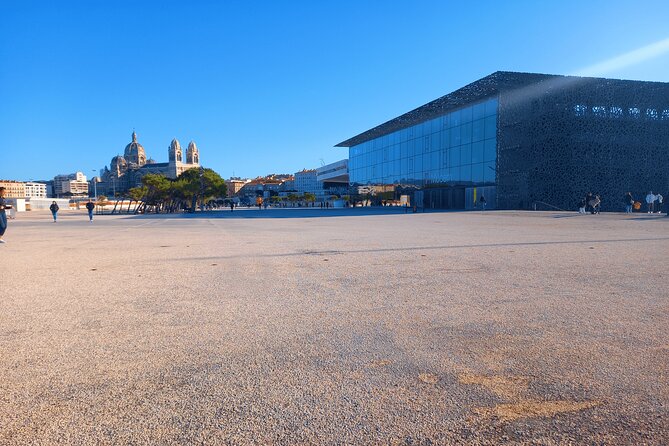
Marseille is best understood on foot, one steep lane, harbor view, and neighborhood at a time. This four-hour route links the old city, the waterfront, a hilltop basilica, and a small fishing harbor without trapping you in a coach. The walking itself is the main event, and local guide Charles Mondon adds the stories that connect each place.
I like the small maximum of eight people and the way the route covers both northern and southern Marseille. I also like the practical follow-up: Charles sends individual ideas for places to eat and visit after the tour. The catch is clear: this is a serious urban hike, with hills, stairs, and possibly 10,000 to 20,000 steps.
Key points to know before booking
- Charles Mondon leads the tour: He provides the walk in English and uses historic maps and photographs to explain Marseille.
- Seven major stops in four hours: The route includes La Major, Le Panier, La Canebière, Notre-Dame de la Garde, Vallon des Auffes, Palais du Pharo, and Abbaye Saint-Victor.
- Expect steep climbs: The walk includes stairs and inclines, especially on the way to Notre-Dame de la Garde.
- A group of up to eight: The small size allows Charles to answer questions and adjust the pace.
- The price is $60.47 per person: Lunch and bottled water are extra, but all listed sightseeing stops are free to enter.
- The best timing is early in your stay: Charles’s follow-up suggestions can help shape the rest of your Marseille visit.
Why this four-hour walk works well in Marseille
Marseille can feel scattered at first. The Old Port sits at the center, but the city’s character spreads toward Le Panier, the cathedral, the southern coast, and the hill above it all. A taxi or sightseeing bus can move you between landmarks, but it will not show you the narrow stairs, side streets, and sudden viewpoints that make the city easier to understand.
This tour gives you a useful first look at that larger picture. You begin at Cathédrale La Major, walk through the oldest parts of the city, cross the Old Port area, climb toward Notre-Dame de la Garde, then continue along the coast and back toward the center. It is a lot for half a day, but the route has a clear purpose: it shows how Marseille’s religious landmarks, port life, neighborhoods, and sea views fit together.
I especially like the group limit of eight. Charles can stop to answer questions, check how people are managing the hills, and adjust the pace. That matters here. A large group would make narrow lanes harder to manage and would make it tougher to hear explanations at busy viewpoints.
The walk is offered at 9 a.m., which is a smart start. You get cooler conditions than later in the day, and you finish at the Old Port with the afternoon still open. At $60.47 per person, the tour is not the cheapest way to see Marseille, but it is fair value if you want a guide who covers many districts and gives you useful advice for the rest of your visit.
Other trips people book in Marseille:
- Marseille: City Sightseeing Hop-On Hop-Off Bus Tour
★ 3.8 · 2,820 reviews - Marseille: Côte Bleue Calanques Half-Day Kayak Tour
★ 4.7 · 877 reviews - Marseille Food Tour – Full Meal of Local Tastes by Do Eat Better
★ 5.0 · 530 reviews
Starting beneath the domes of La Major
The tour begins and ends near Cathédrale La Major, a huge Roman Catholic cathedral beside the port. Its Neo-Byzantine design, domes, and mosaics give you an immediate sense that Marseille is a city shaped by the Mediterranean and by centuries of movement across the sea.
The first stop lasts about 10 minutes. That is enough for an introduction to the cathedral and its place in Marseille, but not enough for an extended interior visit. Admission is listed as free. Think of La Major as the opening chapter rather than a full cathedral tour.
The location is convenient for anyone arriving from the port area. It also makes a good meeting point because the building is easy to identify. Wear comfortable shoes from the start. The route becomes more demanding quickly.
Le Panier, Marseille’s old lanes and stairways
From La Major, you enter Le Panier, the city’s best-known historic district. This is where the tour becomes less about checking off monuments and more about seeing how Marseille feels at street level.
Le Panier is marked by narrow lanes, colorful buildings, stairs, small cafes, and artisan shops. The district also reflects Marseille’s Mediterranean and North African influences. Charles uses the area to explain how the city developed, not just what each building looks like.
You have about 50 minutes here, making it one of the longer stops. That is useful because Le Panier rewards a slow pace. A map can show you the district, but it cannot show how quickly the streets change direction or how a quiet lane can open onto a view of the port.
This is also one of the places where the small group matters. You can pause for photographs without holding up a large crowd, and you can ask about the neighborhood’s past and present. The tradeoff is that stairs and uneven surfaces begin early. If your knees or balance are a concern, tell Charles at the start so he can help adapt the route.
Walking La Canebière and the Old Port
The next section follows La Canebière, Marseille’s famous street, from the northern side of the Old Port toward the south. The walk lasts about 30 minutes and gives you a different view of the city after the close lanes of Le Panier.
Charles explains the street’s history and points out major buildings, including the opera house and landmarks around the old harbor. This part is less secluded than Le Panier, but it helps you read Marseille as a working port city rather than only as a collection of old streets.
The Old Port is the city’s main crossroads. Once the tour ends later in the day, you can continue on foot or use the metro, bus, or boat from here. That makes the route useful beyond the four-hour walk. You finish in a place where you can easily reach your next stop.
Same base, a different kind of day:
- Marseille: Calanques National Park Guided Hike with Picnic
★ 4.9 · 516 reviews - From Marseille: Calanques National Park Guided Hike
★ 4.8 · 489 reviews - Marseille: Musée de l’Illusion Entry Ticket
★ 4.1 · 488 reviews - Marseille: Frioul Calanques Sailing Trip
★ 4.8 · 433 reviews
The climb to Notre-Dame de la Garde
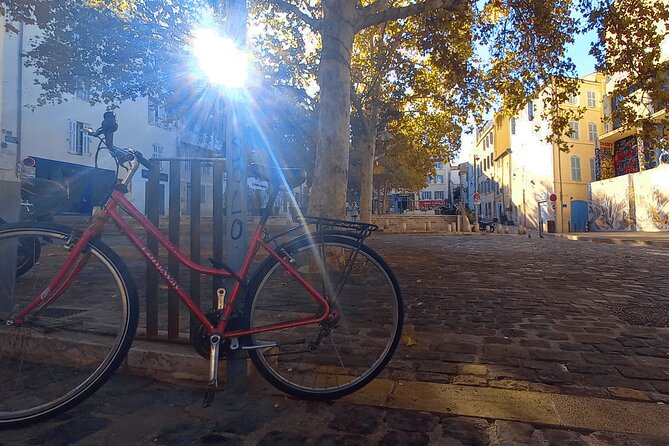
The most demanding part of the tour is the climb to Basilique Notre-Dame de la Garde. The basilica sits above Marseille and is marked by a gleaming statue of the Virgin Mary. From the top, you get broad views over the city and the Mediterranean.
The scheduled visit lasts about 40 minutes. That gives you time to take in the mosaics, the building’s religious importance, and the views. The hilltop is the reward for the effort, but the climb can be substantial.
You should take the physical warning seriously. The walk can reach around 10,000 steps, six miles, or even 20,000 steps depending on the route and pace. Those figures vary in the tour descriptions and personal accounts, but they all point to the same fact: this is not a gentle stroll.
Charles has offered a bus option for people who could not manage the steepest section, including the final climb of roughly 200 steps. He has also used other local transport when rain or physical limits made walking less sensible. That flexibility is helpful, but you should still consider your fitness before booking. The tour is not recommended for people over 70, and it requires a moderate level of physical ability.
Vallon des Auffes and the Mediterranean edge
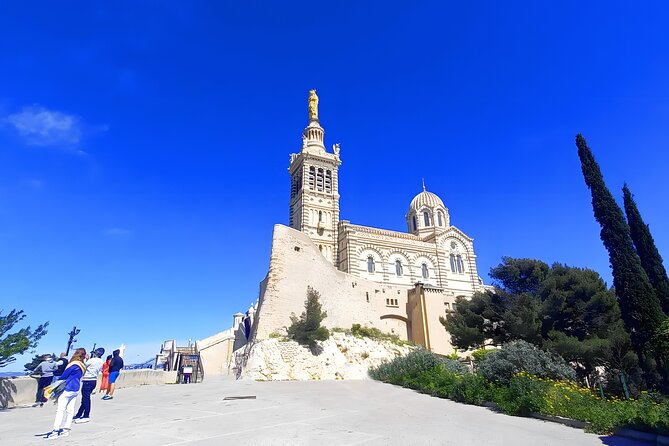
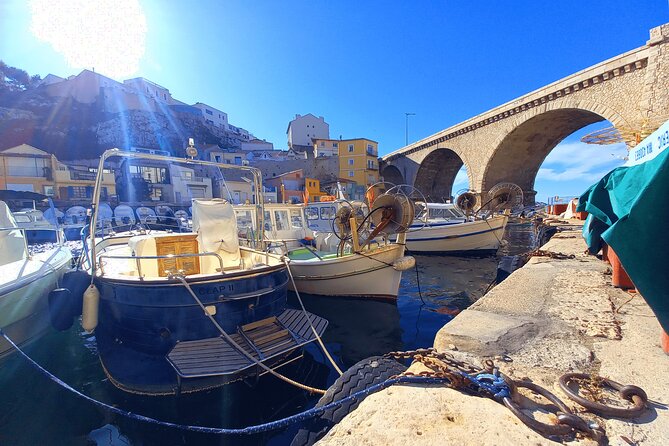
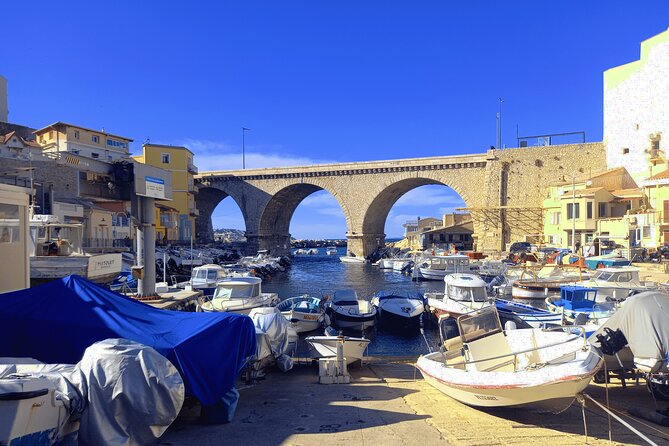
After the basilica, the tour continues to Vallon des Auffes, a small fishing harbor tucked between rocky slopes and the sea. It is one of the most picturesque parts of the route and a welcome change after the uphill streets.
You have about 50 minutes here. Traditional fishing boats sit in the harbor, and waterfront restaurants focus on seafood. The setting feels quieter than the Old Port, even though it remains part of Marseille.
This stop shows why walking is useful. You reach a coastal corner that can feel separate from the city center, yet it is connected to Marseille’s working life and its relationship with the sea. Bring water and protect yourself from the sun, especially in hot weather. One walk took place in temperatures near 37 C, and the group used more than 1.5 liters of water each.
There is no lunch included, so Vallon des Auffes is not a built-in meal stop. You can ask Charles for suggestions afterward, but you should not expect the tour price to cover food or drinks.
Palais du Pharo and the monuments around the harbor
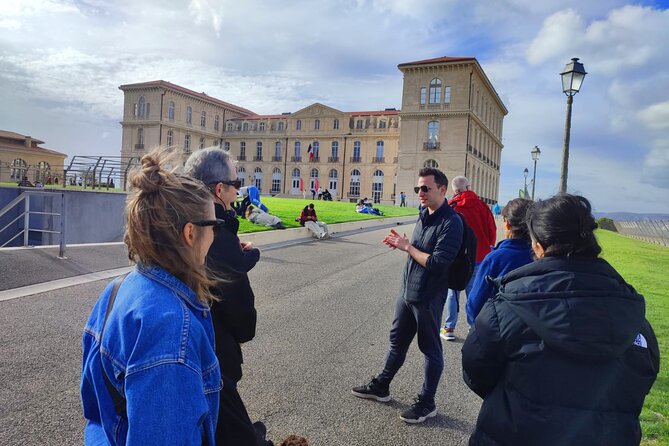
The route then reaches Palais du Pharo, an elegant former palace on a promontory above the Old Port. The building and its gardens provide another strong viewpoint, this time looking back toward the harbor and the city.
The scheduled stop lasts about 40 minutes. Charles also uses this area to explain nearby sights, including Fort Saint-Jean, MUCEM, and the Cosquer museums. That wider view is valuable because it helps you decide what deserves more of your own time later.
This section is less about entering every museum and more about orientation. You learn where the main cultural sites are and how they relate to the port. If you plan to visit MUCEM or the Cosquer museum, the tour can help you place them in your schedule, but admission to those attractions is not part of this walk.
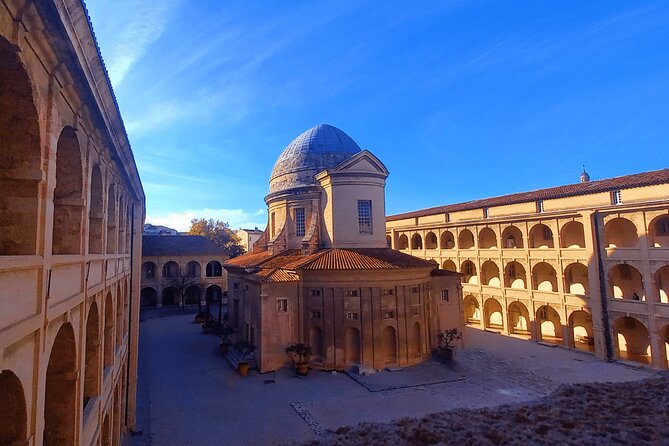
The terraces and gardens are also a good place to pause after the long route. The walk has several rest breaks, and Charles has adjusted the pace for people dealing with knee problems. Still, the day remains active. Do not confuse a stop at a palace with a chance to sit for most of the afternoon.
Abbaye Saint-Victor and the return to the center
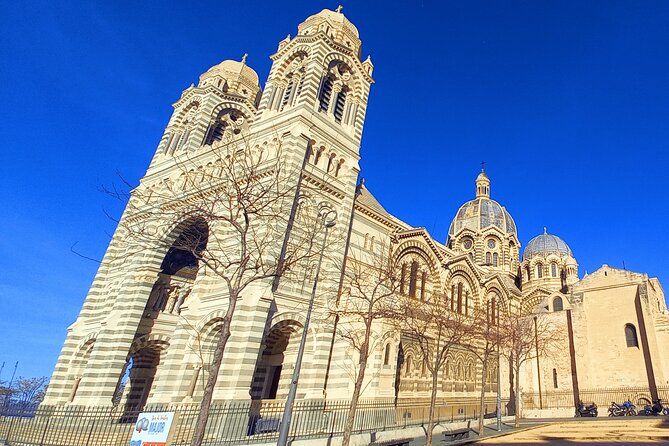
The final sightseeing stop is Abbaye Saint-Victor, an ancient monastery near the Old Port. Its Romanesque architecture, crypts, and religious setting offer a quieter ending after the open views and city streets.
You spend about 20 minutes here. That is enough for an introduction to the abbey and its place in Marseille’s past, but not a long architectural study. The short visit works well at this point in the walk because most people will be ready to finish.
The tour ends at Métro Vieux Port, in the center of Marseille. This is practical for the rest of your day. You can continue on foot, take the metro or bus, or use a boat from the harbor. Ending here also means you do not have to retrace the entire route to return to your hotel or ship connection.
What Charles adds to the route
The places on this walk can be visited independently, but the guide is the main reason to book it. Charles Mondon is presented as a local guide with strong English and a warm, energetic style. He explains the city with historic maps and photographs, which gives you a clearer sense of how Marseille has changed.
I like that the tour is not limited to dates and monuments. Charles discusses the city’s culture and present-day communities as well as its past. That approach helps explain why Marseille feels different from more polished French destinations.
His communication before the tour is another practical strength. You receive clear meeting instructions, including a map and a photo, and he has adjusted dates when weather caused problems. Afterward, he sends individual recommendations based on what you want to do. That follow-up is particularly useful if this is your first day in town.
A guide cannot remove every physical challenge from the route. Charles can suggest a bus or another transport option in difficult sections, but you should still arrive ready for a long walk. Good shoes, water, and a willingness to slow down are essential.
Price, timing, and who gets the best value
At $60.47 per person, this is good value for someone who wants a local orientation rather than a short central-city walk. You get four hours, a small group, a guide, and access to a route that connects several parts of Marseille. The fact that the listed stops do not require admission keeps the cost straightforward.
The value is weaker if you mainly want museum interiors, a relaxed pace, or time for lunch. You will need to pay for food and bottled water separately, and the schedule leaves little room for long visits inside attractions.
I would book it for the first or second day of a Marseille stay. Charles’s recommendations can shape the rest of your plans, and the walk gives you a working map of the city. It also suits cruise passengers with a morning free, provided you can reach La Major at 9 a.m. and manage the physical demands.
This tour is a poor match for anyone who wants to avoid hills, stairs, or long distances. It is also not ideal for a hot afternoon. The early start helps, but summer heat can make the climb and coastal sections tiring.
Should you book the Marseille walking tour?
Book it if you want to see a lot of Marseille in one morning and prefer local streets to a coach window. The combination of Le Panier, Notre-Dame de la Garde, Vallon des Auffes, and the Old Port gives you a broad introduction, while Charles’s maps, stories, and personal suggestions add useful context.
Skip it if you need a slow, mostly flat outing or if you want a tour focused on interiors and formal museum visits. For fit walkers who want history, neighborhoods, harbor views, and practical advice, this is a strong way to get oriented. Pack water, wear proper shoes, and treat the 20,000-step warning as possible rather than theoretical.
FAQ
How long is the Marseille guided walking tour?
The tour lasts approximately four hours and begins at 9 a.m.
Where does the tour begin?
It begins at Cathédrale La Major, at Place de la Major in Marseille.
Where does the tour end?
The tour ends at Métro Vieux Port in central Marseille, near the Old Port.
Who guides the tour?
The local guide is Charles Mondon. The tour is offered in English.
How large is the group?
The tour has a maximum of eight travelers.
Does the tour include lunch or bottled water?
No. Lunch and bottled water are not included, so you should bring or buy water and plan separately for a meal.
How physically demanding is the walk?
The tour requires moderate physical fitness and includes hills, stairs, and long distances. Some participants have walked around 10,000 steps or more, with accounts of up to 20,000 steps.
Can the tour be canceled because of bad weather?
Yes. The experience requires good weather. If poor weather causes cancellation, you can receive a different date or a full refund. Free cancellation is available up to 24 hours before the start time.
Just added in Marseille
- Private French Pastry Class in Marseille★ 5.0 · 90 reviews
- Picturesque Luberon – From MARSEILLE★ 5.0 · 36 reviews
- Provence : Aix en Provence, Cassis and Marseille Private Tour★ 4.5 · 53 reviews
- Marseille Walking food and culture tour 3 hour Private tour★ 4.0 · 36 reviews
- Market & Perched Villages of the Luberon Day Trip from Marseille★ 5.0 · 85 reviews
- Marseille Guided Tour for 2.5 Hours with a Bilingual Local Guide★ 5.0 · 36 reviews
- Private Full Day Wine Tour in Provence From Marseille cruise port★ 5.0 · 32 reviews
- Marseille Shore Excursion: Half Day Tour of Marseille by Electric Bike★ 4.5 · 234 reviews
Tours in Marseille, compared.
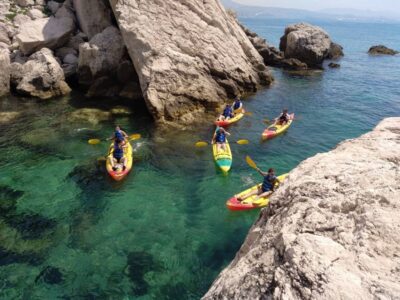
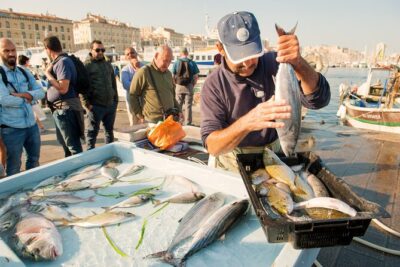
Marseille Food Tour – Full Meal of Local Tastes by Do Eat Better
Read our review →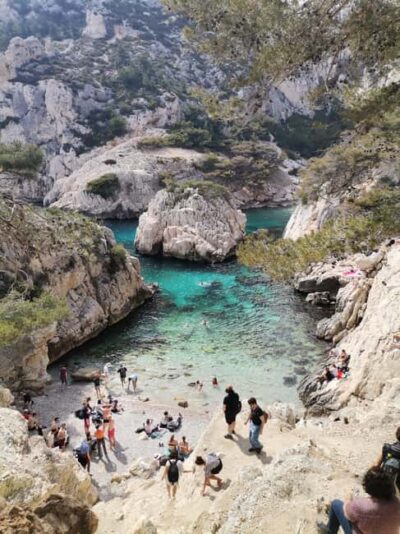
Calanques National Park Guided Hike with Picnic
Read our review →

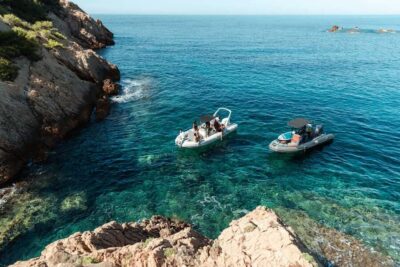
Calanques Sailing Day Trip with Lunch and Wine
Read our review →
Browse the lists this tour appears in