
Reviewed · TOURS IN TOULOUSE
Medieval Carcassonne: Interactive Ghost Story & City Game
Carcassonne’s medieval walls are impressive, but this phone-based game gives you a reason to look closer. You follow clues through the lower town and up toward the Cité, solving 10 puzzles while stories of persecution, plague, architecture, and local legends unfold around you. I like the flexible start and stop times, and I like that the route reveals parts of Carcassonne beyond the obvious castle views. The main caution is practical: getting the Questo app and game working can be confusing, and there is no human guide to fix things on the spot.
For about $6 per person, this is an inexpensive way to add structure to a walk you might take anyway. I would choose it for a couple, a family with older children, or anyone who enjoys puzzles. I would not choose it as my only history tour, since the information is delivered through the app rather than by a local guide, and some of the darker subjects may receive only brief treatment.
Key points to know before you start
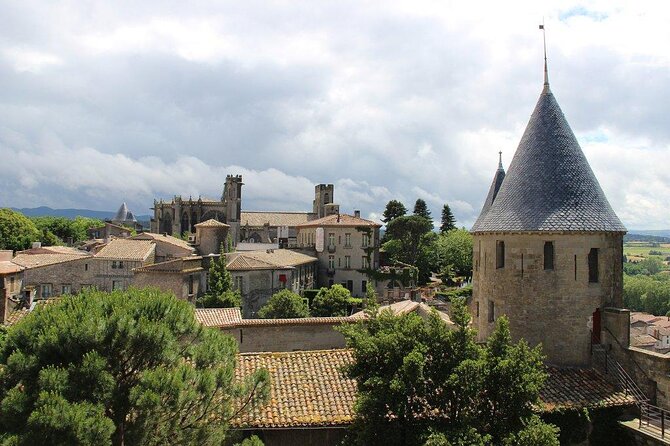
- A 3 km route links the lower town with the medieval Cité, beginning at Square Gambetta and ending at Château Comtal.
- Ten interactive puzzles turn sightseeing into a game, so you need to study buildings, gates, signs, and public spaces.
- The route includes both famous sights and quieter stops, such as the former royal cloth factory and Saint-Gimer Church.
- You control the timing, with unlimited access to pause, take a break, and resume later.
- The experience is private and contactless, with no guide and no shared group.
- App access is the weak point, so allow time to install everything and contact Questo support if the game will not start.
What this Carcassonne game really offers
This is not a guided walking tour with a person leading you from stop to stop. It is a self-guided city game accessed through the Questo app. The phone gives you directions, presents the story, and asks you to solve location-based challenges before moving ahead.
The route covers about 3 km and takes roughly 1 hour 40 minutes. That timing is flexible rather than strict. You can begin any time during the stated operating hours, pause for lunch or a museum visit, and return later. One person described restarting more than 24 hours later after a low-battery problem, which shows how useful the pause feature can be.
The game is offered in English. The experience is designed for your own group, with no strangers joining you and no guide setting the pace. If your party has more than 15 people, you need to make multiple bookings.
I see the game as a middle ground between a sightseeing walk and an escape room. You are not simply listening to facts. You must look around and use what you see to answer each challenge. That can make a familiar gate or church more interesting, especially for children and people who like a clear goal.
It also means you need to keep your phone charged, stay alert to directions, and be comfortable navigating through an app. This is a small adventure, not a passive audio guide.
Other trips people book in Toulouse:
- Toulouse: Carcassonne Day Trip by Coach with Audioguide
★ 4.4 · 580 reviews - Toulouse Food & History Tour with a Chef (in English)
★ 5.0 · 503 reviews - Toulouse: Albi and Cordes/Ciel Day Trip with Audio Guides
★ 4.5 · 486 reviews
Starting at Square Gambetta in the lower town
The route begins at Square Gambetta, across the Aude River from the famous Cité. This puts you in La Bastide de Saint Louis, the old walled lower town built under King Louis IX. It is a useful starting point because you begin with the wider city rather than jumping straight into the postcard version of Carcassonne.
Here, the first challenge asks you to look around the square for an answer. That opening sets the tone for the rest of the activity. You need to inspect your surroundings, notice details, and use the answer to move to the next location.
I like this beginning because it gives you time to get your bearings before tackling the hill and walls of the Cité. It also shows that Carcassonne is more than one fortified ridge. The lower town has its own story and street pattern, and the game gives it a proper place in the route.
The drawback is that the first few minutes may feel less dramatic than arriving at the castle. If you expect an immediate medieval spectacle, you may need patience. The city game is building a story step by step.
Notre Dame de la Santé and the old river crossing
The route then reaches the small chapel of Notre Dame de la Santé. Built in 1527 using money from the legacy of Jean de Saix, the chapel served as a hospital for people suffering from the plague. Its location beside the narrow passage between fortified buildings gave it a practical role as well as a religious one.
This is one of the stops that gives the walk its darker tone. You are not only looking at grand walls and towers. You are also reminded that medieval and early modern cities were places of disease, fear, and limited medical care.
The chapel sits near the Pont-Vieux, the old bridge over the Aude. The game asks you to examine the area and find the clue needed to continue. I find this style of challenge useful because it slows you down at a place many people might cross without stopping.
Do not expect a long lecture on the plague. The information is brief and built into the puzzle format. If you want a detailed account of disease in Carcassonne, you will need another source or a dedicated museum visit.
The former cloth factory beside Pont-Vieux
At the foot of Pont-Vieux, you encounter a building linked to Carcassonne’s prosperous cloth-making period. A noble local family once owned the property. In 1694 it was purchased by a person connected with Colbert, the powerful minister of Louis XIV, and turned into a cloth factory. The factory received the title Manufacture Royale in 1696.
The building still visible today is the former owners’ residence. Its design resembles 18th-century buildings in the lower town, making it a useful clue to Carcassonne’s commercial past. This stop is valuable because it shifts the story away from knights and sieges. Cloth production helped shape the city’s economy and architecture.
The puzzle asks you to inspect the building and surroundings. You may find this stop more rewarding if you enjoy architecture and small historical details. It is also a good reminder that the route does not treat the medieval citadel as the whole story.
This is not a monument with an included entrance. The game takes you to the exterior, and admission to attractions along the route is not included in the $6 price.
Same base, a different kind of day:
- Toulouse Victor Hugo Market Small Group Tasting Tour
★ 5.0 · 337 reviews - Lourdes: Sanctuary Guided Walking Tour
★ 4.6 · 205 reviews - Half-day sailing on the Gave de Pau
★ 5.0 · 180 reviews - Toulouse: Electric Tuk-Tuk Tour with Photo Stops and Audio
★ 4.8 · 138 reviews
Saint-Gimer Church and Viollet-le-Duc’s practical design
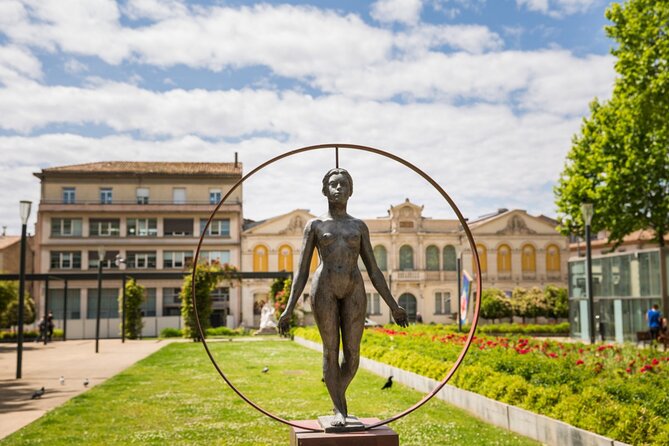
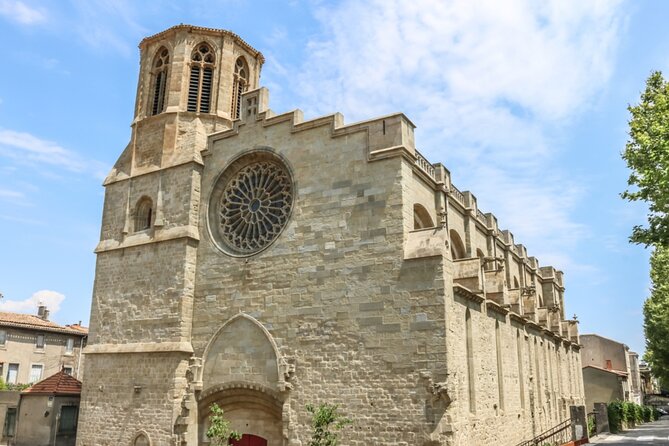
Saint-Gimer Church was built between 1854 and 1859 by Eugène Viollet-le-Duc, the architect closely associated with the restoration of Carcassonne’s medieval citadel. The church is a later building, but it fits neatly into the city’s long architectural story.
Its design is notably modest. It has a nave, two aisles, a polygonal apse, two vestries, and a porch. The building is smaller and less theatrical than the castle complex, which makes it an interesting contrast.
The game brings you here as part of its route toward the Cité. You will use the building and nearby details to solve another challenge. This stop works best for people who enjoy looking at form, proportion, and building history rather than ticking off major sights.
Families should know that children may find this section slower. A younger child who wants constant action may lose interest while adults study architectural details. Older children, however, can take an active role in spotting clues and entering answers.
Porte de l’Aude, one of the city’s great approaches
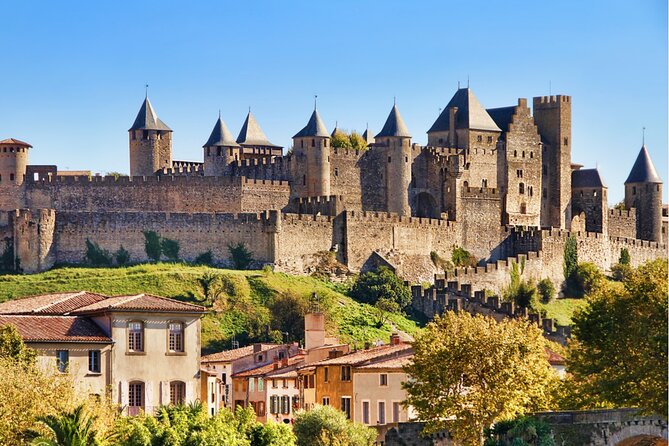
Porte de l’Aude is one of the preserved gates of the medieval walled city. It overlooks the Aude and provides one of the memorable approaches to the Cité. By this point, the route feels more like the Carcassonne most people picture: stone defenses, dramatic views, and a strong sense of arrival.
The game does not simply tell you to admire the gate. It asks you to look carefully for the answer to the next puzzle. That makes you inspect the gate instead of taking a quick photograph and moving on.
This is also where the route may feel physically more demanding, depending on your pace and the direction of your walk. The full route is about 3 km, but it includes movement between the lower town and the elevated citadel. Wear comfortable shoes and keep water with you, especially in warm weather.
Because the activity is self-guided, you can stop for photographs without holding up anyone else. That freedom is one of the strongest reasons to choose this format. You can enjoy the views, pause the game, and continue when you are ready.
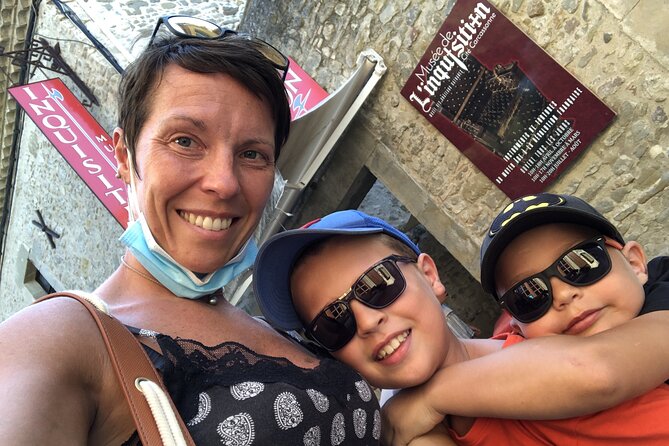
The Inquisition Museum and the game’s darker subject matter
The Inquisition Museum occupies a large 17th-century building and presents instruments of torture from the 12th century through the French Revolution. It also covers important figures, biographies, Cathar castles, and the history of the Inquisition in the region.
The museum is included as a location in the route, but its entry ticket is not included. You should treat the game’s stop and the museum visit as two separate things. The app may take you to the building and provide related context, but you need to pay separately if you decide to go inside.
This distinction matters because the game’s description points to medieval persecution and the Inquisition, yet the app content may not explore every dark subject at length. If you are booking mainly for a detailed account of disease, torture, or Cathar history, you may find the treatment too brief.
For families, this is the stop that deserves the most care. The material can be grim, and the experience is not simply a light treasure hunt. Parents should decide in advance if the subject fits their children. Older children interested in history may find it memorable, while younger children may not.
The cathedral and Château Comtal finish
The route ends at Château Comtal, reached step by step through the app. The castle was built in the 12th century by Bernard Aton Trencavel over the western part of the Roman walls. It gives the game a strong final destination and connects the puzzle walk to the central fortress.
Nearby, the present Romanesque cathedral began construction in June 1096. A Lady Chapel was added in the early 15th century beside an infirmary and chapel built by Bishop Radulph in the 1260s. These details help explain why the Cité contains more than military architecture. Religious buildings, hospitals, defensive walls, and noble residences grew together over many centuries.
The finish at Château Comtal is satisfying because you have crossed from Square Gambetta and the lower town into the fortified city. It also leaves you in the best position to continue sightseeing on your own.
Remember that entry to Château Comtal is not part of the game. The experience guides you to the exterior meeting point, but you need a separate ticket if you want to visit inside.
Price, timing, and the practical value
At $6 per person, the activity is inexpensive for a nearly two-hour route. The price makes sense if you want a structured walk with puzzles and local stories, especially if you are already planning to explore the city on foot.
The value is less clear if you expect a full guided tour. There is no physical guide, no live narration, and no included admission to the Inquisition Museum or Château Comtal. You are paying for the app, route design, story, and challenges.
One useful detail is that a single phone may be enough for the group. The activity is private, and the challenges can be solved together. A booking note indicates that groups over 15 should make multiple bookings, but smaller groups do not need to behave like a formal tour party.
The unlimited access is the feature that changes the value most. You can begin between 6:00 AM and 11:30 PM, pause at any point, and resume later. That works well if you want to combine the game with lunch, a museum visit, or an evening stroll.
Cancellation is free if you cancel at least 24 hours before the scheduled start. Cancellations inside that window are not refunded.
Getting the Questo app to work
The biggest practical concern is the launch process. Some people have found access difficult, including trouble with the QR code, email address, or the required app steps. In a few cases, users spent a long time trying to start the game and could not proceed.
I would prepare before reaching Square Gambetta. Download the Questo app, check your booking email, charge your phone, and allow time for the game to load. Do not wait until your whole family is standing in the square before dealing with setup.
If the game will not start, contact Questo through the in-app chat, Tripadvisor messaging, or the listed support email, [email protected]. Support is stated to be available around the clock through the app, and the provider has offered help or refunds when technical problems prevented play.
This is not a reason to dismiss the activity, but it is a reason to plan ahead. The experience succeeds only if the technology cooperates.
Who will enjoy this city game most
I would recommend it most to:
- Couples who want an easy way to explore together without joining a group
- Families with children old enough to follow directions and solve clues
- Visitors who enjoy architecture, local stories, and detail-based puzzles
- Independent sightseers who dislike fixed departure times
- Repeat visitors who want a different way to cross between the lower town and the Cité
I would be more cautious if you want a professional historian, long explanations, or a traditional audio guide. One phone-based experience in English can also be awkward for people who prefer Spanish, French, or another language. The game is listed as English only, and some users have had to rely on translation tools.
The activity may also be less suitable for children who cannot stay focused while adults study buildings. The route is designed around observation, so the fun depends on paying attention.
Should you book Medieval Carcassonne?
I would book this for $6 if I wanted a flexible, low-cost way to connect the lower town, Pont-Vieux, the river gate, and the medieval Cité. The best parts are the freedom to pause, the private format, and the way the puzzles make you notice less obvious buildings.
I would not book it expecting a complete account of Carcassonne’s persecutions, plague history, or Cathar past. For that, add a museum or a proper guided tour. Also, prepare the app before you arrive, since technical access has been the main source of frustration.
Choose this game if you like exploring at your own speed and turning a walk into a small mystery. Skip it if you want a person beside you explaining every stone. For the right kind of visitor, it is a clever and affordable extra layer on a day in Carcassonne.
FAQ
Where does the Carcassonne city game begin?
It begins at Square Gambetta, 11000 Carcassonne, across the Aude River from the famous Cité.
Where does the experience end?
The route ends at Château Comtal. The Questo app provides step-by-step directions to reach it.
How long does the activity take?
It takes approximately 1 hour 40 minutes, with a route of about 3 km.
How many puzzles are included?
The experience includes 10 interactive puzzles.
Is the activity guided by a person?
No. It is a private, self-guided mobile experience accessed through the Questo app. No physical guide is included.
Can I pause and resume the game?
Yes. You can start at any hour, pause whenever you like, and resume later. Access is unlimited.
Is the game offered in English?
Yes. The activity is offered in English.
Are entry tickets to Château Comtal or the Inquisition Museum included?
No. Admission tickets to monuments and attractions are not included.
What happens if I cannot start the game?
You can contact Questo support through the in-app chat, Tripadvisor messaging, or [email protected]. The provider states that support is available 24 hours a day, seven days a week.
Just added in Toulouse
- Lourdes, Guided Walking Tour in the Sanctuary★ 4.0 · 70 reviews
- Private guided tours of Lourdes / Walking tour★ 5.0 · 56 reviews
- Half-day sailing on the Gave de Pau★ 5.0 · 180 reviews
- Private guided tour of the city of Carcassonne★ 5.0 · 58 reviews
- Cité de Carcassonne Guided Walking tour. Private tour.★ 5.0 · 42 reviews
- Carcassonne ‘s Medieval Walls: A Self-Guided Tour★ 4.5 · 43 reviews
- Carcassonne During World War 2★ 5.0 · 127 reviews
- Toulouse Food & History Tour with a Chef (in English)★ 5.0 · 59 reviews
Tours in Toulouse, compared.

Toulouse Food & History Tour with a Chef (in English)
Read our review →
Albi and Cordes/Ciel Day Trip with Audio Guides
Read our review →
Toulouse Victor Hugo Market Small Group Tasting Tour
Read our review →



Browse the lists this tour appears in