
Reviewed · TOURS IN PARIS
Paris: 2-Hour Passages Private City Tour in German
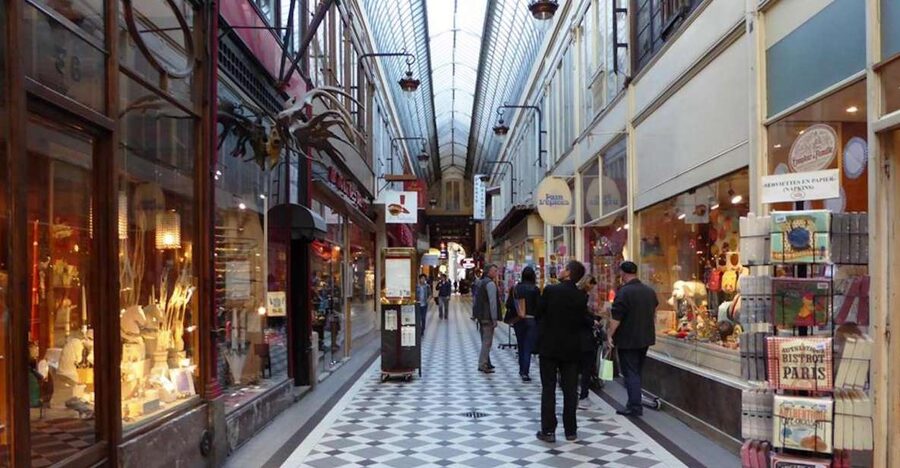
Paris’s covered passages are easy to miss, which is exactly why this tour is appealing. In two hours, you move from Le Peletier to Palais-Royal, passing through three historic arcades that offer a quieter, more intimate view of the city than the usual grand sights. The passages also explain how early 19th-century Parisians adapted to a dirty, rapidly changing city.
I like the private format, since your guide can shape the conversation around your questions. I also like the German-language focus, especially for travelers who want more detail than they might get while translating a fast-moving English tour. The main consideration is the price: at $94 per person, it makes the most sense for people who value personal guidance and a less familiar side of Paris.
Key points to know
- Three covered passages: See Passage Verdeau, Passage Jouffroy, and Passage des Panoramas in one compact walk.
- A history-focused route: Learn why these arcades appeared before the rise of the grand department store.
- Private German tour: You receive a German-speaking guide for your own group rather than joining a large public walk.
- Convenient central route: Begin at Metro station Le Peletier and finish near Palais-Royal.
- Two-hour length: The tour fits neatly into a morning or afternoon without taking over your day.
- A personal guide can matter: Solene, one of the guides, is specifically praised for clear explanations and a friendly manner.
Why Paris’s passages are worth two hours
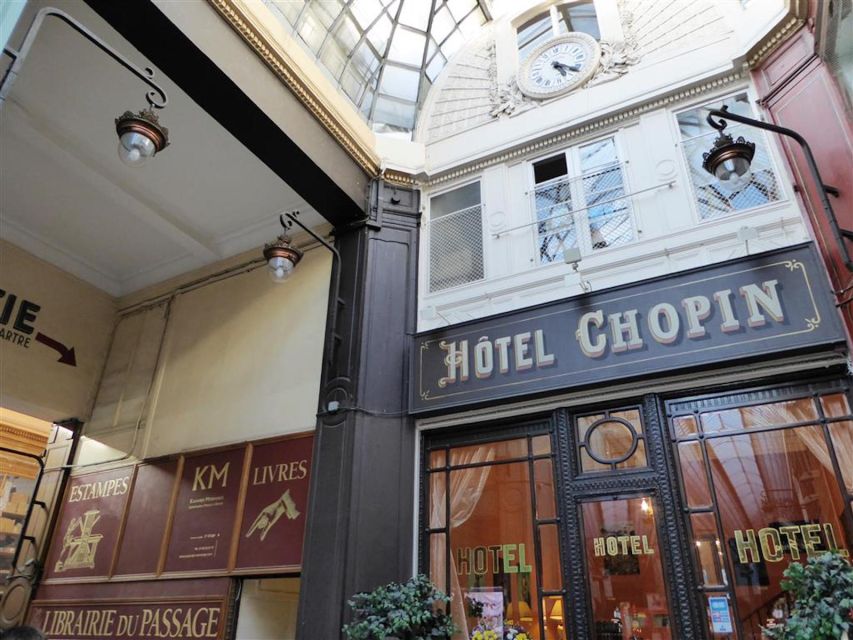
Many first visits to Paris focus on famous monuments, museums, and broad boulevards. This route takes a different turn. The covered passages sit in the center of the city, yet they can feel easy to overlook because they are tucked into ordinary streets and do not announce themselves with the force of the Eiffel Tower or the Louvre.
That quiet entrance is part of the appeal. You are not simply walking from one major sight to another. You are learning how Paris once worked at street level.
The passages came into use in the early 19th century, when Paris was far less polished than the city you see today. Streets could be dirty and unpleasant, and these covered routes offered a more sheltered way to move through the city. They also gathered shops and other commercial activity under one roof.
That makes them early relatives of the grand department store. The comparison helps explain why the passages can feel both practical and decorative. They were not created only as pretty places for a stroll. They answered a real urban problem, then gradually became places where people browsed, met, and watched city life.
Your guide’s job is to connect those pieces. You see the arcades, but you also learn why they mattered and why interest in them has returned only in recent years. That context is more useful than a simple list of architectural details.
Other trips people book in Paris:
- Paris: Louvre Museum Timed-Entrance Ticket
★ 4.6 · 71,977 reviews - Disneyland® Paris 1-Day Ticket
★ 4.6 · 49,412 reviews - Paris: Versailles Palace and Gardens Full Access Ticket
★ 4.6 · 41,579 reviews
Starting at Le Peletier
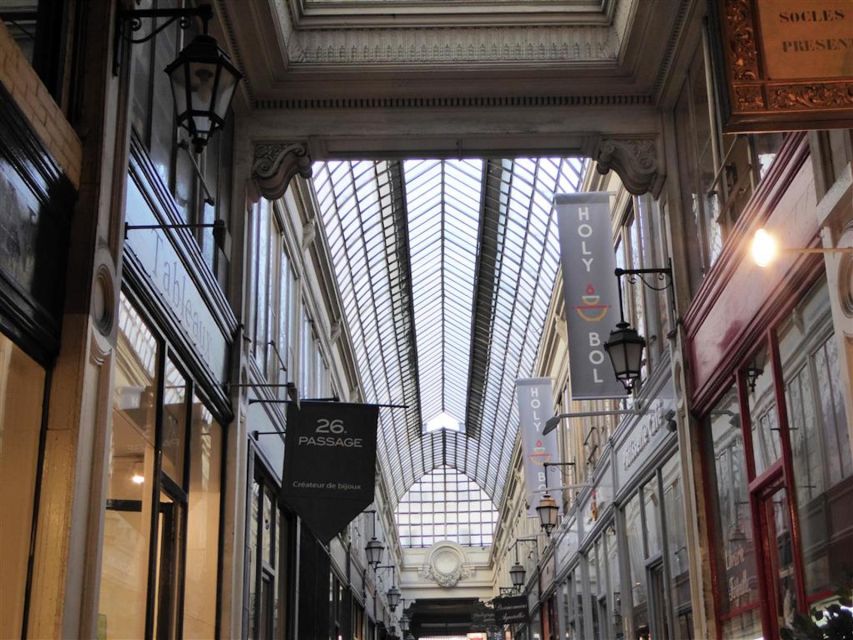
The meeting point is Metro station Le Peletier on Line 7. Look for a guide carrying a HelpTourists bag. This is a practical meeting place because the route begins in a central part of Paris and does not require hotel pickup.
You should allow enough time to reach the station without rushing. The tour lasts two hours, and a late arrival could be awkward with a private walking route that moves through several locations. Since there is no hotel pickup, you are responsible for getting to Le Peletier.
The start also sets the tone. You do not begin in front of a famous monument with a crowd of people taking photographs. You begin near a working Paris neighborhood, then move into passages that reveal themselves gradually.
For German-speaking visitors, the language is a real advantage. You can ask about connections between the passages, the streets around them, and Paris’s changing commercial life without stopping to translate every explanation. A private tour also gives you room to ask for clarification if a historical point needs more time.
Passage Verdeau and the first change of pace
Passage Verdeau is the first listed passage on the route. It helps you understand the basic idea of Paris’s covered arcades before you see the next two.
Expect the atmosphere to shift as you enter. The street outside is open and exposed, while the passage offers a more enclosed route through the city. This change is one of the pleasures of the walk. You are still in central Paris, but the pace becomes more measured.
The tour does not present the passage as an isolated curiosity. Instead, it places Verdeau within the larger story of the early 19th-century city. That approach matters because a passage can otherwise become a quick photo stop. With explanation, it becomes evidence of how people dealt with Paris before modern improvements changed the streets.
You may enjoy this first stop most if you like urban history and small changes in atmosphere. If you are mainly looking for famous paintings, grand interiors, or major monuments, the appeal may be less immediate. This is a tour about how a city functioned, not a checklist of headline attractions.
Passage Jouffroy and the charm of the covered arcades
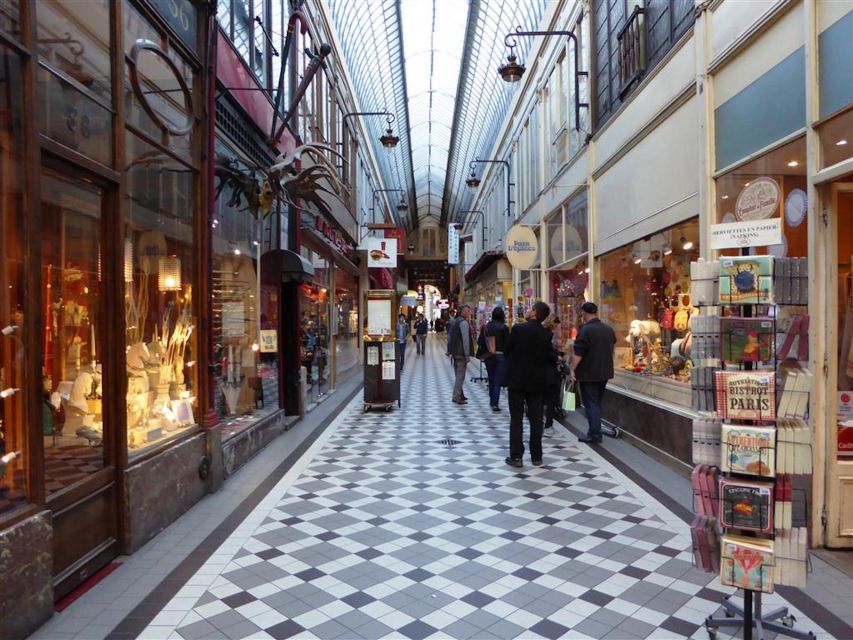
The route continues to Passage Jouffroy. Seeing the passages one after another lets you compare them rather than treating each as a separate stop.
This is where the theme of Parisian charm becomes clearer. The passages are not just shortcuts. Their covered design and enclosed setting helped create a distinct kind of city experience, one that sits between shopping street, social space, and sheltered walkway.
Your guide can help you notice how the passages relate to one another and why they were once useful. One of the strongest features of a private tour is that you can stay with a subject when it catches your interest. If you want to understand the relationship between the arcades and the later grand magasins, you can ask directly instead of waiting for a standard group schedule.
The tour is conducted in German, and the guide is live rather than recorded. That sounds basic, but it changes the experience. You receive explanations in real time, at the pace of your group, with the chance to ask questions.
Solene is one guide associated with this experience. Her explanations have been singled out as informative, friendly, and good at showing the connections between different parts of Paris. Those qualities fit this route especially well, since the passages make more sense when they are linked into one story.
Same base, a different kind of day:
- Paris: Evening River Cruise with Music
★ 4.4 · 22,721 reviews - Paris: Eiffel Tower Entry Ticket with Optional Summit Access
★ 4.4 · 20,035 reviews - Paris: Eiffel Tower Summit or Second Floor Access
★ 4.3 · 17,248 reviews - Paris: Louvre Guided Tour with Reserved Access & Boat Cruise
★ 4.3 · 16,353 reviews
Passage des Panoramas and the larger city story
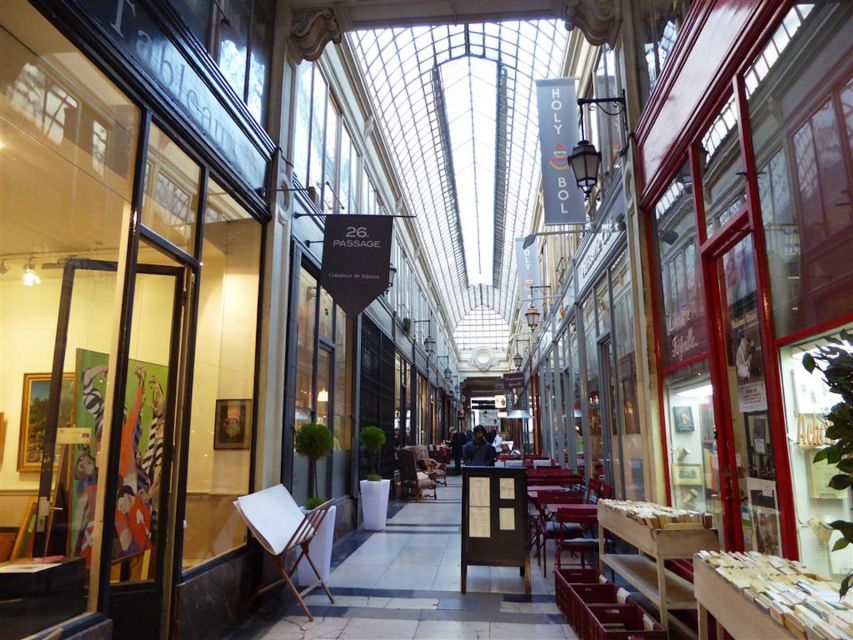
Passage des Panoramas is the third covered passage on the route. By this point, you have seen enough of the route’s pattern to understand why these spaces are more than decorative curiosities.
The passage helps broaden the story from one arcade to a whole part of Paris. You can consider how covered routes changed the way people moved, shopped, and spent time in the city. The tour’s central question is not simply what the passages look like. It is why they appeared, why they became fashionable, and why they later faded from everyday attention.
That last point gives the tour a useful sense of change. Paris is often presented as timeless, but these passages remind you that the city’s character has shifted repeatedly. What feels charming today once served a practical purpose, then lost some of its importance as Paris modernized.
I like that this route gives you a more layered picture of the city. You are not just collecting attractive corners. You are seeing how a particular urban idea rose, became less fashionable, and returned to public attention.
Do not expect every passage to feel completely separate or dramatically different. The itinerary is built around a connected theme, so the value comes from comparison and explanation. If you prefer constant variety, the route may feel focused. If you enjoy following one idea through several places, that focus is a strength.
The Grands Boulevards and Paris beyond the arcades
After the three passages, the tour reaches the Grands Boulevards. This part of the route helps connect the enclosed arcades to the wider city.
The boulevards provide a change in scale. The passages are intimate and sheltered, while the boulevards represent the larger public structure of Paris. Placing them in the same walk makes the urban story easier to follow.
This is also a useful moment to ask your guide about how the passages fit into the surrounding neighborhoods. The route is not limited to interiors. It shows you how the arcades sit within the city around them, and why their location matters.
The Grands Boulevards section may be less unusual than the passages themselves, but it keeps the tour from becoming a string of disconnected indoor stops. You get a better sense of how Paris moves between narrow, enclosed spaces and broad public routes.
Because the entire experience lasts only two hours, the itinerary cannot provide an exhaustive tour of every passage in Paris. That is worth understanding before booking. You are getting a focused introduction to three important examples, along with the nearby boulevards and Palais-Royal quarter.
Ending in the Palais-Royal quarter
The walk finishes in the Palais-Royal quarter. This is a sensible ending because the tour moves from the passages into one of central Paris’s best-known historic areas without requiring you to return to the starting point.
Finishing at Palais-Royal also gives you useful flexibility. You can continue exploring on your own, stop for food, or make your way to another appointment. The tour does not include food, entrance fees, or hotel transportation, so plan your next step separately.
The ending feels like a conclusion to the route’s main idea. You begin with covered commercial passages and finish in a quarter that shows how Paris’s central districts developed around public spaces, shopping, and movement.
You might find that the final stop is not as focused as the three passages, since its role is to complete the route rather than introduce one more covered arcade. Still, it helps place the earlier stops in the broader center of Paris.
What the private German format adds
The private group format is the biggest practical difference between this experience and a standard walking tour. You are not simply following a large crowd from one point to the next. Your group has a dedicated German-speaking guide.
That can make the tour more comfortable for couples, families, or small groups who want to ask questions freely. It also helps if you prefer a slower explanation of historical connections instead of a quick stream of facts.
The private format does not mean every part of the walk will be customized. The published route follows Le Peletier, Passage Verdeau, Passage Jouffroy, Passage des Panoramas, the Grands Boulevards, and the Palais-Royal quarter. Still, within that structure, a private guide can respond to your interests.
German-speaking visitors should pay attention to the guide assigned to their date. Solene has been praised for being especially friendly and for explaining many useful details and connections. The available feedback also highlights the tour’s friendly atmosphere, strong information, and well-judged two-hour length.
That last point is important. Two hours is long enough to develop a proper theme, but short enough to fit around museum visits, meals, or an evening plan. You get a distinct Paris experience without giving up half a day.
Is $94 per person a fair price?
At $94 per person, this is not a bargain walking tour. The price needs to be judged against what you receive: two hours, a private group, and a German-speaking guide.
For one person booking alone, the cost may feel high for a walk that does not include admission tickets, food, or hotel pickup. The passages themselves are visited as sightseeing stops, and no separate entrance fees are included.
For a couple or family that values privacy and German-language guidance, the calculation looks better. You are paying for the guide’s time and the ability to explore a specific subject in a small setting. That is different from paying for admission to a major attraction, and it should be evaluated on those terms.
I would book it if you have already seen the major sights or want to understand Paris through its streets and commercial spaces. I would be more cautious if your budget is tight or if this is your first and only Paris tour. In that case, a broad introductory city tour may give you more coverage for the money.
The experience has a 4.9 rating from 30 reviews, which supports the idea that the format is working well for the people who choose it. The most consistent strengths are the guide’s explanations, the friendly tone, and the fact that the two-hour length feels well judged.
Who should book this experience?
This tour suits you if you enjoy small-scale city history, unusual routes, and the way architecture reflects everyday life. It is also a strong match if you prefer German and want to speak with a guide rather than rely on an audio guide or written notes.
It works well for repeat visitors who have already covered the Eiffel Tower, Louvre, and major river views. The passages offer a different look at Paris, one built around movement, shopping, and urban change.
Couples and small private groups should find the format especially appealing. Families may also like the two-hour length, though the experience will be most rewarding for children who can engage with historical explanations.
You may want to skip it if you want a fast tour of famous monuments, a food-focused walk, or a visit with included attractions and admission tickets. The route is specialized by design.
The tour operates Monday through Saturday, so Sunday visitors cannot use this specific experience. Cancellation is free up to 24 hours before the start, and you can reserve now and pay later, which gives you some flexibility if your plans are still moving.
My verdict on the Paris passages tour
I like this experience because it gives Paris a clear subject instead of trying to cover everything at once. The three passages, the Grands Boulevards, and the Palais-Royal quarter form a compact route with a real story behind it.
The strongest reasons to book are the private German guidance and the chance to see places many people pass without noticing. The main weakness is value for money. At $94 per person, you should want personal interpretation, not just a pleasant walk.
Book it if you want a calm, focused introduction to Paris’s covered passages and appreciate a guide who can explain the links between architecture, commerce, and city life. Skip it if you need the lowest-cost option or want a wider survey of Paris. For the right person, this is a smart way to spend two hours in the city.
FAQ
Where does the tour begin?
The tour begins at Metro station Le Peletier on Line 7. Look for the guide carrying a HelpTourists bag.
Where does the tour finish?
The tour finishes in the Palais-Royal quarter.
Which passages are included?
The route includes Passage Verdeau, Passage Jouffroy, and Passage des Panoramas.
What language is the tour conducted in?
The tour is conducted in German with a live German-speaking guide.
Is this a private tour?
Yes. The experience is offered for a private group.
Does the tour run every day?
No. The city tour takes place from Monday through Saturday.
Just added in Paris
- Private Transfers in Paris★ 5.0 · 75 reviews
- Personalized Transport service from Disneyland to Paris★ 5.0 · 63 reviews
- Disneyland® Paris 1 Day Ticket with Transport from Paris★ 3.5 · 302 reviews
- CDG – Euro Disney – CDG Two Way Private Shuttle Transfer★ 5.0 · 233 reviews
- Monet’s Gardens & House-Private Giverny Tour From Paris★ 4.5 · 137 reviews
- Giverny Monet House and Gardens Skip the line Walking tour★ 4.0 · 217 reviews
- Guided tour Monet’s house and gardens/small group★ 4.5 · 68 reviews
- Monet’s House and Garden & Giverny Village★ 4.5 · 39 reviews
Tours in Paris, compared.

Versailles Palace and Gardens Full Access Ticket
Read our review →
Eiffel Tower Entry Ticket with Optional Summit Access
Read our review →
Louvre Guided Tour with Reserved Access & Boat Cruise
Read our review →
Moulin Rouge Cabaret Show Ticket with Champagne
Read our review →
Louvre Museum Masterpieces Guided Tour with Access
Read our review →Browse the lists this tour appears in