
Reviewed · TOURS IN LE HAVRE
Rouen: Discover Rouen with a licenced tour guide
Rouen’s story is unusually easy to read as you walk. Gothic churches, a medieval law court, a Black Death ossuary, Joan of Arc’s final square, and post-war buildings all appear within a compact old center. This tour links those pieces into one brisk introduction, with the cathedral and Great Clock as its main anchors.
I like the mix of famous sights and odd details, especially the Saint Maclou ossuary, a reminder that medieval beauty and grim realities often share the same street. I also like the small-group format. With no more than 10 people, you have a better chance to ask questions and keep the guide’s voice in the middle of the group.
The main caution is value. At $64 for two hours, this is not a cheap orientation walk. One past departure also had a guide substitution and a language problem, so clear communication may depend on who leads your group that day.
Key points to know before you book
- The route covers Rouen’s essential center: You’ll see the cathedral, Saint Maclou, Saint Ouen Abbey, the law court, Great Clock, Old Market Square, and Joan of Arc’s church.
- Saint Maclou adds unusual historical depth: Its atrium once served as a bonehouse during the Black Death.
- Joan of Arc’s final chapter is built into the walk: You visit the site of her pyre and the modern church dedicated to her.
- You get both medieval and modern Rouen: Half-timbered houses sit alongside post-war construction.
- The group is capped at 10: That is a useful size for a walking tour through narrow old streets.
- Guiding is offered in three languages: You can book in English, French, or German, subject to the available departure.
Why this two-hour walk works in Rouen
Rouen is a city that rewards a guide because its most interesting details are easy to pass without context. You can admire the cathedral, photograph the clock, and walk through the market square on your own. But the meaning of the bonehouse, the Jewish connection to the law court, and the contrast between old and rebuilt Rouen are harder to spot without someone pointing them out.
This tour is built as a compact city walk rather than a visit to one major monument. That makes it useful early in a Normandy trip, when you want to understand Rouen before returning later to explore a museum or church at your own pace.
You will walk on cobblestones and through streets lined with half-timbered buildings dating from the 14th to the 18th centuries. The route also includes modern construction from the post-war period. That mixture matters. Rouen is not a perfectly preserved medieval set. It is a working city shaped by fire, war, rebuilding, religion, law, and trade.
The pace is likely to be active but manageable for most people over two hours. You should still wear comfortable shoes. The description focuses on walking between sites, not on transportation, so come ready for a continuous stroll rather than a hop-on, hop-off style visit.
Other trips people book in Le Havre:
- D-Day Beaches Shore Excursion from Le Havre with Packed Lunch
★ 5.0 · 486 reviews - All-in-One Normandy D-Day Landing Beaches and Lunch from Le Havre
★ 5.0 · 201 reviews - Outdoor Escape Game in Étretat
★ 5.0 · 171 reviews
Starting beneath Rouen’s Gothic cathedral
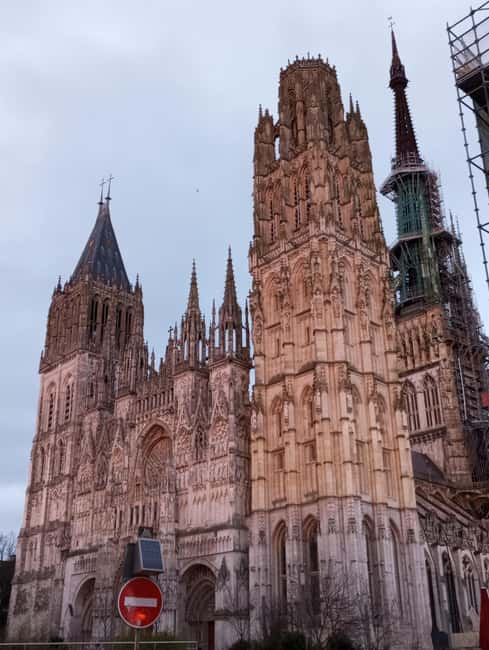
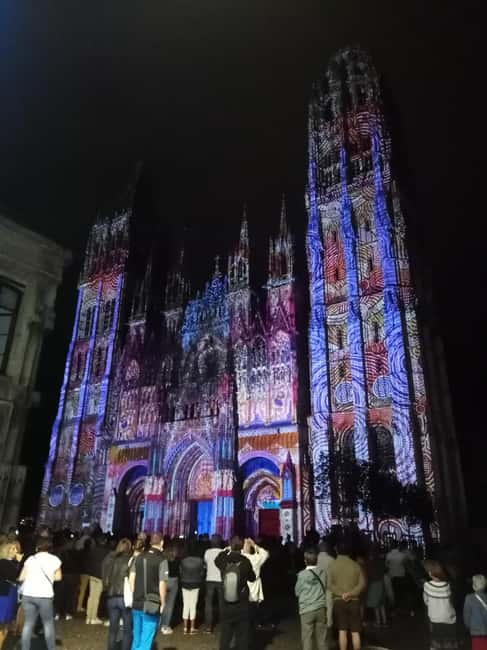
The meeting point is in front of the cathedral, a sensible place to begin. It gives you an immediate sense of Rouen’s scale and architectural ambition before the group moves into the surrounding streets.
The cathedral is included both inside and outside. From the square, you can study its Gothic façade and understand why it dominates the city center. Inside, the focus shifts to the building’s height, stonework, and religious space. The visit is an important part of the tour because later stops make more sense once you have seen Rouen’s central church.
Do not expect a long, specialist cathedral lecture during a two-hour route. The guide has several other major stops to cover. Think of this as an introduction, with enough explanation to orient you and perhaps enough detail to give you a reason to return.
The cathedral also helps you get your bearings. From here, Rouen’s old streets lead toward churches, courts, market spaces, and the Great Clock. You are not spending the whole tour inside one building, so the opening stop gives the walk a clear starting point.
Saint Maclou and the uneasy beauty of the ossuary
Saint Maclou is one of the route’s more unusual stops. The church is associated with an atrium that served as a bonehouse during the Black Death. That detail changes the way you see the place. It is not simply an attractive church with carved details. It also records how communities dealt with mass death in a crowded medieval city.
This is where a local guide can add real value. The structure’s purpose is not obvious from a quick glance, and the connection between religious architecture and public health is easy to miss. You get a more honest picture of medieval Rouen, one that includes fear, disease, and practical responses alongside grand churches and elegant streets.
Saint Maclou also fits the tone of the wider walk. Rouen’s old center is handsome, but it is not polished into a simple fairy tale. A good explanation here should help you read the city as a lived place rather than just a backdrop for photographs.
If you prefer a tour that avoids difficult historical subjects, this stop may feel stark. I see that as a strength, but it is worth knowing in advance. The route includes death and religious history in a direct way.
Saint Ouen Abbey and its stained glass
The Saint Ouen abbey church is included for its impressive stained-glass windows. This is a different experience from the cathedral. Instead of seeing only one great Gothic landmark, you get to compare two major religious buildings and notice how each creates its own mood.
The church’s windows are the main visual reward here. Light, color, and height do much of the work, though the guide can give the building a place in Rouen’s wider story. The stop is especially useful if you enjoy church interiors but do not want to spend an entire day on religious architecture.
Saint Ouen also demonstrates the range of the tour. The route is not limited to the most heavily photographed street in town. It moves you toward a major abbey church, then back through the civic center and market areas.
Allow yourself a moment to look up. On a quick group walk, it is easy to hear the explanation and immediately move on. The stained glass is one of the stops where a few quiet seconds can make the visit more rewarding.
Same base, a different kind of day:
- Private tour: visit Deauville in a sidecar
★ 5.0 · 161 reviews - Private sidecar tour and cider tasting from Deauville or Honfleur
★ 5.0 · 145 reviews - Rouen: Guided Tour of the Historic Center
★ 4.8 · 145 reviews - Best of Paris: Stress-Free Tour with River Cruise from Le Havre
★ 4.5 · 141 reviews
The law court and Rouen’s Jewish past
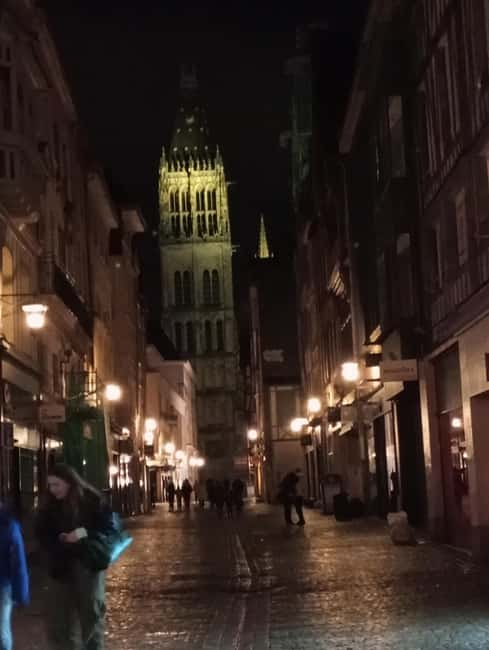
The Gothic law court offers a change of subject. It was once home to a Jewish university, giving the building a connection to the Jewish community and intellectual life of medieval Rouen. The site is still an active court, which makes it more than a historic shell.
This is a useful stop for anyone interested in how cities use old buildings today. Religious buildings and civic buildings often become frozen in the visitor’s mind. Here, you see a Gothic structure that remains part of public life while carrying layers of earlier history.
The court may be less immediately exciting than a cathedral or clock tower. That is precisely why a guide helps. Without context, you might simply admire the façade and keep walking. With context, the building becomes part of the city’s story about law, education, religion, and power.
The tour includes an exploration of the law court, but you should understand the limits of a short walking visit. It is not presented as a separate, extended museum tour. The emphasis is on seeing the site and understanding why it matters.
Great Clock, Rouen’s best-known street marker
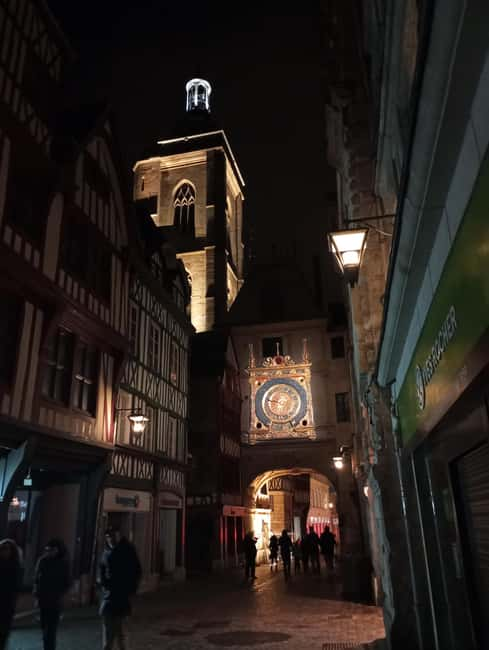
Rouen’s astronomical clock, known locally as le gros horloge, is one of the route’s clearest crowd-pleasers. Its mechanism and decorated arch span a street in the historic center, making the clock both a monument and a useful landmark.
The clock is worth more than a quick photograph. Its position shows how medieval and early modern city life was organized around public time. It helped make the passage of hours visible in a busy urban setting, and its presence still gives the street a strong sense of place.
This is likely one of the busiest sections of the walk, so stay close to your guide. The route description includes a skip-the-ticket-line benefit, but the experience is still a group walking tour, not a private visit with unlimited time at every stop.
I like this part of the itinerary because it connects grand history to an ordinary city habit. You do not need to be an expert in clocks to appreciate it. You simply need to look up and notice how much decoration and civic pride went into something designed to mark time.
Joan of Arc in the Old Market Square
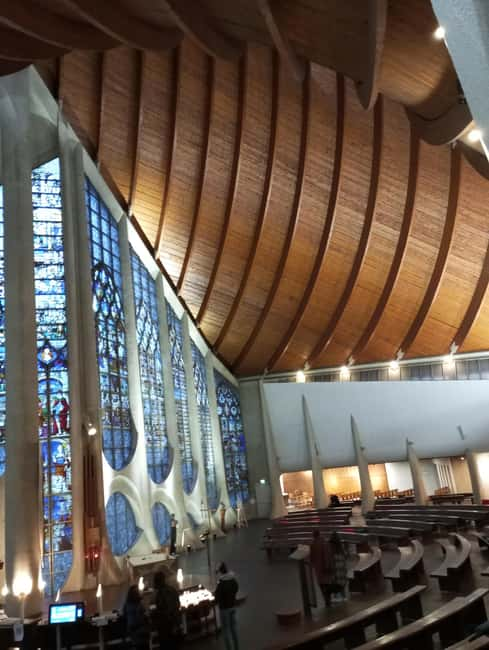
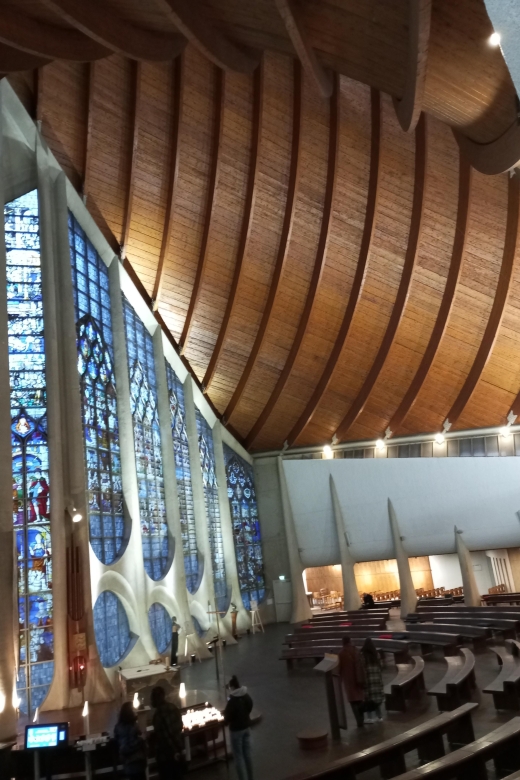
The Old Market Square brings the walk to one of Rouen’s most important historical figures. Joan of Arc’s pyre emplacement is here, along with the modern church dedicated to her.
The setting is powerful because the square is not treated as a distant historical scene. It remains part of the city, surrounded by the daily life of the market area. You see where Joan of Arc’s final moments took place and then enter a modern religious building created in her memory.
The church is a striking contrast to the medieval churches on the route. Its presence shows how Rouen continued to reshape its memory of Joan of Arc in the modern era. You get both the historical site and the later interpretation of that history.
This stop can be emotionally heavier than the clock or half-timbered streets. The guide’s explanation matters, particularly if you want to understand why Joan of Arc remains so important in Rouen and France. The tour gives you the place, the church, and the basic historical setting within a short time.
Half-timbered streets and the contrast with post-war Rouen
Between the major stops, the route passes along cobblestone streets and buildings with half-timbered façades from the 14th through 18th centuries. These stretches are not filler. They are what ties the monuments together.
You get a feel for the old city by walking rather than simply being driven between landmarks. Narrow streets, timber frames, church fronts, and civic buildings create a visual sequence that is difficult to understand from a map. A guide can also point out details you might otherwise pass without noticing.
The inclusion of post-war construction is an important touch. It prevents the tour from presenting Rouen as untouched. Modern buildings are part of the city’s identity, too, and seeing them beside older structures helps you understand the choices made during rebuilding.
I would especially recommend this route to you if you have only a short time in Rouen. In two hours, you get a broad first look rather than a specialist examination. You can then decide which church, street, or historical subject deserves a longer return visit.
What the guide can add to the experience
The tour is offered in English, French, and German, with a live guide. Recent departures have included Polly and Guido. Polly has been described as helpful with local arrangements as well as history, including assisting with a cheese board, fresh baguette, and wine purchase at a market where little English was spoken.
That kind of help is a pleasant bonus, but it should not be treated as a promised part of the tour. The core product is the guided walk and the historical explanation. The strongest feedback has focused on local knowledge and detailed facts about French and Rouen history.
There has also been an uneven experience when the scheduled guide did not appear and an unlicensed replacement led the group. Communication was difficult in that case. I would not treat one bad departure as a prediction of every tour, but it is a fair reason to confirm the meeting details and guide language before setting out.
A small group of up to 10 gives the guide room to answer questions. It also makes it easier to hear on narrow streets and keep the route together. If you want a totally private pace, this is not that. If you want more personal attention than a large city group, the limit is helpful.
Is $64 fair for two hours in Rouen?
At $64 per person, the tour sits in the higher range for a two-hour city walk. The value depends on what you want from your first look at Rouen.
The price makes more sense if you want a guide to connect a long list of places in a short period. You are not paying only for a stroll past buildings. You are getting the cathedral, Saint Maclou, Saint Ouen, the law court, Great Clock, Joan of Arc’s sites, and the old streets in one organized route.
The price feels less attractive if you mainly want a basic orientation walk. You can see many of Rouen’s central streets independently, and two hours is not enough for extended time inside each building. One past departure also felt that the cost did not match the simple nature of the walk.
For me, the deciding factor is the guide. An excellent explanation of the ossuary, law court, Jewish university, Joan of Arc, and post-war rebuilding can make the fee worthwhile. A guide who simply points out the sights would make the price harder to defend.
The tour offers free cancellation up to 24 hours before departure and a reserve-now, pay-later option. It is also wheelchair accessible, according to the activity details. Starting times vary, so check availability for your date.
Who should book this Rouen tour?
I would choose this tour if you are visiting Rouen for the first time, have a tight schedule, or want historical context before exploring alone. It suits people who enjoy churches, medieval streets, civic buildings, and stories that include both famous figures and uncomfortable facts.
It is also a good match for you if you prefer a small group and want to ask questions. The English, French, and German options make it practical for mixed-language travel plans.
I would hesitate if you want a slow, highly detailed visit to the cathedral or Saint Ouen. The route covers many sites in two hours, so each stop has to share the time. I would also think twice if $64 feels high for a walking introduction and you are comfortable researching the city yourself.
Should you book it?
Book this tour if you want Rouen’s main sights arranged into one clear story, especially the less obvious stops at Saint Maclou and the law court. The combination of Gothic churches, Great Clock, Joan of Arc’s final square, old houses, and post-war buildings gives you a useful portrait of the city in a short time.
Skip it if your priority is lingering inside one monument or keeping costs low. Before paying, confirm the language and meeting details, then judge the price against the value of having a guide explain what you would otherwise see only from the outside. For a first visit, the route is strong. Its success depends heavily on the quality and clarity of the guide on your date.
FAQ
Where does the tour meet?
The meeting point is in front of Rouen Cathedral.
How long does the tour last?
The tour lasts two hours.
How much does the tour cost?
The listed price is $64 per person.
Which languages are available?
Guiding is available in English, French, and German.
What major sights are included?
The tour includes Rouen Cathedral, Saint Maclou church and its former ossuary, Saint Ouen Abbey church, the Gothic law court, the Great Clock, the Old Market Square, and the church dedicated to Joan of Arc.
Does the tour visit Joan of Arc’s execution site?
Yes. The route includes the location of Joan of Arc’s pyre and the modern church dedicated to her in the Old Market Square.
Is the tour wheelchair accessible?
Yes, the activity is listed as wheelchair accessible.
How large is the group?
The tour is a small-group experience limited to 10 participants.
Just added in Le Havre
- Paris On Your Own from Le Havre Port with Round Trip Bus Transfer★ 5.0 · 59 reviews
- From Le Havre Breathtaking Honfleur and Deauville Shore Excursion★ 4.5 · 100 reviews
- Deluxe Paris Shore Excursion from Le Havre with Seine Cruise★ 4.5 · 79 reviews
- One day Private Round Tour to Paris from Le Havre Port★ 5.0 · 36 reviews
- Best of Paris: Stress-Free Tour with River Cruise from Le Havre★ 4.5 · 141 reviews
- Private 3.5-hour sidecar tour & cider tasting from Le Havre port★ 5.0 · 52 reviews
- Normandy D-Day US Sector from Le Havre | Private Tour with Guide★ 4.5 · 49 reviews
- Private sidecar tour and cider tasting from Deauville or Honfleur★ 5.0 · 145 reviews
Tours in Le Havre, compared.

D-Day Beaches Shore Excursion from Le Havre with Packed Lunch
Read our review →
All-in-One Normandy D-Day Landing Beaches and Lunch from Le Havre
Read our review →


Private sidecar tour and cider tasting from Deauville or Honfleur
Read our review →
Best of Paris: Stress-Free Tour with River Cruise from Le Havre
Read our review →
Browse the lists this tour appears in