
Reviewed · SEINE RIVER CRUISES
Tours of Paris and the Hauts-de-Seine in an Amphibious Bus
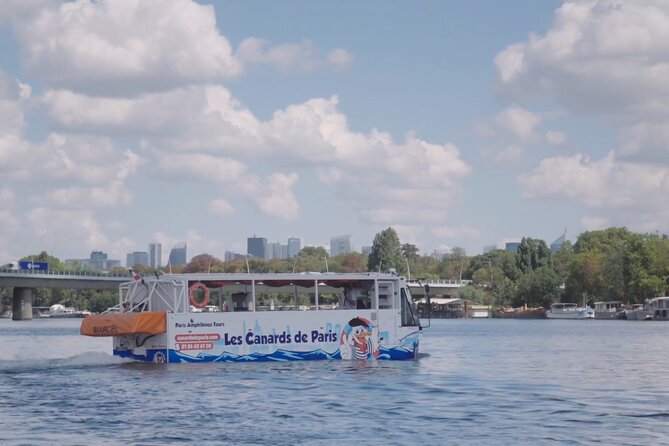
The best part of this Paris tour is the moment Marcel le Canard, France’s first amphibious bus, leaves the road and splashes into the Seine. You get a city sightseeing ride, a short river trip, and a good dose of comedy in roughly two hours.
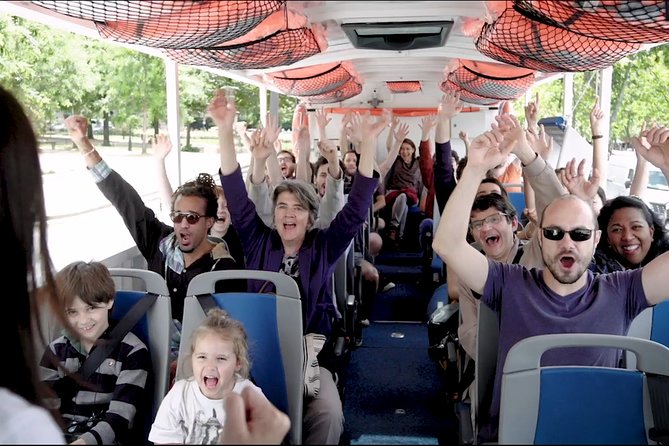
I like the compact group size, capped at 35 people, and the route through western Paris, where you see places many first-time visitors miss. I also like the guides’ lively style. Elliot, Paul, and others switch between French and English, answer questions, and keep children involved. The main consideration is language: the tour is bilingual, and one English-speaking passenger felt that the French commentary received more detail and humor.
Key points to know before booking
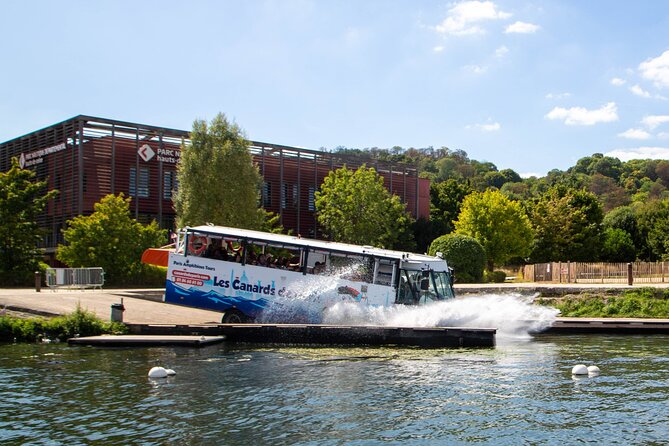
- Marcel le Canard enters the Seine: The bus makes a spectacular splash near Île Monsieur, then cruises past Seine Musicale, Seguin Island, and the gardens of Saint-Cloud.
- The route mixes famous and lesser-known Paris: Expect Les Invalides, Pont Alexandre III, the Champs-Élysées, Eiffel Tower views, Parc de Saint-Cloud, and western suburbs.
- The tour lasts about 1 hour 45 minutes to 2 hours: It returns to the same place where it starts.
- The group is limited to 35 people: That gives the guide a better chance to speak with you than a large coach tour.
- French and English are both used: English is offered, but the balance can vary with the group and guide.
- You must arrive 15 minutes early: The meeting place can be Place Jacques Rueff or Place Vauban, so check your confirmation email carefully.
Why the amphibious bus makes this Paris tour different
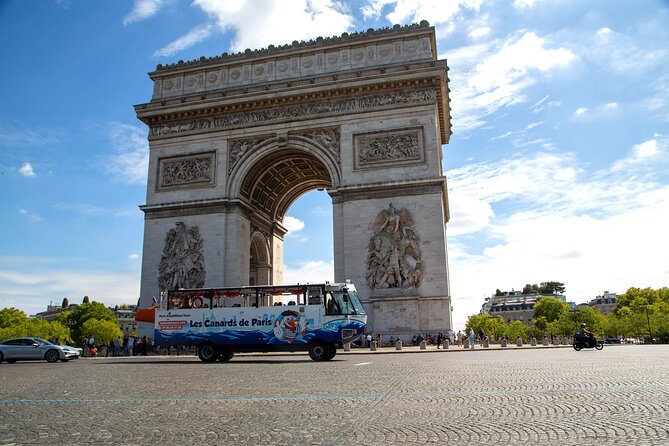
Paris has no shortage of bus tours and Seine cruises. This one earns its place by combining both in a single vehicle. You do not transfer from a coach to a boat. Instead, the wheels carry you toward the water, the bus enters the river, and the ride continues afloat.
That change is the main event. It is playful, a little theatrical, and especially effective if you are traveling with children. The splash is not just a quick photo stop. The route then continues on the Seine, giving you a different view of western Paris and its riverfront.
The vehicle is called Marcel le Canard, or Marcel the Duck. Before reaching the water, the guide explains how the amphibious bus was built and why it can operate on both road and river. That small piece of engineering context helps turn a novelty ride into a proper local attraction.
The bus is not a traditional sightseeing coach, and this matters. You are not getting the broadest possible tour of central Paris. Instead, you are getting a lively trip through several well-known sights, followed by a river crossing in an unusual vehicle.
Other boats on the Seine leaving Paris:
- Paris: Seine Cruise & Crepe Tasting near the Eiffel Tower
★ 4.4 · 11,231 reviews - Paris: Seine River Panoramic Views Dinner Cruise
★ 4.3 · 10,611 reviews - Paris: Eiffel Tower Access by Elevator & Seine River Cruise
★ 4.6 · 7,329 reviews
From Les Invalides to Pont Alexandre III
The tour begins near Place Jacques Rueff, with an alternate meeting location sometimes used at Place Vauban. From there, the route heads toward Les Invalides, the grand complex built under Louis XIV in 1671.
Les Invalides is closely linked with France’s military past and Napoleon’s legacy. The guide uses the building as a starting point for stories about Paris, the army, and the monuments built to honor French soldiers. You will not have time for a full interior visit, so treat this as an exterior introduction rather than a museum tour.
Next comes Pont Alexandre III, one of Paris’s most ornate bridges. Built for the 1900 Universal Exhibition, it is decorated with elaborate gold details, sculpture, and broad views toward the Invalides and the Seine. From a road vehicle, you get a useful look at the bridge’s full setting, though traffic and the bus design may limit your view at times.
This early section works well for first-time visitors because it quickly gives you two classic Paris scenes. It also sets up the tour’s main strength: you receive short historical explanations while moving through the city, rather than stopping for long formal talks.
The Champs-Élysées and the Arc de Triomphe area
The bus then reaches the Champs-Élysées, the famous avenue often called the most beautiful in the world. The phrase is grand, but the avenue has genuine importance as a ceremonial route and one of Paris’s best-known public spaces.
The tour also circles the Arc de Triomphe, the monument honoring Napoleon’s armies. From the bus, you can hear anecdotes about its design, military symbolism, and place in the city. You will not climb the monument or walk beneath the arch, so anyone wanting rooftop views should plan a separate visit.
This portion is best for orientation. You see how the avenue, monument, and grand western approach fit together. It is less useful if you have already taken a detailed central Paris tour and want only quiet streets or extended photo stops.
Eiffel Tower views and Paris’s balloon-flying past
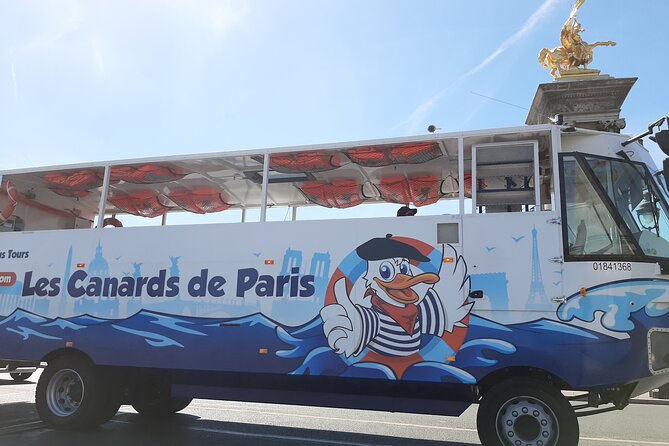
The route includes a location known for strong views of the Eiffel Tower. The exact appeal here is the wider setting rather than a visit to the tower itself. You can photograph the Iron Lady from a different angle and hear how the tower was disliked by some Parisians when it was first built.
That contrast is one of the better themes in the commentary. The Eiffel Tower is now the symbol of Paris, but its early reception was far less warm. The guide uses that story to show how a structure can shift from controversy to national icon.
The bus also passes through one of Paris’s attractive western districts and a park connected with the first manned hot-air-balloon flight. This adds a bit of scientific and aviation history to the route. It is the kind of detail you might miss if you only visit the Eiffel Tower and the central monuments.
Same base, a different kind of day:
- Paris: Louvre Museum Timed-Entrance Ticket
★ 4.6 · 71,977 reviews - Disneyland® Paris 1-Day Ticket
★ 4.6 · 49,412 reviews - Paris: Versailles Palace and Gardens Full Access Ticket
★ 4.6 · 41,579 reviews - Paris: Evening River Cruise with Music
★ 4.4 · 22,721 reviews
A swimming pool, Parc des Princes, and western Paris
The route continues past a grand swimming pool housed with a luxury hotel. This place has a role in Paris’s architectural and social story, and the guide uses it as another quick look at the city beyond the standard postcard sights.
You then pass the Parc des Princes, home of Paris Saint-Germain. If a match or event is taking place, you might hear supporter chants near the stadium. The tour cannot promise that atmosphere, but the stop gives football fans a welcome connection to modern Paris.
As the bus crosses Boulogne-Billancourt, the commentary turns back to Marcel. You learn more about the vehicle’s construction and the practical tricks that let it operate on land and water. This part is useful because the route is not simply a ride with a surprise splash. The guide explains the machine itself, which gives the water crossing more meaning.
The western suburbs also offer a change of pace from central Paris. Instead of one monument after another, you see parks, stadiums, riverfront buildings, and residential areas. For a first visit, this helps you understand that Paris extends well beyond the familiar central districts.
The splash at Île Monsieur
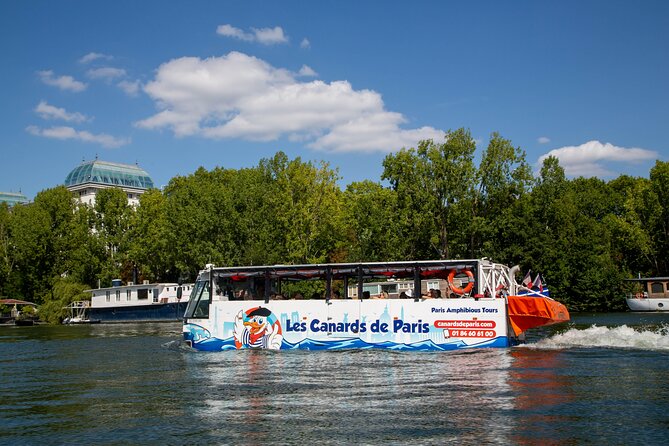
The key transition takes place at the small nautical park on Île Monsieur, named for Monsieur, the brother of Louis XIV. Here, Marcel le Canard drives into the Seine.
Expect a clear change in sensation as the wheels disappear and the vehicle becomes a boat. The moment is designed to be fun, and children often get the most out of it. The warning that you may get wet should be taken seriously, especially near the water entry.
This is not the same as boarding a conventional Seine cruise. A standard boat offers more room and often covers a more central stretch of the river. The amphibious bus offers novelty and a direct connection between the city street and the water. If you have already taken a normal cruise, this gives you a fresh way to experience the river. If you have not, you should know that the river portion follows a less central section.
One passenger found the Seine route less interesting than the usual central river cruise, but still liked the green spaces along the banks and the reaction of a child who loved seeing a bus drive into the water. That is a fair way to judge this section: the spectacle is the attraction, while the scenery is a bonus.
Seine Musicale, Seguin Island, and Saint-Cloud
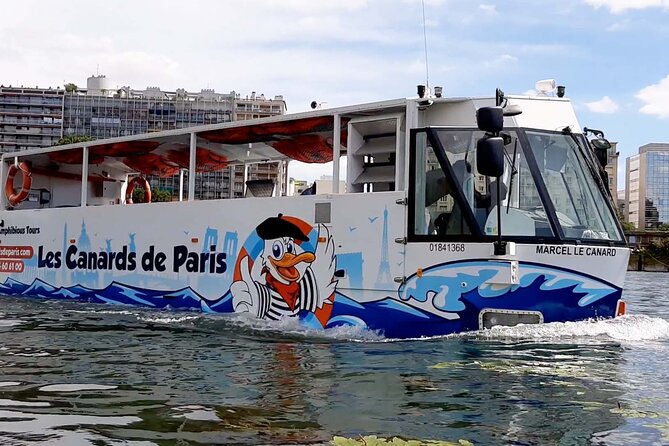
Once afloat, the bus passes Seine Musicale, the large music and performance complex on Seguin Island. The guide explains both the building and the island’s past, giving you a glimpse of how former industrial areas along the Seine have been reused.
The river crossing also gives you views of the gardens of Saint-Cloud and its large waterfall. These green areas are a pleasant change after the monuments and busy avenues of central Paris. You may find this section calmer and more scenic than the road portion, though visibility depends on your seat, weather, and the position of the bus.
The tour does not pretend to be a full garden visit. You remain on board, so think of these sights as a moving introduction. If Saint-Cloud interests you, note the location for a separate outing rather than expecting time to explore it here.
Île Saint-Germain and the largest Paris Statue of Liberty
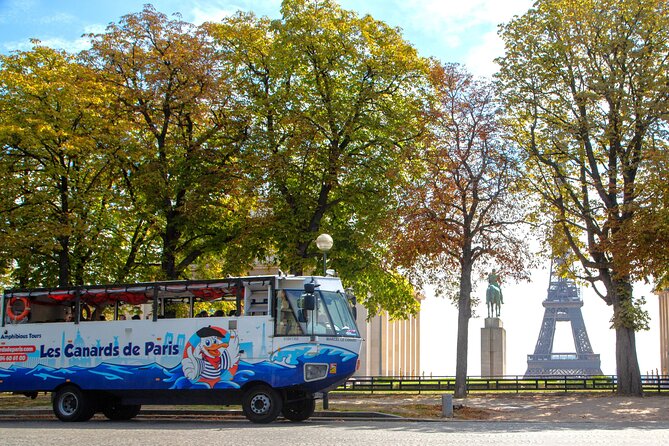
After leaving the water, the bus heads back toward the starting point through Île Saint-Germain in Issy-les-Moulineaux. This affluent district includes the striking Tower with the Figures by Jean Dubuffet, an artist associated with outsider art.
The sculpture is a useful reminder that Paris does not end with Haussmann facades and royal monuments. You get a look at a more modern side of the city, with public art and redeveloped river districts.
The return route also includes one of Paris’s six Statues of Liberty, the largest of the group. This statue served as a model, through enlargement, for the Statue of Liberty in New York. It is a good example of the kind of fact that gives the tour its character: small, specific, and easy to remember after you leave.
Before returning, the guide circles back to the Eiffel Tower and its complicated beginning. By this point, the story lands well because you have already seen the tower from a distance and heard how public opinion changed over time.
Guide style and the French-English balance
The guides are a major part of the experience. Elliot is described as funny, personable, and good at engaging adults and children. Paul has also led the tour, and the team includes people who move quickly between French and English.
That quick switching can make the ride lively, but it can also create uneven English commentary. The tour is described as French and English, not as a separate English-only departure. If the bus contains more French speakers, the guide may give the French portion more jokes, detail, or time.
I would ask a question early if you need a point clarified. The guides are expected to answer questions, and the company has shown a willingness to address concerns about the language balance. Still, an English speaker looking for a fully English lecture should keep this limitation in mind.
The best fit is someone who enjoys personality, jokes, and short stories more than a formal audio-guide presentation. The tour works particularly well for families, first-time visitors, and anyone who wants a lighter afternoon activity between museum visits.
Price, timing, and what you receive
At $50.79 per person, this is not the cheapest way to see Paris. A standard city bus ride or public transport trip costs less, and a conventional Seine cruise may offer more time on the water for a similar price.
The value comes from combining several pieces in one outing: a guided road tour, a look at western Paris, a river crossing, and the amphibious vehicle itself. You also avoid spending a separate block of time arranging transport between a sightseeing bus and a boat.
The total ride lasts about 1 hour 45 minutes to 2 hours. That is long enough to feel substantial, but short enough to fit into a busy Paris plan. I would place it early in your stay if you want orientation, or late in your stay if you want to see places you missed during your walking days.
The group maximum is 35 people. That is still a full vehicle, but it is more manageable than a large coach. The mobile ticket is convenient, and confirmation is provided when you book.
Arrive 15 minutes before departure. Check the exact meeting place in your confirmation because the departure may be at Place Jacques Rueff or Place Vauban. The tour finishes where it starts, which makes planning your next stop easier.
Good weather is required. If conditions force a cancellation, you can choose another date or receive a full refund. You can also cancel for a full refund up to 24 hours before the start time. Late cancellations and changes are not accepted.
Who should book this amphibious Paris tour
I would choose this tour for a family with children, a first-time visitor who wants a broad look at western Paris, or a repeat visitor seeking something more unusual than another museum. It is also a good choice if you like guides who tell stories and keep the mood light.
I would hesitate if your main goal is a detailed tour of central Paris, an English-only presentation, or a long Seine cruise past the Louvre and Notre-Dame. The route focuses on western Paris and the suburbs near Boulogne-Billancourt, so it does not replace a walking tour of the historic center.
The strongest reason to book is simple: you get to ride a bus into the Seine. That odd, memorable moment, backed by lively commentary and a useful route through lesser-seen districts, gives this experience a clear identity.
FAQ
Where does the amphibious bus tour start?
The listed starting point is Place Jacques Rueff, Place Jacques Rueff, 75007 Paris, France. The meeting place may sometimes be Place Vauban, so check your booking confirmation email.
Where does the tour finish?
The tour finishes at the same meeting point where it begins.
How early should I arrive?
You should arrive 15 minutes before the scheduled departure time.
How long does the tour last?
The experience lasts approximately 1 hour 45 minutes to 2 hours.
Is the tour offered in English?
English is offered, but the tour uses both French and English. The guide may switch between the two languages during the ride.
How many people can join the tour?
The tour has a maximum group size of 35 people.
Does the bus actually enter the Seine?
Yes. Marcel le Canard enters the water at the nautical park on Île Monsieur, then crosses the Seine.
Can the tour be canceled because of weather?
Yes. The experience requires good weather. If it is canceled because of poor weather, you can receive a different date or a full refund.
What is the cancellation policy?
You can cancel up to 24 hours before the start time for a full refund. Cancellations or changes made less than 24 hours before departure are not accepted for a refund.
Should you book it?
Book it if you want a playful, family-friendly way to see western Paris and the Seine, especially if you have already visited the main central monuments. At $50.79, you are paying for the unusual vehicle and entertaining guide as much as for the sightseeing route.
Skip it if you want a conventional boat cruise, a fully English tour, or close visits inside major monuments. For everyone else, the splash, the small-group setting, and the chance to see Paris from both road and river make this a memorable addition to a Paris itinerary.
Just added in Paris
- Paris: Vallée Village Outlet Shopping Day★ 4.3 · 362 reviews
- Paris night out : Comedy in English ‘How to Become a Parisian ?’★ 4.5 · 373 reviews
- La Vallee Village Shopping Outlet by Luxury Transport from Paris★ 3.5 · 111 reviews
- Design Luxury and Personalized Jewelry in Paris le Marais★ 5.0 · 160 reviews
- Oh My God She’s Parisian! English Comedy Show in Paris★ 4.5 · 116 reviews
- Paris: Eiffel Tower Photo Shoot★ 5.0 · 420 reviews
- Photo Session in Paris – Photographer at the Eiffel Tower★ 5.0 · 422 reviews
- Paris City Sightseeing Half Day Guided Segway Tour with a Local Guide★ 5.0 · 371 reviews
Seine River Cruises, compared.
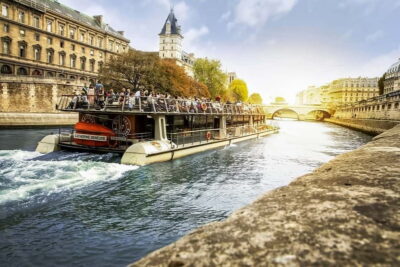
Seine Cruise & Crepe Tasting near the Eiffel Tower
Read our review →
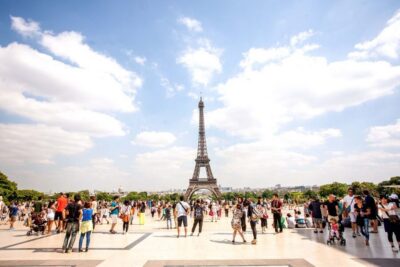
Eiffel Tower Access by Elevator & Seine River Cruise
Read our review →
3-Course-Dinner Cruise on the Seine with live music
Read our review →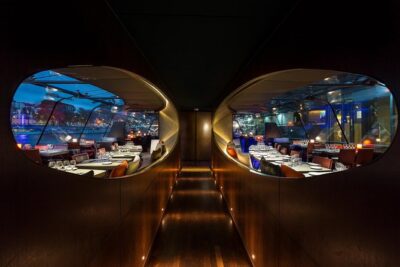
Bateaux Parisiens Seine River Gourmet Dinner & Sightseeing Cruise
Read our review →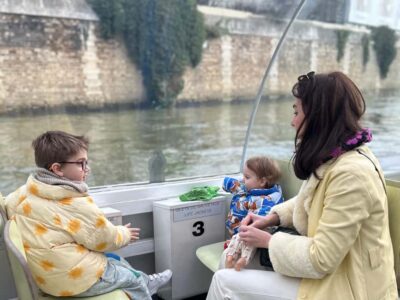
Hop-On Hop-Off Seine Cruise Pass with 9 Stops
Read our review →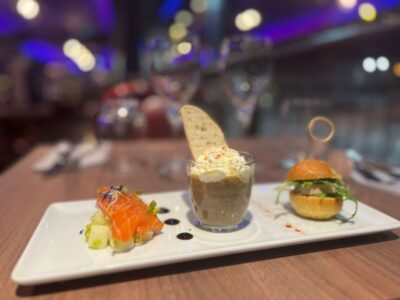
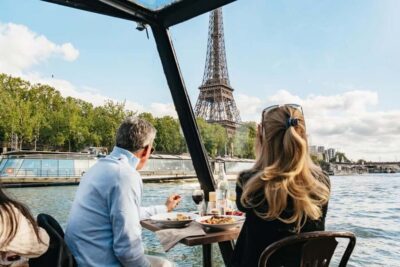
3-Course Gourmet Dinner Cruise on Seine River
Read our review →Browse the lists this tour appears in