
Reviewed · LOUVRE MUSEUM TOURS
Paris: Guided Tour of the Must-Sees of the Louvre Museum
The Louvre is too large to conquer in one visit, so this 90-minute guided tour makes a sensible first attack. You meet at the Arc de Triomphe du Carrousel, cross toward the glass pyramid, and let an English-speaking guide lead you to the museum’s essential works instead of wandering through endless corridors with a map in hand.
I like two things right away: the reserved entrance saves valuable Paris time, and the guide gives each famous work a story rather than leaving you to stare at a nameplate. The main drawback is pace. This is a brisk highlights tour, not a slow art seminar, and security can still take up to 20 minutes even with reserved access.
Key points to know before booking
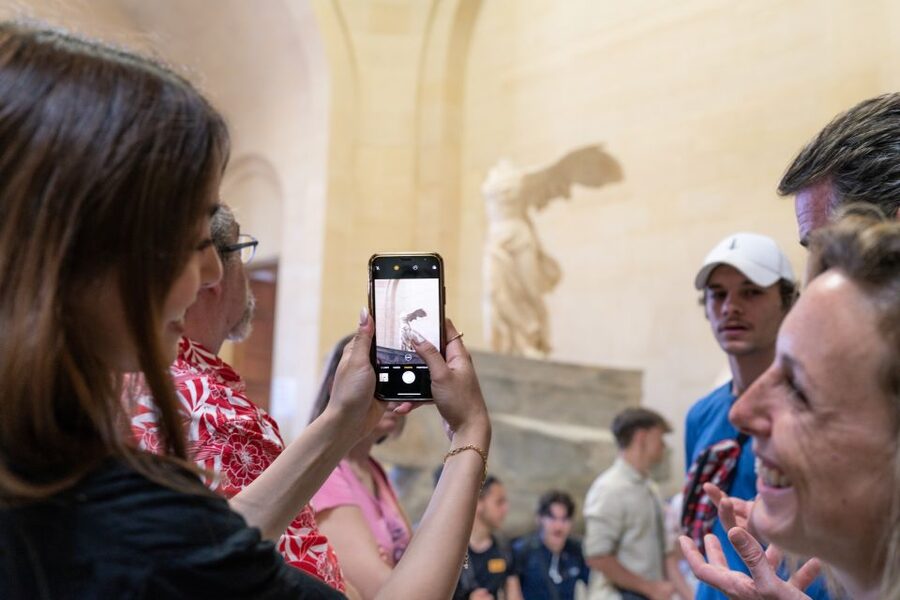
- The famous trio is included: See the Mona Lisa, Venus de Milo, and Winged Victory, along with other important works.
- The guide does the navigating: You move through a huge museum in a planned order, with commentary on art, artists, architecture, and French history.
- Reserved entry saves time: It helps with the main access line, though security screening can still cause a wait.
- Headsets keep the tour audible: You can hear the guide even when the galleries are crowded.
- The pace is brisk: The advertised duration is 90 minutes, although some descriptions refer to two hours. Plan for a short, tightly organized visit.
- Come prepared to walk: Wear comfortable shoes, bring identification, and leave luggage and baby strollers elsewhere.
Why a guided Louvre visit makes sense
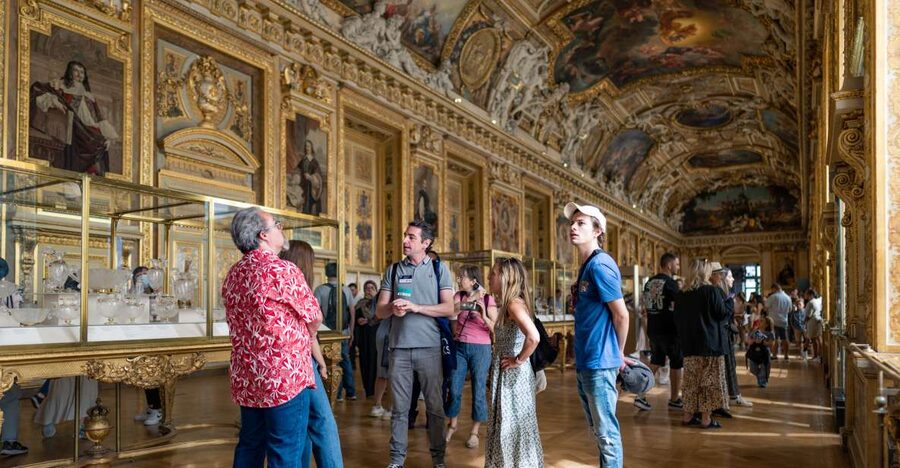
The Louvre is not simply a large museum. It is a former royal palace with several wings, many floors, and a collection too broad to see in a single day. Even finding the Mona Lisa can take time if you do not know which turns to make.
That is where this tour earns its keep. Your guide sets a route through selected rooms and explains why each stop matters. You are not expected to decide between ancient Egypt, Renaissance painting, Greek sculpture, and French art while trying to keep a museum map pointed in the right direction.
I especially like this format for a first visit. You get a framework for the building and its collection, then you can stay afterward and return to the rooms that caught your attention. The tour finishes inside the Musée du Louvre, giving you a useful starting point for exploring independently.
The approach is active rather than leisurely. You will stop at major works, listen to short explanations, move with the group, and repeat the process. If your ideal museum visit means sitting quietly in front of one painting for half an hour, this will feel too fast. If you want to get your bearings and see the essentials, the pace is useful.
Other ways into the Louvre from Paris:
- Paris: Louvre Museum Timed-Entrance Ticket
★ 4.6 · 71,977 reviews - Paris: Louvre Guided Tour with Reserved Access & Boat Cruise
★ 4.3 · 16,353 reviews - Louvre Museum Masterpieces Guided Tour with Access
★ 4.5 · 12,023 reviews
Meeting at the Arc de Triomphe du Carrousel
The meeting point is the Arc du Carrousel du Louvre, the arch opposite the glass pyramid. This location matters because it places you directly beside the museum, rather than sending you to a distant office or hotel pickup point.
Look for a guide wearing a guide card on an orange lanyard marked Memories France. Arrive early enough to identify the group without rushing. One past departure had a small mix-up at the start, so punctuality and a clear look at the meeting instructions are wise.
There is no hotel pickup or drop-off. You make your own way to the Louvre and meet the group outside. That keeps the price lower than a private transfer package, but you need to allow time to reach the Carrousel from your Paris accommodation.
The walk from the arch to the museum is short. It also gives the guide a chance to gather the group and explain how the entry process will work before you reach the security area.
Entering the Louvre with reserved access
Reserved tickets are one of the strongest practical reasons to book this experience. The Louvre is one of Paris’s busiest attractions, and arriving without a plan can mean spending a large part of your morning or afternoon waiting.
Reserved access does not mean walking straight through every line. Everyone still passes security, and the wait can reach about 20 minutes during the busiest periods. That distinction matters. The tour reduces the ticket-line problem, but it cannot remove airport-style screening or crowd pressure inside the building.
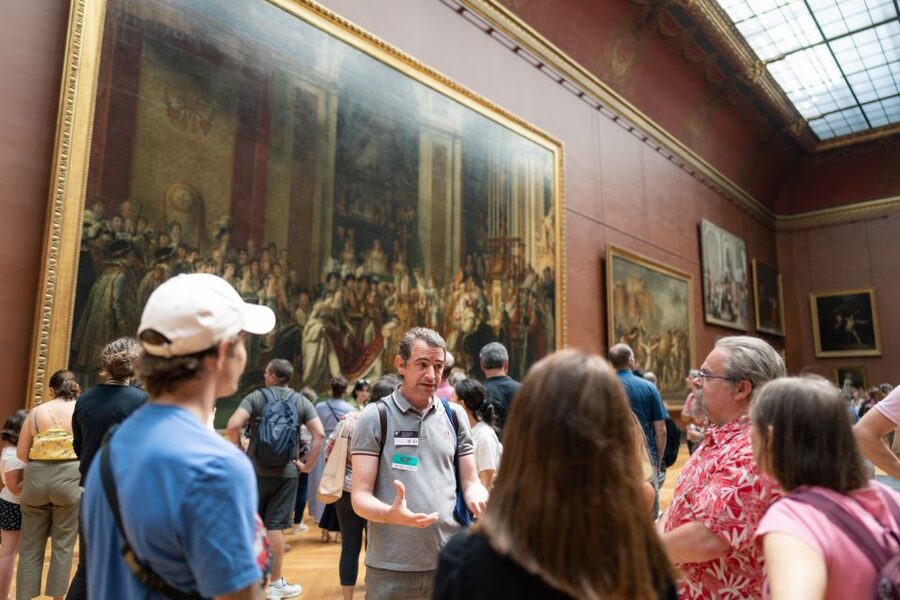
Once inside, the headset becomes useful. Large rooms and thick crowds can make it hard to stand beside the guide, especially near the Mona Lisa. The audio system lets you hear commentary while keeping a little space around yourself.
The equipment also helps if you need to pause briefly to look at a detail or take a photograph. Stay aware of the group, though. The guide may move to another position once the explanation ends.
The Louvre as a former royal palace
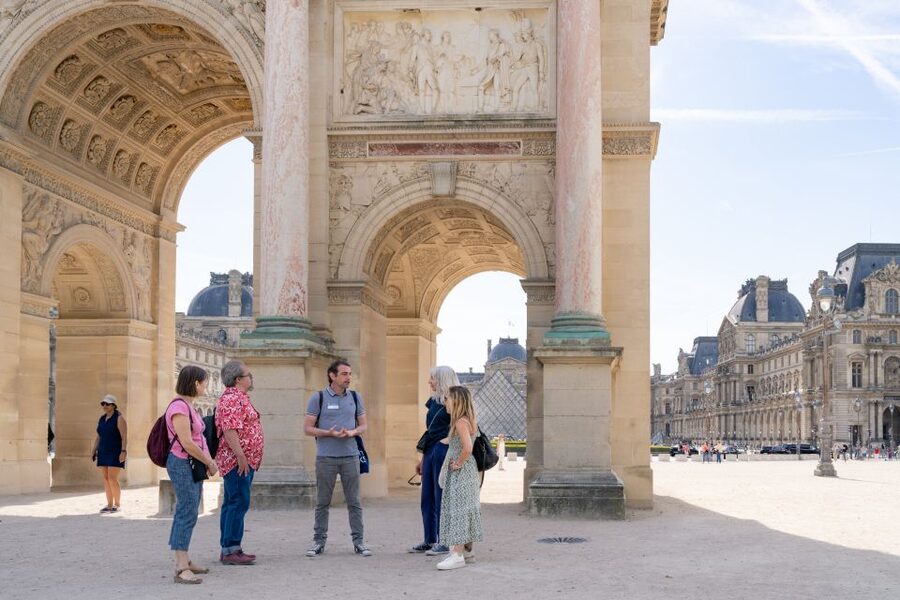
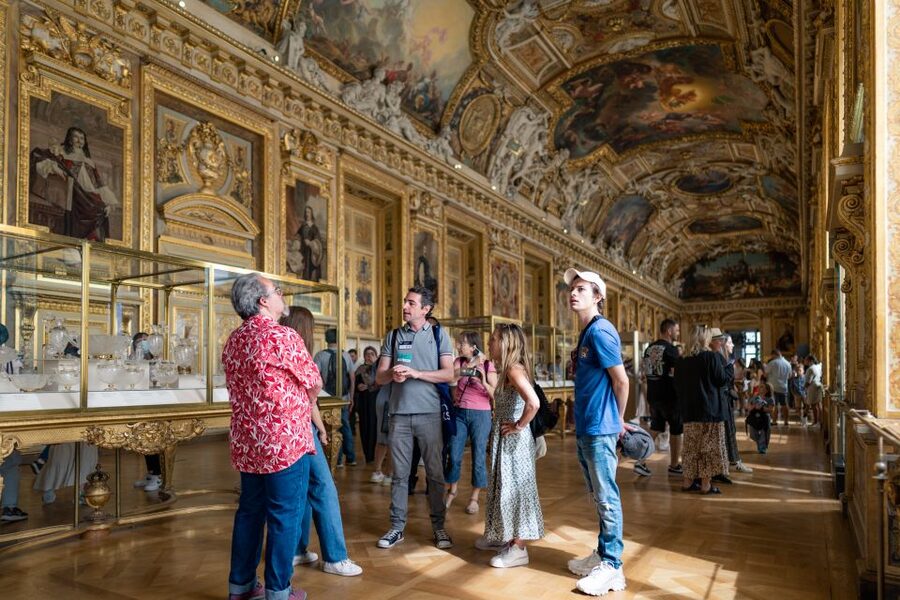
One of the best features of the visit is that the building itself receives attention. The Louvre was once a royal palace, and the route takes you through sumptuous corridors and grand interiors associated with kings, queens, and emperors.
That context changes the way you see the collection. You are not entering a neutral white-box gallery built only for modern exhibitions. You are walking through a place shaped by royal power, national ambition, and centuries of collecting.
A good guide connects the rooms to the objects inside them. The tour also covers the Louvre’s development and the role of Paris in French art and culture. This is useful because the museum can otherwise feel like a string of unrelated galleries.
You may also see part of the medieval section, depending on the route and guide. One past participant specifically discovered that area for the first time during a highlights visit. It is a reminder that the tour can include more than the three headline works, even though the exact selection may vary.
More museums in Paris:
- Paris: Louvre Museum Entry Ticket With Host and River Cruise
★ 4.6 · 9,926 reviews - Les Invalides: Napoleon’s Tomb & Army Museum Entry
★ 4.6 · 9,185 reviews - Louvre Museum – Exclusive Guided Tour (Entry Included)
★ 5.0 · 6,296 reviews - Paris: Louvre Museum Hosted Entry and Mona Lisa Audioguide
★ 4.6 · 5,235 reviews
The Mona Lisa and the reality of the crowd
The Mona Lisa is the stop most people expect, and it is usually the most crowded. You should expect a dense area around the painting, limited personal space, and a short chance to look before the group moves on.
The guide helps by approaching the room efficiently and explaining the work before or after you reach the viewing area. Several guide-led visits have been praised for getting groups through the crowd and into a useful position without losing people.
Still, no tour can turn this into a private viewing. You may spend more time managing the crowd than studying the painting. Keep your expectations realistic: the value lies in seeing the work and understanding its fame, technique, and place in art history, not in having a quiet conversation with it.
I like that the route does not treat the Mona Lisa as the entire point of the Louvre. The painting is one important stop among several. That helps prevent the common mistake of rushing through a world-class collection just to take one photograph.
Venus de Milo and Winged Victory
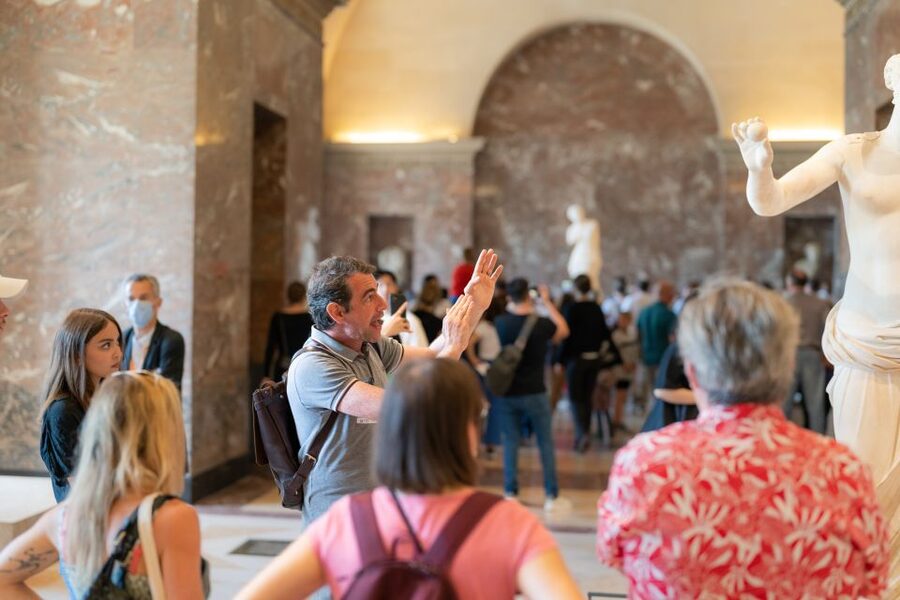
The Venus de Milo and Winged Victory provide a welcome contrast to Leonardo’s small Renaissance portrait. These monumental sculptures give you a sense of the Louvre’s ancient Greek collection and show how much the museum offers beyond paintings.
The Venus de Milo is known for its missing arms and balanced form. Winged Victory, also called Nike of Samothrace, is displayed in a dramatic setting at the top of a grand staircase. The approach to the sculpture is part of the experience, and the guide can point out how movement and fabric are suggested in stone.
These stops also help you compare different artistic aims. The Mona Lisa invites close attention to expression and technique. The ancient sculptures depend on idealized bodies, scale, posture, and the impression of motion.
The tour gives you time for the key ideas without asking you to memorize a lecture. Guides such as Anthony, Ivan, Sara, Sarah, Sylvanie, and Stephanie have been praised for explaining symbolism, technique, and historical context in clear, lively ways. Your guide will vary, but the supplied format is built around a personal, spoken interpretation rather than a recorded audio guide.
Ancient Egypt, Greece, Rome, and Renaissance art

The route reaches across several periods. Expect references to ancient Egypt, Greece and Rome, the Italian Renaissance, and French painting from the 19th century.
That range is a major benefit of a guided visit. You get a compact explanation of how artistic ideas changed across time, rather than seeing only the most famous objects in isolation.
The tour cannot cover every period in depth. One description of the experience suggests that some departures may give more attention to Roman material and the Mona Lisa than to the full sweep of the collection. The exact balance depends on the guide, crowd movement, and museum conditions.
This is not a criticism so much as a planning point. If you have a particular interest in Egyptian antiquities, French Romantic painting, or another department, tell the guide early if there is a chance to do so. The advertised promise is the museum’s must-see works, not a specialist route through one collection.
The strongest guides make the art easier to remember by using stories, symbolism, and questions. Reports about Sara describe an orderly, chronological presentation. Anthony has been praised for inviting questions and looking beyond the object itself. Ivan is noted for fitting a great deal into a short visit while keeping the group together.
How the 90-minute route feels
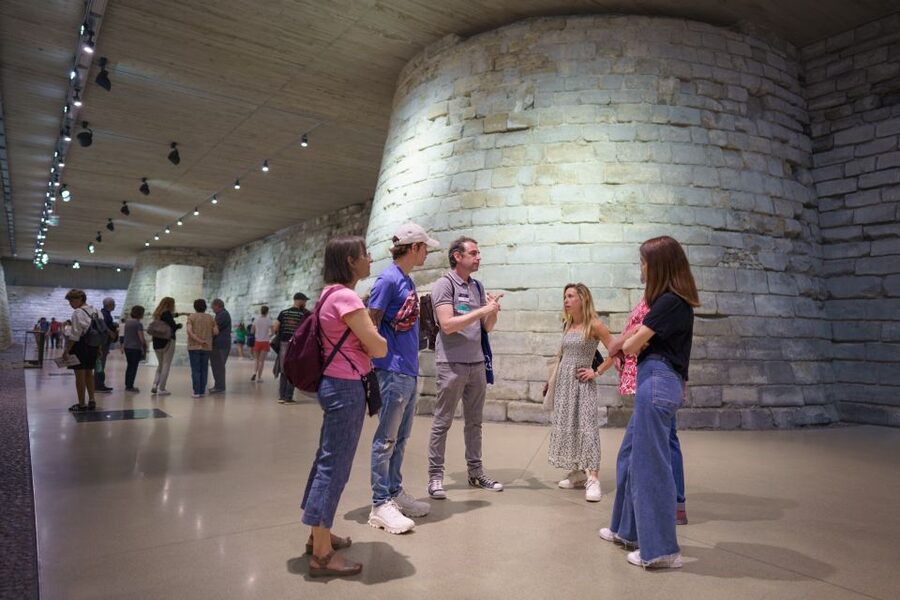
The stated duration is 90 minutes, while some promotional wording describes the experience as two hours. Treat it as a 90-minute guided visit, with extra time needed for meeting, security, and getting settled inside.
That is enough time for a carefully chosen highlights route. It is not enough to see the Louvre in any full sense. You will likely move steadily from room to room, stop for explanations, and keep an eye on the guide in crowded areas.
The pace has clear advantages. Families and first-time visitors can see the most important works without tiring themselves out in a vast building. A short tour also fits well into a day that includes the Tuileries Garden, the Seine, or other central Paris sights.
The limitation is that some rooms will receive only a passing glance. You may want to stay longer at a painting, but the group needs to keep moving. The best way to handle this is to treat the tour as an introduction, then remain in the museum afterward if your ticket and museum conditions allow you to continue exploring.
Several guides have been praised for keeping the group moving without making the experience feel rushed. That balance is important. The Louvre is so large that a slow pace can actually leave you with fewer meaningful stops.
Group size, guide quality, and the headsets
A small-group option is available, but the exact group size is not stated as a fixed guarantee. Smaller groups generally make it easier to hear explanations, ask questions, and stay close to the guide.
The human guide is the heart of the experience. The best feedback centers on clear English, enthusiasm, humor, and the ability to explain difficult ideas without turning the visit into a classroom lecture.
The guide names praised in the supplied material include Marjolein, Antonio, Anton, Sara, Sarah, Stan, Saeed, Matt, Sylvanie, Perrine, Ivan, Anthony, Stephanie, Claire, Sylvia, Adolfo, Caroline, and Meghan. This long list also makes one point clear: your guide is assigned by departure, so you should not book expecting one particular person unless the provider confirms it.
The headsets are a practical plus. In a crowded gallery, the guide may be several steps away, and the equipment lets you listen while viewing the art. One family particularly appreciated being able to move slightly and continue hearing the explanation.
Is $82 a fair price?
At $82 per person, this is not the cheapest way into the Louvre. You are paying for the reserved ticket, an English-speaking guide, the planned route, and headsets, not just admission.
I think the price can make sense if this is your first Louvre visit or if you have limited time in Paris. The museum’s size creates a real navigation problem, and the cost of getting lost is not only financial. You can lose an hour wandering between wings, miss the works you came to see, and finish tired before you understand what you saw.
The value is weaker for repeat Louvre visitors who already know the building and prefer to choose their own rooms. It is also less appealing if you want a private guide, a specialist art focus, or a long, quiet study of individual paintings.
For families, the value can be strong. A guide who keeps children involved, checks that everyone is following, and adds humor can turn a demanding museum into a manageable visit. One guide was specifically praised for including a child around eight to ten years old.
The cancellation terms add flexibility: cancel up to 24 hours before departure for a full refund, and you can reserve now while paying later. A missed departure is not refundable, so build in time for transport and the meeting point.
Who should book this Louvre tour?
I would choose this tour for:
- First-time Louvre visitors who want the major works without getting lost.
- Families that need a clear route and short explanations.
- People with only a few hours in central Paris.
- Anyone who wants art, architecture, and historical context in plain English.
- Repeat visitors who want a quick orientation before exploring alone.
I would look elsewhere if you use a wheelchair, since the experience is not listed as suitable for wheelchair users. A walking aid may be manageable in some circumstances, but the route includes substantial walking and you should contact the provider before booking if mobility is a concern.
Leave baby strollers and large bags behind. Bring a passport or identification card, wear comfortable shoes, and avoid arriving with luggage. Those rules can determine whether an otherwise good booking works for you.
Final verdict: book it for direction, not depth
This is a practical Louvre introduction. The reserved entrance helps, the headsets solve a real crowd problem, and the guide gives you a route through works that are difficult to find efficiently on your own.
I would book it if I wanted to see the Mona Lisa, Venus de Milo, and Winged Victory in one focused visit while still hearing the stories behind them. I would not book it expecting a quiet museum morning or a complete survey of the Louvre.
The smartest plan is to use the 90-minute tour as your orientation, then continue on your own if you still have energy. You leave knowing which galleries matter to you, rather than wondering where to begin.
FAQ
How long does the Louvre tour last?
The activity information gives a duration of 90 minutes, although some descriptions refer to two hours. Plan on a brisk 90-minute guided visit, plus time for meeting and security.
What works of art will I see?
The route includes the Mona Lisa, Venus de Milo, and Winged Victory. It also covers additional works from ancient Egypt, Greece and Rome, the Italian Renaissance, and 19th-century French painting.
Is museum admission included?
Yes. The experience includes a pre-reserved entrance ticket to the Louvre and a guided visit.
Does the tour skip the Louvre ticket line?
Reserved access helps you avoid the regular ticket line. You still need to pass security, and the wait can reach about 20 minutes during high season.
What language is the tour in?
The live tour guide speaks English.
Where do I meet the guide?
Meet at the Arc du Carrousel du Louvre, opposite the glass pyramid. The guide wears an orange lanyard with the Memories France logo and a guide card.
Is hotel pickup included?
No. You make your own way to the meeting point, and the tour finishes at the Musée du Louvre.
What should I bring?
Bring a passport or identification card and wear comfortable shoes. The tour includes a reasonable amount of walking.
Can I bring a stroller or large bag?
No. Baby strollers, luggage, and large bags are not allowed for this activity. The tour is also not suitable for wheelchair users.
Just added in Paris
- Paris: Create your Signature Scent Perfume Workshop★ 4.8 · 221 reviews
- Paris: Flea Market Insider’s Tour in Extra-Small Group★ 4.6 · 73 reviews
- Paris : Painting experience in an art cafe★ 4.6 · 204 reviews
- Paris: Vallée Village Outlet Shopping Day★ 4.3 · 362 reviews
- Paris night out : Comedy in English ‘How to Become a Parisian ?’★ 4.5 · 373 reviews
- La Vallee Village Shopping Outlet by Luxury Transport from Paris★ 3.5 · 111 reviews
- Design Luxury and Personalized Jewelry in Paris le Marais★ 5.0 · 160 reviews
- Oh My God She’s Parisian! English Comedy Show in Paris★ 4.5 · 116 reviews
Louvre Museum Tours, compared.


Louvre Guided Tour with Reserved Access & Boat Cruise
Read our review →
Louvre Museum Masterpieces Guided Tour with Access
Read our review →
Louvre Museum Entry Ticket With Host and River Cruise
Read our review →
Priority Access Louvre with Host -Direct to Mona Lisa
Read our review →
Mona Lisa & Louvre Masterpieces Tour with Reserved Access
Read our review →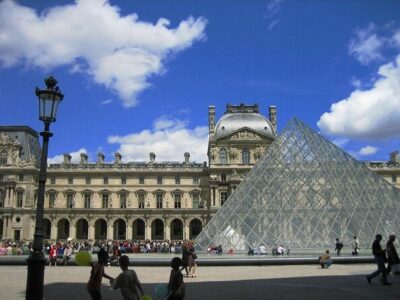
Louvre Museum – Exclusive Guided Tour (Entry Included)
Read our review →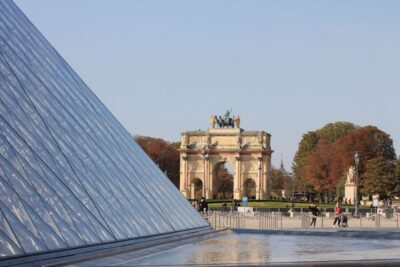
Louvre Reserved Ticket and River Cruise Combo
Read our review →Browse the lists this tour appears in