
Reviewed · TOURS IN TOULOUSE
Narbonne: visit the Archbishops’ Palace and Cathedral
Narbonne’s grandest sights sit close together, but they make more sense when you see how they connect. This two-hour walk moves from the old Roman road to the Archbishop’s Palace, through the Gothic cathedral and cloister, then along the river to Les Halles. Marion Quart leads the visit in French and Sangro.
I like the route’s variety: you get serious architecture inside the cathedral, small details such as the Passage de l’Ancre, and ordinary city life at the market. I also like the private-group format, which gives the guide room to explain rather than rush you past the good bits.
The main consideration is scope. Two hours gives you a strong introduction, but the €23 price does not include the Donjon, town art collection, or Treasure Room. If you want every museum interior, you will need to add the €12 admission ticket.
Key points at a glance
- Follow the Via Domitia: Begin on the ancient route that helps explain why Narbonne became such an important city.
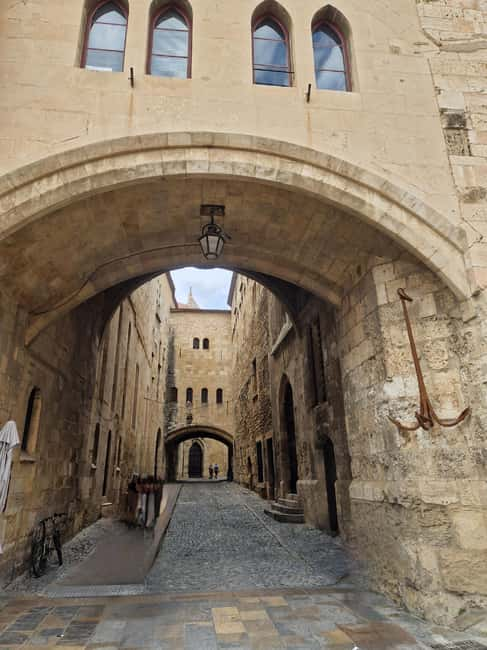
- Enter the Archbishop’s Palace: See the main courtyard and Grand Staircase, with the palace façade providing clues to the city’s past.
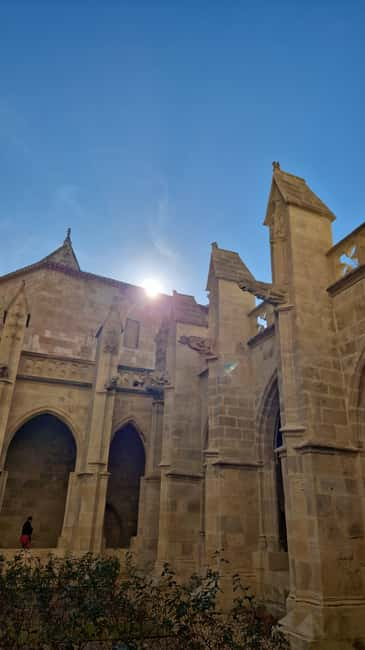
- Look up in the cathedral cloister: Gargoyles, Gothic stonework, and the soaring vaulted ceiling give this part of the visit its strongest visual moments.
- Admire three major interior features: The monumental organ, the 17th-century altarpiece, and the 14th-century sculpted altarpiece are all included.
- Finish where local life gathers: The walk ends around the Promenade des Barques, Pont des Marchands, and Les Halles.
- Expect a guide-led history walk: Marion Quart is praised for clear explanations, humor, enthusiasm, and an ability to make two hours pass quickly.
Starting at Les Halles and the Via Domitia
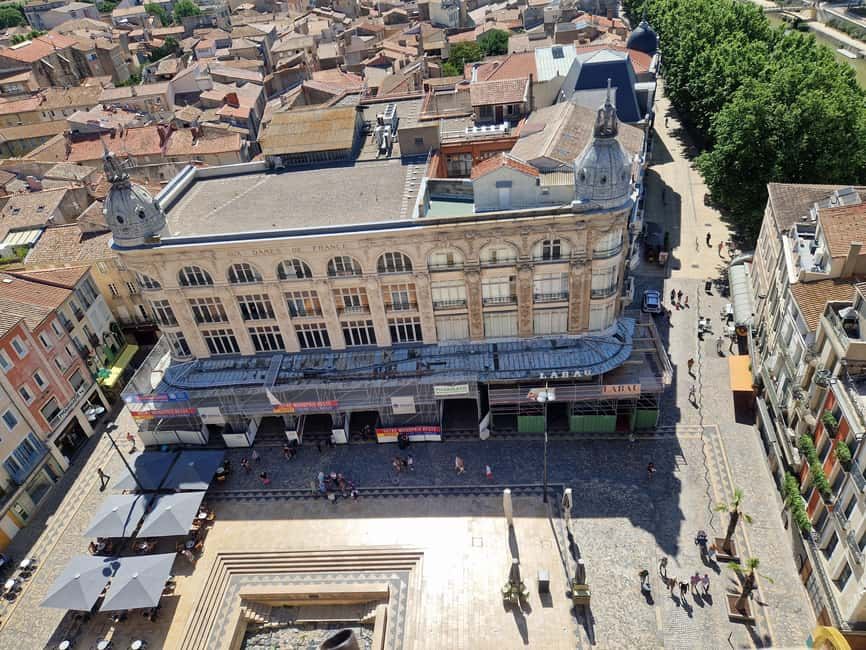
You meet in front of the main entrance to Les Halles de Narbonne, near the war memorial. Look for a guide wearing a green neckerchief and carrying a professional card. This is a useful meeting point because Les Halles is not just a market building on the route. It is also one of Narbonne’s best-known gathering places.
The walk begins by setting the city in its ancient surroundings. The Via Domitia gives you a sense of Narbonne’s long role as a place of passage and settlement. Rather than treating the old road as a disconnected archaeological feature, the guide uses it as a starting point for understanding where people have lived in the city over many centuries.
I like this opening because it gives the rest of the walk a clear thread. You are not simply ticking off a palace, cathedral, bridge, and market. You are following the changing center of Narbonne, from an ancient route to the seat of church power, then to streets and public spaces still used today.
The Via Domitia stop is brief enough to keep the visit moving, but it adds useful context before you reach the palace. If you enjoy Roman history, this part will probably feel like an appetizer rather than a full archaeological tour. The focus here is the city’s story, not a long technical discussion of Roman construction.
Other trips people book in Toulouse:
- Toulouse: Carcassonne Day Trip by Coach with Audioguide
★ 4.4 · 580 reviews - Toulouse Food & History Tour with a Chef (in English)
★ 5.0 · 503 reviews - Toulouse: Albi and Cordes/Ciel Day Trip with Audio Guides
★ 4.5 · 486 reviews
Reading the Archbishop’s Palace façade
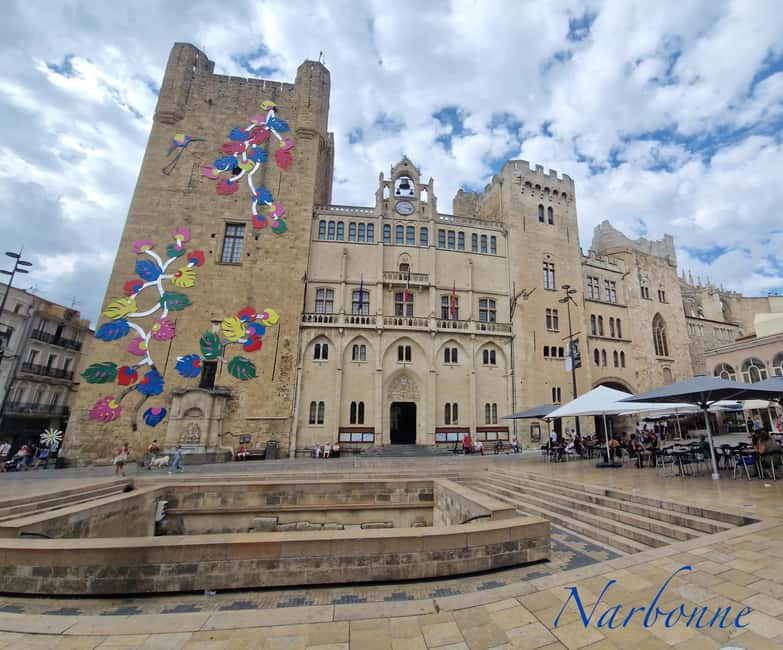
The former Palais des Archevêques occupies today’s Place de l’Hôtel de Ville, the main civic space in the center. The façade has a great deal to say, and the guide helps you read it instead of merely photographing it.
That is one of the tour’s strongest ideas. A large historic building can be hard to understand when you see only its size and stonework. With Marion Quart, the façade becomes part of the story of Narbonne’s religious and political power. Details that might otherwise pass unnoticed are given a place in the larger picture.
You then enter the palace’s main courtyard. The Grand Staircase is the next major feature, and this change from public square to enclosed court makes the palace feel more substantial. You get to see both the exterior face presented to the city and the interior courtyard used by the people who lived and worked in the complex.
The visit includes the exterior and interior courtyards, along with the Passage de l’Ancre. These are valuable additions because they give you more than the main postcard view. The palace becomes a group of connected spaces, with movement through courtyards and passages shaping your understanding of the building.
The tour does not include admission to the Donjon. That matters if the tower is high on your list. You can buy the additional €12 admission ticket, which also covers the town’s art collection and the Treasure Room, but the basic €23 tour is designed around the palace spaces included in the guided walk rather than every paid room.
Crossing the cloister into Saint-Just and Saint-Pasteur
From the palace, you follow the archbishops toward Saint-Just and Saint-Pasteur Cathedral. The cloister provides a calm transition between the palace and the church. Look above you as you walk. Gargoyles tower over the cloister, adding a playful and slightly fierce edge to the formal Gothic setting.
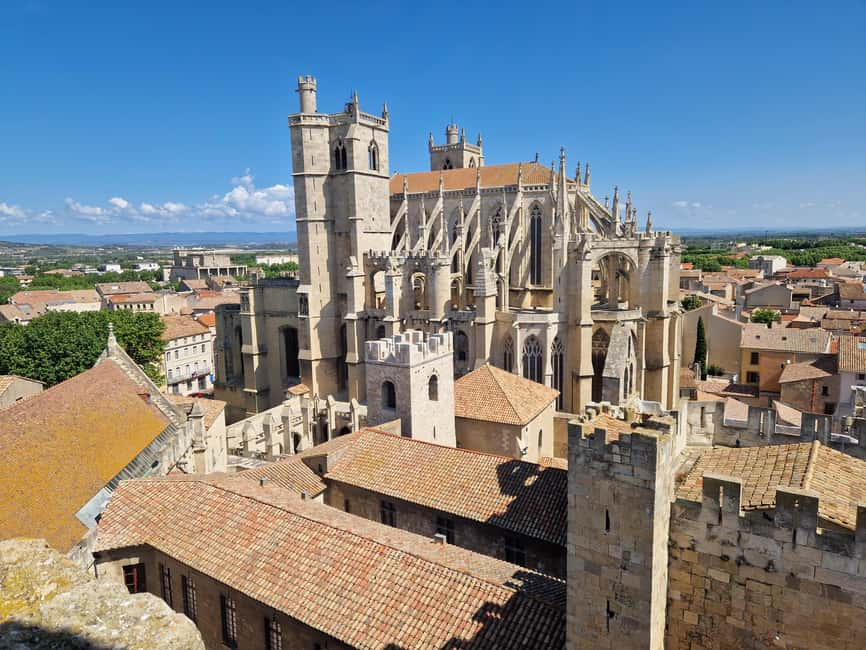
The cathedral is the architectural centerpiece of the visit. Its 14th-century Gothic design is most impressive once you are inside and can take in the height of the vaulted ceiling. I would give yourself a moment here before focusing on individual objects. The scale of the interior is part of what makes the building memorable.
A guide adds real value in a space like this. You can see the ceiling, organ, and altarpieces on your own, but it is harder to know what deserves your attention first. Marion explains the major features in a way that keeps the visit approachable. Several descriptions of her guiding style point to enthusiasm, humor, and simple explanations rather than a heavy lecture.
The cathedral visit includes both the exterior and interior. That lets you compare the structure’s formal outer appearance with the height and decoration inside. You also visit the cloister and the archbishop’s garden, so the church experience is not limited to a single nave or altar.
The organ and altarpieces worth your time
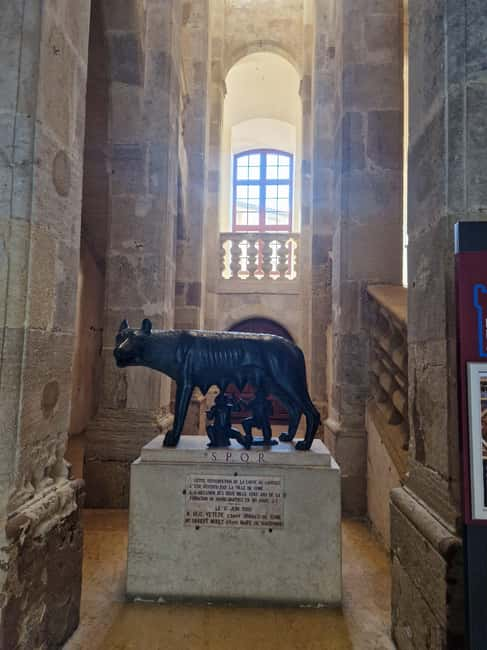
Three interior details receive particular attention. The monumental organ gives the cathedral a strong vertical focal point, while the 17th-century altarpiece adds a different period and style to the Gothic setting.
The 14th-century sculpted altarpiece is especially useful for visitors who like art that rewards close looking. It is described as a picture book, and that is a good way to approach it. Instead of treating it as one large object, take time to look at the figures and scenes as separate pieces of a larger visual story.
I appreciate that the tour includes these details rather than stopping at the broad claim that the cathedral is old and Gothic. Architecture becomes easier to remember when you attach it to specific objects. After the tour, you are more likely to recall the organ, the carved altarpiece, and the ceiling than a general description of medieval design.
The cathedral is also the point where the tour feels most formal. If you prefer markets, streets, and everyday city life to religious architecture, the second half will probably suit you better. If church interiors are your main interest, you may wish the visit lasted longer, since the two-hour route has several other stops to cover.
Same base, a different kind of day:
- Toulouse Victor Hugo Market Small Group Tasting Tour
★ 5.0 · 337 reviews - Lourdes: Sanctuary Guided Walking Tour
★ 4.6 · 205 reviews - Half-day sailing on the Gave de Pau
★ 5.0 · 180 reviews - Toulouse: Electric Tuk-Tuk Tour with Photo Stops and Audio
★ 4.8 · 138 reviews
The archbishop’s garden and the return to city life
The archbishop’s garden offers a change of pace after the stone corridors and cathedral interior. The supplied details do not specify the garden’s size or exact planting, so I would treat it as a pleasant part of the palace complex rather than plan the visit around elaborate formal gardens.
That modest pause matters. A tour made entirely of grand interiors can become tiring, especially when you are taking in dates, names, and architectural terms. The garden gives the route some breathing room before it returns to the public spaces of Narbonne.
This is also where the route’s theme becomes clear. You begin with ancient movement along the Via Domitia, move into the palace and cathedral where authority was concentrated, then finish among the places where people meet, shop, and walk today. The progression gives the tour more shape than a simple list of monuments.
Promenade des Barques, Pont des Marchands, and Les Halles
The final stretch follows the Promenade des Barques toward Pont des Marchands and Les Halles. This is a smart ending because it brings you back to the city’s everyday center rather than leaving you at the last historic monument.
Pont des Marchands is one of the named highlights, and the riverside walk gives you a chance to see Narbonne from a more open angle. The route does not turn into a long river excursion. Instead, the promenade connects the architectural core with the market area where the visit began.
Les Halles is described as an emblematic meeting place for the people of Narbonne. The tour includes access to the market, but it does not promise a food tasting or a meal. You should think of this as an introduction to the market’s role in local life, not a separate culinary activity.
I like ending here because you can continue your time in Narbonne on your own. After the guide finishes, you are already near one of the city’s key public places. You might browse the market, return to a palace area for one of the paid admissions, or simply use the central location to plan your next stop.
Marion Quart’s guiding style
The strongest part of this experience is the guide. Marion Quart is repeatedly described as passionate, engaging, professional, and clear. One useful detail is that she does not rely only on facts. Her approach includes humor and simple explanations, which can make a long sequence of historical dates easier to follow.
A history-minded visitor will appreciate the level of detail. At the same time, the tone is not presented as academic or difficult. The best fit is someone who wants to understand Narbonne’s past but does not want to spend two hours listening to a dry lecture.
The high rating of 4.9 from 43 reviews supports the view that the guiding is consistently strong. More important for your decision, the praise focuses on specific qualities: enthusiasm, professionalism, thoughtful attention, and the ability to make the city feel like a journey through time.
The language information needs a small note. The tour is listed in French and Sangro, and some content is shown in its original language. If you need English, confirm language arrangements before booking because English is not listed among the tour languages provided here.
Who gets the best value from €23
At €23 per person, the tour offers good value if you want a guided introduction to Narbonne’s main historic center. You get two hours, a private group, palace courtyards, the cathedral, cloister, garden, Via Domitia, Pont des Marchands, Promenade des Barques, and Les Halles.
The value is strongest for first-time visitors who want the city’s major stories connected for them. You avoid the common problem of seeing several impressive buildings without understanding how they fit together. A guide also helps you use your limited time well.
The price is less attractive if your main aim is independent museum time. The Donjon, town art collection, and Treasure Room are not included. The extra €12 admission ticket gives access to those areas, so budget for €35 total if you choose both the tour and the additional admissions.
Because the group is private, the experience may suit families, couples, and small groups who prefer a more personal pace. The data does not specify the maximum group size, so do not assume it is a one-to-one tour. It is wheelchair accessible, which makes it a practical option for many visitors, though the route includes historic buildings and courtyards where surfaces may vary.
Timing, meeting details, and practical planning
The activity lasts two hours, with starting times shown according to availability. Build a little extra time around it so you are not hurrying to the meeting point. The guide waits near the war memorial by the main entrance to Les Halles, wearing a green neckerchief and professional card.
You can cancel up to 24 hours in advance for a full refund. You can also reserve now and pay later, which helps if your schedule in southern France is still shifting.
The route combines outdoor streets and courtyards with indoor palace and cathedral spaces. Wear shoes you can walk in comfortably, and remember that the cathedral is a place of worship. The tour is accessible to wheelchair users, but if you have particular mobility needs, it is sensible to confirm the exact route and access arrangements when booking.
Should you book this Narbonne walk?
Book it if you want Narbonne explained rather than simply photographed. The route covers the city’s main historic center in a sensible order, Marion Quart brings energy and clarity, and the €23 cost includes far more than a quick look at the cathedral.
I would especially choose it for a first visit, a history-focused afternoon, or a private group that wants a guide who can adjust the level of detail. I would skip it only if you want extensive museum access, a food-focused tour, or an English-language guide, since those points are not included in the stated experience.
For most visitors, the best plan is to take the tour first, then decide if the Donjon, art collection, or Treasure Room deserves the extra €12. That way, you understand the city’s main story before choosing where to spend more time.
FAQ
Where does the tour begin?
Meet in front of the main entrance to Les Halles de Narbonne, near the war memorial. The guide wears a green neckerchief and carries a professional card.
How long does the experience last?
The tour lasts two hours. Starting times depend on availability.
What languages are offered?
The listed languages are French and Sangro. Some content is shown in its original language.
Is the tour private?
Yes. It is organized as a private group experience.
Is the tour wheelchair accessible?
Yes, the activity is listed as wheelchair accessible.
What is included in the €23 price?
The price includes guided visits to the Via Domitia, Archbishop’s Palace courtyards, Passage de l’Ancre, cloister, cathedral interior and exterior, archbishop’s garden, Promenade des Barques, Pont des Marchands, and Les Halles.
Are the Donjon, museum, and Treasure Room included?
No. Those admissions are not included in the tour price. They are available with a separate €12 admission ticket.
Just added in Toulouse
- Lourdes, Guided Walking Tour in the Sanctuary★ 4.0 · 70 reviews
- Private guided tours of Lourdes / Walking tour★ 5.0 · 56 reviews
- Half-day sailing on the Gave de Pau★ 5.0 · 180 reviews
- Private guided tour of the city of Carcassonne★ 5.0 · 58 reviews
- Cité de Carcassonne Guided Walking tour. Private tour.★ 5.0 · 42 reviews
- Medieval Carcassonne: Interactive Ghost Story & City Game★ 3.5 · 33 reviews
- Carcassonne ‘s Medieval Walls: A Self-Guided Tour★ 4.5 · 43 reviews
- Carcassonne During World War 2★ 5.0 · 127 reviews
Tours in Toulouse, compared.

Toulouse Food & History Tour with a Chef (in English)
Read our review →
Albi and Cordes/Ciel Day Trip with Audio Guides
Read our review →
Toulouse Victor Hugo Market Small Group Tasting Tour
Read our review →



Browse the lists this tour appears in