
Reviewed · BATTLEFIELD & WWII TOURS
Somme Battlefields Small-Group Day Trip with John Monash Centre from Paris
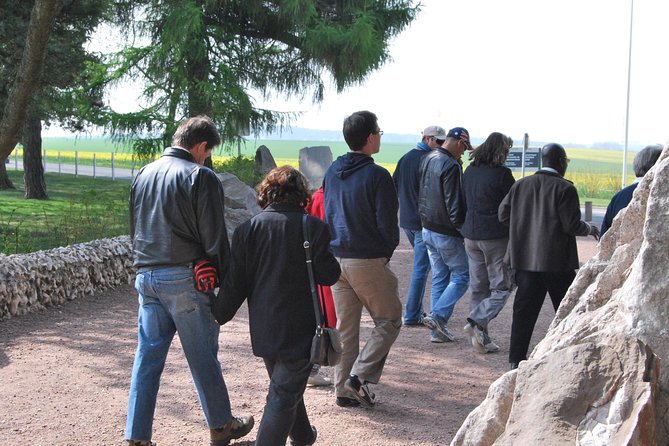
The Somme battlefield is not a single monument. It is a wide area of villages, cemeteries, mine craters, memorials, and surviving trenches, all tied to the catastrophic 1916 offensive. This tour gives you a lot in one long day, with an emphasis on the Australian, British, French, and Newfoundland experience of the First World War.
I like the visit to the Sir John Monash Centre, which uses film and interactive displays to explain the Australian role on the Western Front. I also like the chance to see places that are hard to reach without a car, including Lochnagar Crater and the Australian sites around Pozières and Villers-Bretonneux. The main drawback is the length: with an early start, a long drive, and many stops, you may wish for more time at the most meaningful sites.
Key points to know before booking
- The Somme is a full-day commitment: Expect about 11 hours from central Paris, including the drive north and return.
- The Sir John Monash Centre adds modern context: Its multimedia displays help explain what happened beyond the names and dates.
- The itinerary is especially strong for Australians and New Zealanders: Villers-Bretonneux, Pozières, the Australian National Memorial, and ANZAC sites receive close attention.
- You see both memorials and physical evidence: Lochnagar Crater, old trenches, cemeteries, and ruined battlefield positions give the day a strong sense of place.
- Guide quality matters: Regis, Honoré, Heniere, and Julian have all led highly praised departures, but the guide assigned to your date is not guaranteed.
- Bring patience and suitable clothing: The tour operates in all weather, and outdoor stops require walking over uneven ground.
Why this Somme day trip is worth the long ride from Paris
At $294.36 per person, this is not a cheap day out. You are paying for a full day of transport from Paris, an English-speaking driver-guide, a small-group format, and access to several places that would be awkward to connect by public transport.
I think the price makes sense if you have a serious interest in the First World War, family connections to the campaign, or only one available day for the Somme. A rental car could offer more freedom, but you would need to plan the route, understand the sites, and drive for much of the day. Here, the guide links the places together and explains why each one matters.
The tour has an average rating of 4.6 from 270 reviews, with 92 percent recommending it. That is a strong result, though you should not expect a relaxed countryside excursion. This is a demanding history day, with a 6:50 am departure and a packed route.
The group size needs a quick check before you reserve. The tour is described in one place as limited to eight people, while the booking details give a maximum of 16. If a small group is important to you, confirm the expected group size with Paris TRIP before paying. A genuinely small group makes a major difference at cemeteries and memorials, where a guide can answer questions without losing the group in the crowd.
Other battlefield and wartime sites reachable from Paris:
- Somme Battlefields from Paris with Australian memorial & Amiens Cathedral
★ 5.0 · 228 reviews - Normandy Battlefields Tour – American Sites (A3)
★ 5.0 · 876 reviews - Normandy Battlefields D-Day Private Trip with VIP Services from Paris
★ 5.0 · 240 reviews
Starting before sunrise and heading north
You meet at Le Duplex on Avenue Foch in central Paris at 6:50 am. The return point is near the Arc de Triomphe, so the tour begins and ends in central locations, but you need to arrive early. The group does not wait for late arrivals, and a missed departure caused by delay is not refundable.
The drive to the Somme takes time, but it also gives your guide a chance to set the scene. The Battle of the Somme began in 1916 as a major Allied offensive against German positions. It became one of the bloodiest campaigns of the war, with enormous losses among British, French, Australian, Newfoundland, and other forces.
A good guide makes the drive useful rather than filling it with random facts. Regis is repeatedly praised for clear explanations, efficiency, and a friendly manner. Honoré has also been singled out for combining historical detail with humor and warmth. Heniere and Julian have received similar praise for their command of the subject.
Still, guide quality can vary. One otherwise positive account described a guide as too loud and insensitive at sites where quiet reflection was needed, with some concerns about incorrect details regarding Australian service. That is a useful warning. This subject calls for facts, but also for restraint. At a cemetery or memorial, you may want a few quiet minutes without continuous commentary.
Delville Wood and the human cost of the battle
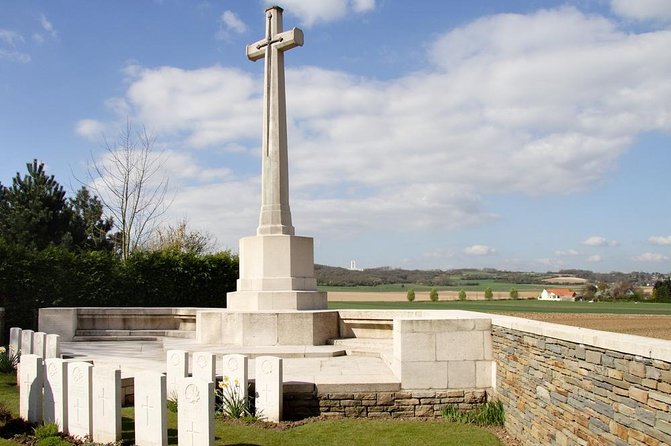
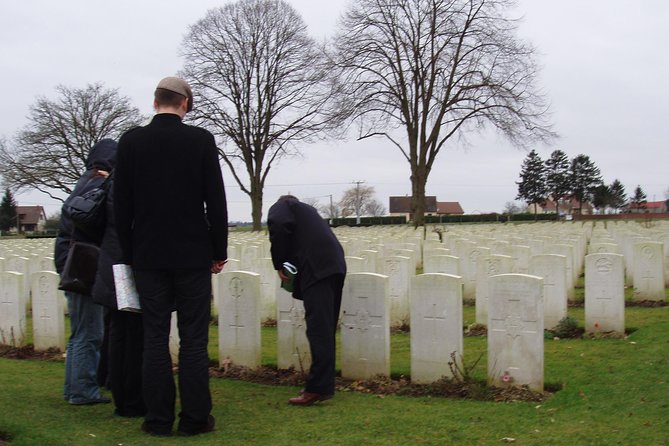
Delville Wood Cemetery at Longueval is one of the day’s most affecting stops. More than 5,500 Commonwealth servicemen from the First World War are buried or commemorated there. The neat rows of headstones make the scale of the losses personal, one name at a time.
The cemetery is not simply a place to tick off a stop. Take time to read a few names and notice the different ages, units, and inscriptions. If you are visiting because of a family connection, tell the guide early in the day. Guides have sometimes helped visitors make special stops connected with relatives, although you should not assume an off-route visit will always be possible.
Delville Wood is also important for Australians and South Africans, who suffered heavily in the area. The surrounding villages and fields do not look like a battlefield in the usual sense. That contrast is part of the experience. Farms and roads now occupy ground that once held trenches, artillery positions, and troops under fire.
You may find this stop emotionally heavy. That is not a flaw, but it is worth knowing before booking. The day deals with death, sacrifice, and the consequences of military decisions. It is not designed as light sightseeing.
Lochnagar Crater, a scar left by explosives
At La Boisselle, Lochnagar Crater gives you one of the clearest physical reminders of the battle. The crater measures about 330 feet, or 100 meters, across. It was created by a massive mine detonated beneath German lines on July 1, 1916.
The size is difficult to grasp from photographs. From the edge, you can see how a single explosion reshaped the ground. The crater has been preserved as a memorial, so your visit is about both military engineering and remembrance.
This is one of the stops where sensible shoes help. The tour involves outdoor walking, and the ground can be uneven or muddy in poor weather. The operator says the experience runs in all weather, so pack a waterproof layer rather than relying on a clear Paris forecast.
Lochnagar also helps you understand why the Somme cannot be reduced to a list of dates. The battlefield survives in fragments: a crater here, a cemetery there, a trench line elsewhere. Your guide’s job is to connect those fragments.
Same base, a different kind of day:
- Paris: Louvre Museum Timed-Entrance Ticket
★ 4.6 · 71,977 reviews - Disneyland® Paris 1-Day Ticket
★ 4.6 · 49,412 reviews - Paris: Versailles Palace and Gardens Full Access Ticket
★ 4.6 · 41,579 reviews - Paris: Evening River Cruise with Music
★ 4.4 · 22,721 reviews
Pozières and the Australian battlefield story
The Australian focus becomes especially clear around Pozières. You visit the First Australian Division Memorial, close to the former German Gibraltar blockhouse. Australian forces captured and held Pozières village between July 23 and 26, 1916, at great cost.
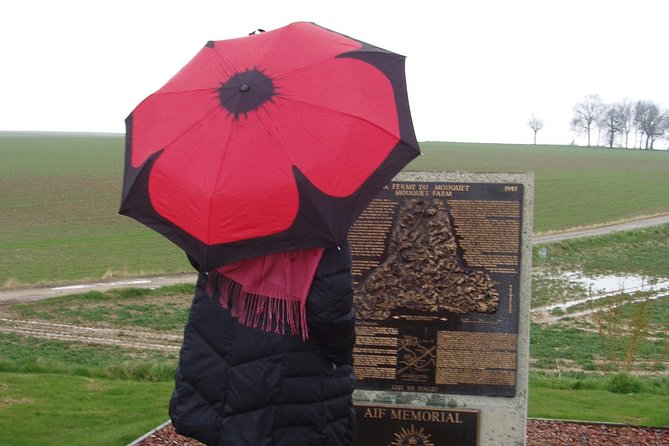
The memorial honors officers, non-commissioned officers, and soldiers of the First Australian Division who fought in France and Belgium in 1916. The area also recalls the wider Australian contribution to the Somme, including the fighting around Mouquet Farm.
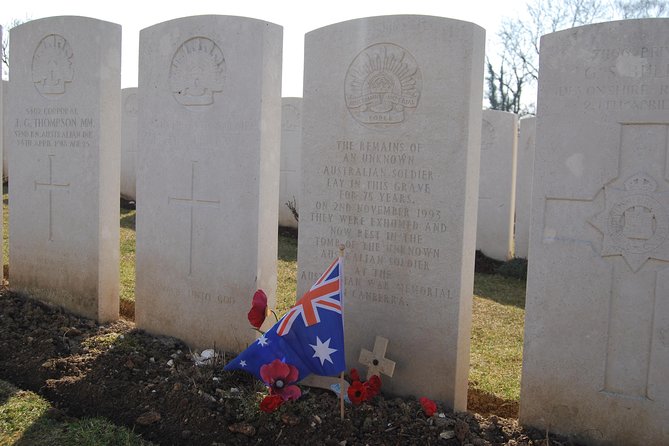
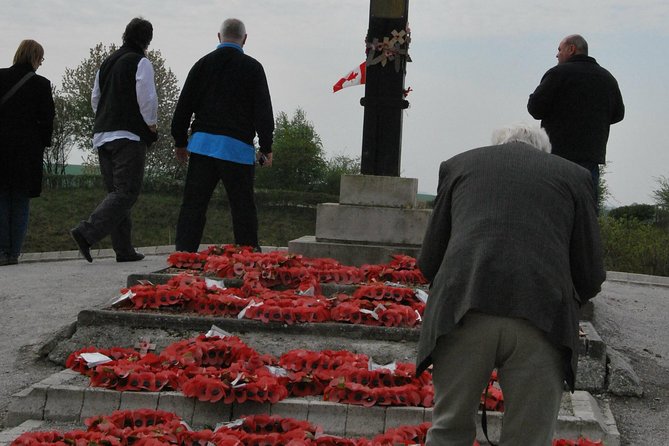
An Australian flag still flies over Pozières, a small but powerful detail for visitors with family or national connections. Several people choose this tour specifically to understand where Australian soldiers served, and the itinerary gives that interest real attention rather than treating it as a passing reference.
The Australian emphasis does not exclude other national stories. The route also includes British and Newfoundland sites, and guides have adapted explanations for groups containing Australians, Canadians, and other nationalities. If your interest is mainly British, French, Canadian, or Newfoundland history, tell the guide what you want to understand. The schedule is broad enough to support more than one perspective, but the Australian thread is particularly strong.
Thiepval, Ulster Tower, and Beaumont-Hamel
The British memorial at Thiepval commemorates soldiers who have no known grave and who went missing during the Somme fighting. Its huge brick and stone structure dominates the surrounding fields, making it one of the most recognizable memorials in the region.
You also visit the Ulster Tower, a memorial connected with the 36th Ulster Division. These sites remind you that the Somme was not one national story. Units arrived from across the British Empire and the United Kingdom, each carrying its own local loyalties and losses.
The route includes the Beaumont-Hamel Newfoundland Memorial, where sections of trenches remain visible. This is among the most valuable parts of the day for anyone who wants to see how soldiers lived and fought rather than only read names on stone.
Walking near preserved trenches changes your understanding of the battle. The spaces are tight, the ground is uneven, and the defensive positions feel far less orderly than a map suggests. You may not get as much time here as you want, since the day has many stops. One practical tip is to keep questions focused and use free moments for your own quiet look around.
Villers-Bretonneux and the Sir John Monash Centre
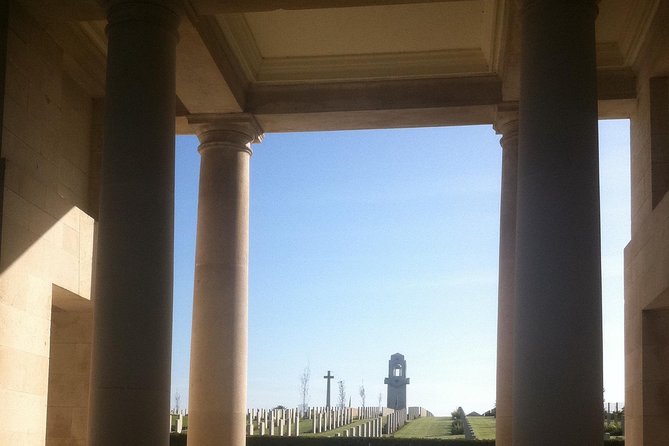
The Sir John Monash Centre sits on the grounds of Villers-Bretonneux Military Cemetery beside the Australian National Memorial. It forms the main hub of the Australian Remembrance Trail on the Western Front.
The center uses interactive media, film, and other displays to tell the Australian Western Front story. This is a helpful change of pace after outdoor memorials. Instead of standing in front of a monument and trying to picture events from a small inscription, you get a more structured account of campaigns, people, and wartime conditions.
You should allow about an hour here, although several people would prefer more time. If modern museum interpretation is important to you, this may be the day’s highlight. The multimedia approach can also help family members who are less familiar with military history follow the story.
Next door, the Australian National Memorial commemorates Australian soldiers who fought in France and Belgium during the First World War. A total of 10,729 Australian servicemen are officially commemorated there. The memorial is also associated with the annual Dawn Service held on April 25 for Anzac Day.
This is a particularly meaningful stop for Australian visitors, especially those tracing a relative. It is also a place where a guide should allow silence. You may want to step away from the group briefly, if permitted, to take in the cemetery and memorial at your own pace.
The Historial in Péronne gives the day a wider frame
The Historial Great War Museum in Péronne broadens the tour beyond battlefield movement and military memorials. Its collection includes more than 50,000 historic objects connected with military and civilian life during the war.
That civilian focus matters. The First World War did not only affect soldiers in trenches. Families, workers, refugees, nurses, and children all lived with shortages, fear, separation, and political upheaval. A museum visit helps you connect the battlefield to the society that supported, endured, and remembered it.
The museum is scheduled late in the day, when you may already be tired. That is the trade-off in a one-day tour. You see a great deal, but the final museum visit requires concentration after hours of walking and driving. If Péronne is your main priority, a separate visit would allow more time. If your aim is a broad introduction to the Somme, the stop adds useful context.
Transport, pace, and what to bring
The air-conditioned minibus is a practical choice for this route. You avoid the stress of driving unfamiliar rural roads and can rest during the return journey. The vehicle is comfortable according to the supplied information, but the day still involves many hours seated in transit.
Wear sturdy walking shoes and clothing suited to changing weather. The tour runs in all conditions, and several sites are outdoors. Bring water and food, since meals and drinks are not included. One person enjoyed lunch in one of the towns, but you should treat that as a practical possibility rather than a promised part of the tour.
The schedule is tight. You will see many important sites, but you may not linger at every one. That is the central compromise: this tour offers reach and interpretation, not a slow, private exploration of one battlefield.
Who should book this experience?
I would choose this tour if you are staying in Paris and want a guided introduction to the Somme without arranging a car. It is especially well suited to Australians, Canadians, New Zealanders, British visitors, military history enthusiasts, and families researching relatives who served in the First World War.
It can also work for first-time visitors who know little about the Great War. The museums and guide commentary provide enough structure to make the subject understandable. You do not need a military history degree, but you should be ready for a serious day.
I would hesitate if you dislike early starts, long drives, outdoor walking, or a tightly packed schedule. I would also think twice if your priority is extended time at one cemetery or memorial. A private tour or overnight stay in the Somme region would offer a slower pace, but at a higher cost and with more planning.
Should you book the Somme battlefield tour?
Book it if you want to see a wide range of major Somme sites in one day and value a guide who can explain the connections. The combination of Lochnagar Crater, surviving trenches, Delville Wood, Thiepval, Villers-Bretonneux, the Sir John Monash Centre, and the Historial makes this a substantial introduction rather than a quick memorial stop.
The strongest reason to go is access. From Paris, these sites are spread across rural northern France and are difficult to combine efficiently without private transport. The main caution is pace, along with the possibility that your assigned guide may not match the very high standard set by guides such as Regis or Honoré.
If you can handle the 6:50 am start and an 11-hour day, I think the tour offers solid value for a history-focused visit. Go prepared to listen, walk, and pause. The Somme rewards attention, not haste.
FAQ
How long is the Somme battlefield tour from Paris?
The experience lasts approximately 11 hours, including the journey from Paris to the Somme region and the return trip.
What time does the tour begin?
The stated start time is 6:50 am. You should arrive promptly because the group will not wait for late arrivals.
Where does the tour start and finish?
The meeting point is Le Duplex, 2 bis Avenue Foch, 75116 Paris. The listed end point is near the Arc de Triomphe at Place Charles de Gaulle.
What sites are included?
The route includes the Sir John Monash Centre, Australian National Memorial, First Australian Division Memorial, Thiepval Memorial, Lochnagar Crater, Delville Wood Cemetery, the Ulster Tower, Beaumont-Hamel Newfoundland Memorial, Australian sites around Pozières and Mouquet Farm, and the Historial Great War Museum in Péronne.
Is food included?
No. Food and drinks are not included in the tour price.
Is the tour suitable for all fitness levels?
The operator recommends a moderate level of physical fitness. You should expect walking at outdoor memorials and battlefield sites, including areas with uneven ground.
Does the tour operate in bad weather?
Yes. The experience operates in all weather conditions, so you should dress appropriately.
What is the cancellation policy?
You can cancel up to 24 hours before the start time for a full refund. Cancellations or changes made less than 24 hours before the start time are not accepted for a refund.
Just added in Paris
- Design Luxury and Personalized Jewelry in Paris le Marais★ 5.0 · 160 reviews
- Oh My God She’s Parisian! English Comedy Show in Paris★ 4.5 · 116 reviews
- Paris: Eiffel Tower Photo Shoot★ 5.0 · 420 reviews
- Photo Session in Paris – Photographer at the Eiffel Tower★ 5.0 · 422 reviews
- Paris City Sightseeing Half Day Guided Segway Tour with a Local Guide★ 5.0 · 371 reviews
- Paris Create your Own Perfume Workshop with a Perfumer★ 4.5 · 275 reviews
- Paris: Oh My God She’s Parisian! English Comedy Show★ 4.7 · 257 reviews
- Paris: Create your Signature Scent Perfume Workshop★ 4.8 · 221 reviews
Battlefield & WWII Tours, compared.
Normandy Battlefields Tour – American Sites (A3)
Read our review →
Normandy Battlefields D-Day Private Trip with VIP Services from Paris
Read our review →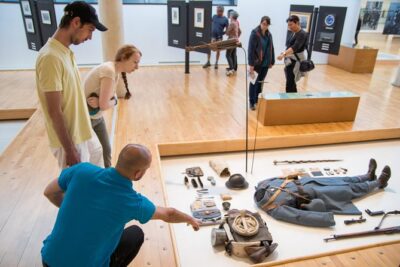
Somme Battlefields from Paris with Australian memorial & Amiens Cathedral
Read our review →Browse the lists this tour appears in