

Reviewed · MUSEUMS
Paris Museum of Illusions Entry Ticket
The best part of the Paris Museum of Illusions is its hands-on nature. You do not simply look at displays behind glass. You step into rooms, test your balance, pose for strange photos, and try to work out why your eyes are telling you something impossible. I like the spinning tunnel and tilted room most, and I like that children and adults can enjoy the same exhibits together. The main catch is size: you may finish in 20 to 40 minutes, even though the suggested visit lasts about an hour.
This is a cheerful, compact stop near public transportation, with friendly staff and a self-paced layout spread across two floors. It works well on a hot day, during a family afternoon, or when you want something lighter than another grand Paris museum. At $22.48 per person, though, you should book it for the playful photo opportunities and interactive tricks, not for a long, serious museum visit.
Key points at a glance
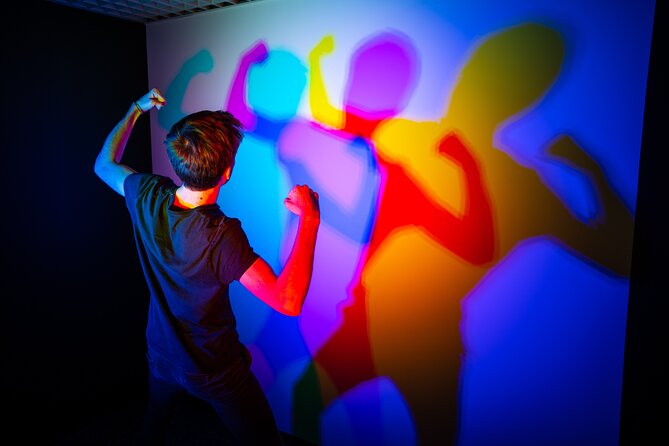
- The spinning tunnel is the star exhibit: It can make you feel as if the floor is moving beneath you.
- The tilted room tests your balance: Walking straight suddenly becomes much harder than it should be.
- Two compact floors keep the visit manageable: Most people can finish in about an hour, while some move through in 20 to 40 minutes.
- The experience is self-paced: You can linger at the displays that interest you and repeat the ones your children enjoy.
- Photos are part of the fun: Several setups create playful pictures, though getting the right angle can be tricky.
- The price rewards the right expectations: It is a good short family activity, but poor value if you expect the scale of a major Paris museum.
What the Paris Museum of Illusions actually offers
This is not a traditional museum filled with paintings, sculpture, or a long historical collection. It is a compact series of interactive rooms and installations built around visual tricks, balance, perspective, and the way your brain interprets what your eyes see.
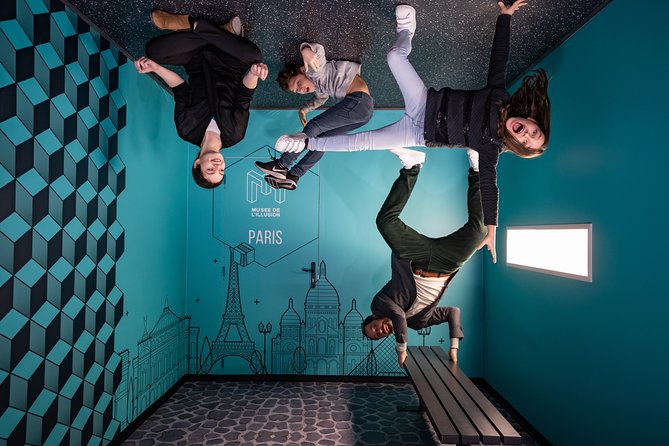
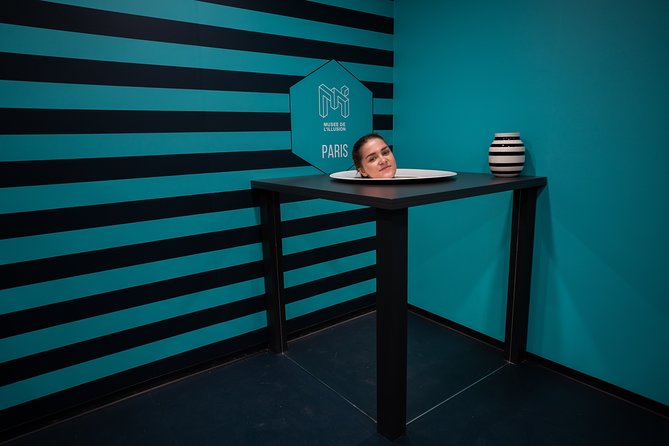
The basic idea is simple: you enter a display, take part in it, and try to explain what just happened. One room may make a person appear larger or smaller. Another may make a flat image feel three-dimensional. A particular opening lets you create a comical photograph in which your head appears separated from your body.
The museum describes its purpose as a mix of interaction, learning, and reflection. That is a fair description, provided you keep the scale in mind. You will get short explanations and chances to test each illusion, but this is primarily a playful outing. It is not a guided science lesson.
The experience is especially easy for families because there is no fixed lecture to follow. You can move at your own pace, let children repeat an exhibit, or spend more time taking pictures. Couples and adult friends can have fun with the same displays, although some adults may find the child-focused tone a little light.
More museums in Paris:
- Paris: Louvre Museum Timed-Entrance Ticket
★ 4.6 · 71,977 reviews - Louvre Museum Masterpieces Guided Tour with Access
★ 4.5 · 12,023 reviews - Paris: Louvre Museum Entry Ticket With Host and River Cruise
★ 4.6 · 9,926 reviews
The spinning tunnel and the tilted room
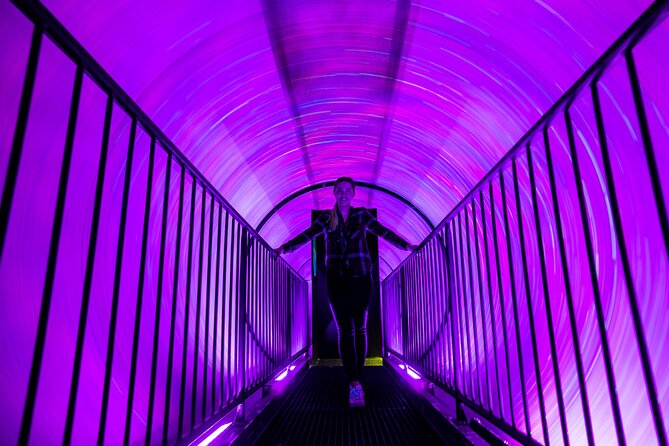
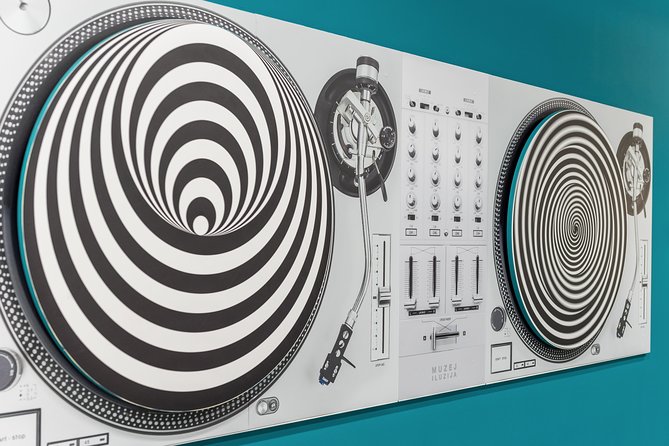
Two installations deserve special attention. The spinning tunnel is the one most likely to make you question your footing. The room itself creates the sensation that everything is rotating, even when you know the structure is not behaving as your eyes suggest. You may feel unsteady for a moment afterward, so take your time before moving on.
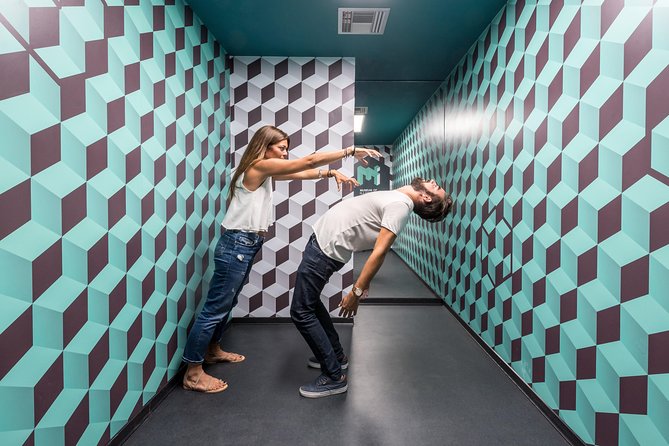
The tilted room creates a different trick. The floor and walls appear ordinary at first glance, but your sense of balance quickly disagrees. Walking in a straight line can feel oddly difficult, and photographs taken inside often make the effect clear. This is one of the better places to pause and watch family members attempt the same simple movement.
Some people find the motion-based displays mildly uncomfortable. One visitor left feeling a little motion sick, so if spinning sensations bother you, approach the tunnel carefully and do not rush through it. You can still enjoy the many static and photo-based installations.
The museum also includes perspective tricks and optical effects that do not work exactly the same way for everyone. That is part of the charm, but it can also lead to uneven reactions. One illusion may leave you puzzled, while another may seem obvious. The strongest displays are the ones that let you physically test what you see.
A self-paced visit across two floors
The museum is arranged over two floors, with exhibits that you walk through rather than a long route led by a guide. Staff check you in, then you explore independently. This gives you freedom, but it also means you should not expect a tour leader explaining every station.
Plan on about an hour if you want to try most displays and take photos. A quick visit can be over in 20 to 30 minutes, especially if you move directly from one station to the next. A family with young children may stay much longer by repeating favorite exhibits. One family with a three-year-old spent roughly two and a half hours, while adults visiting without children might be finished in an hour or less.
That wide time range matters when you judge the price. At $22.48 per person, the ticket is reasonable if it fills a useful hour and gives you memorable pictures. It feels less convincing if you spend only 20 minutes inside. I would treat the museum as a compact activity to pair with other plans, not as a half-day attraction.
The small footprint is also an advantage for younger children. They are less likely to tire before reaching the end, and you can keep an eye on everyone more easily than in a huge museum. On the other hand, narrow spaces and queues at popular stations can make the interior feel cramped at busy times.
Why the photo opportunities matter
Most people will remember the photographs as much as the explanations. The displays are designed for participation, and several work best when someone stands in a marked spot while another person takes the picture. The result can show you floating, shrinking, losing your head, or standing at an impossible angle.
Bring a phone with enough battery and be ready to take several attempts. The correct camera position is not always obvious, and a line may form behind you while you work it out. The museum would be easier to use if staff helped with photos at the trickier stations, but you should expect to manage the pictures yourself.
This can be a real advantage for families and couples. A standard museum may give you lovely objects to admire, but this one gives you pictures of your own group inside the joke. Children aged around nine and thirteen have plenty to do, and younger children can enjoy repeating the physical displays.
If you dislike taking posed photographs, the museum loses some of its appeal. You can still test the illusions, but much of the fun comes from seeing the finished image and sharing it with the person beside you.
Same base, a different kind of day:
- Disneyland® Paris 1-Day Ticket
★ 4.6 · 49,412 reviews - Paris: Versailles Palace and Gardens Full Access Ticket
★ 4.6 · 41,579 reviews - Paris: Evening River Cruise with Music
★ 4.4 · 22,721 reviews - Paris: Eiffel Tower Entry Ticket with Optional Summit Access
★ 4.4 · 20,035 reviews
How it works for children and adults
Children are the clearest audience for this attraction. The exhibits are physical, visual, and quick to understand. A child does not need a long attention span or special background knowledge to begin experimenting with a room or display.
The visit can suit a three-year-old as well as older children, although each child will engage in a different way. A toddler may repeat the same station several times, while older children may want to understand how the illusion works or compete to take the funniest photograph.
Adults are not left out. The spinning tunnel and tilted room work on grown-ups too, and couples often enjoy the chance to take unusual photos together. Still, I would not choose this as a top Paris attraction for adults seeking art, architecture, or serious science. It is a light, playful stop.
The attraction works particularly well when your group has mixed interests. One person can enjoy the visual puzzles, another can focus on photography, and children can move between the interactive stations. The compact layout also makes it easier to keep the group together.
Timing, crowds, and the Paris setting
The museum is close to public transportation, and transport to and from the attraction is not included in the ticket. You will need to arrange your own route and allow time to reach the entrance.
A weekday visit between 11 a.m. and noon has been described as relatively calm, though you should not assume the museum will always be quiet. It can become crowded around the installations, even for people who have reserved a time slot. That affects the experience because many exhibits require you to stand in a particular position and wait for a photo.
If your schedule is flexible, I would choose a weekday and arrive with patience. A quiet period lets you repeat the best exhibits and take cleaner photographs. At a busy time, you may feel hurried by the next group waiting behind you.
The surrounding area also gives you a practical reason to visit. You can combine the museum with a meal or another nearby activity rather than making a long journey for a 30-minute stop. This is where the attraction makes the most sense in a Paris itinerary: as a short, easy addition rather than the main event of your day.
Is $22.48 good value?
The answer depends almost entirely on how long you stay and what sort of outing you want. The ticket includes admission to the Musée de l’Illusion Paris, and the mobile ticket makes entry simple. It does not include transport, food, or skip-the-line access.
For a family that spends an hour or more testing exhibits and taking photos, the price can be fair. The museum offers an activity rather than a passive display, and the shared experience may be worth more than the number of objects on show.
For an adult who finishes in 20 minutes, the cost feels high. The venue is small, and some displays may not produce a strong effect for every person. You should not compare it with a full day at the Louvre or Musée d’Orsay. Compare it with a short family activity, a rainy-day diversion, or a place to fill an open hour.
The overall rating is 2.9 from 941 ratings, which reflects this split. The strongest praise focuses on the fun, interactive displays, friendly staff, family appeal, and good photo moments. The sharpest criticism focuses on the compact size, crowding, short visit, and price.
That pattern gives you useful guidance. The museum is not secretly enormous, and it is not a major Paris cultural institution. If you accept that before arriving, the experience is more likely to feel like a fun extra rather than a disappointment.
Practical advice before you go
Buy the ticket only after checking your day’s route. Since the ticket is non-refundable and cannot be changed, you should be certain you can make the visit before paying.
Bring a phone for photographs, and if possible, visit with someone willing to take pictures. Some displays are hard to frame from the correct angle on your own.
Give yourself about an hour, but keep your wider schedule flexible. You might finish in 20 minutes, or children may want to repeat favorite installations for much longer.
The museum accepts cash, credit cards, and holiday vouchers at the venue. Confirmation is received at booking, and the ticket is available by mobile. The attraction is near public transportation, but you must arrange your own journey.
There is no guide named in the supplied information, and you should expect a self-paced visit rather than a guided tour. Staff handle check-in and are described as friendly, but the exhibits do the teaching.
Who should book this Paris activity?
I would recommend it most strongly to families with children, couples who enjoy silly photographs, and anyone with a spare hour near the attraction. It is also a useful indoor option on a hot day, since the interior is comfortable.
You may enjoy it less if you want a large collection, a formal explanation of optical science, or a long visit for your money. Adults without children should book only if the interactive format sounds genuinely appealing. The museum’s best moments come from trying the displays, not from reading labels.
I would also think twice if your group dislikes crowds, motion effects, or taking turns at photo stations. The tilted room and spinning tunnel can feel strange, and the compact layout may become cramped when several groups arrive together.
Should you book the Paris Museum of Illusions?
Book it if you want a short, playful break with hands-on exhibits and photographs you cannot get at a normal museum. The spinning tunnel, tilted room, and family-friendly displays give the visit a clear purpose, and the self-paced format makes it easy to fit into a busy Paris day.
Skip it if you expect a grand museum, a guided tour, or several hours of content. At $22.48 per person, it offers fair value only when you use it as an interactive one-hour activity. Go with realistic expectations, visit at a quieter time if you can, and you are more likely to leave smiling rather than counting the exhibits.
FAQ
How long does the Paris Museum of Illusions visit take?
The expected duration is about one hour. Some people finish in 20 to 40 minutes, while families with young children may stay much longer by repeating exhibits.
What is included in the ticket?
The ticket includes admission to the Musée de l’Illusion Paris.
Is transportation included?
No. Transport to and from the attraction is not included, though the museum is near public transportation.
Is this a skip-the-line ticket?
No. The ticket is not sold as a skip-the-line ticket.
Can I use a mobile ticket?
Yes. The experience provides a mobile ticket, and confirmation is received at the time of booking.
Is the museum suitable for children?
Yes. Most travelers can participate, and the interactive exhibits are particularly suited to families and children of different ages.
Is the visit guided?
The supplied information describes a self-paced experience. It does not name a guide or promise a guided tour.
What are the most notable exhibits?
The spinning tunnel and tilted room receive the strongest attention. The museum also includes optical illusions, interactive displays, and setups designed for photographs.
What payment methods does the museum accept?
The museum accepts cash, credit cards, and holiday vouchers.
Can I cancel or change my booking?
No. This experience is non-refundable and cannot be changed for any reason.
Just added in Paris
- Paris night out : Comedy in English ‘How to Become a Parisian ?’★ 4.5 · 373 reviews
- La Vallee Village Shopping Outlet by Luxury Transport from Paris★ 3.5 · 111 reviews
- Design Luxury and Personalized Jewelry in Paris le Marais★ 5.0 · 160 reviews
- Oh My God She’s Parisian! English Comedy Show in Paris★ 4.5 · 116 reviews
- Paris: Eiffel Tower Photo Shoot★ 5.0 · 420 reviews
- Photo Session in Paris – Photographer at the Eiffel Tower★ 5.0 · 422 reviews
- Paris City Sightseeing Half Day Guided Segway Tour with a Local Guide★ 5.0 · 371 reviews
- Paris Create your Own Perfume Workshop with a Perfumer★ 4.5 · 275 reviews
Museums, compared.
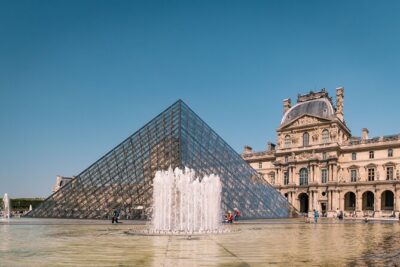
Louvre Museum Masterpieces Guided Tour with Access
Read our review →
Louvre Museum Entry Ticket With Host and River Cruise
Read our review →
Les Invalides: Napoleon’s Tomb & Army Museum Entry
Read our review →
Louvre Museum – Exclusive Guided Tour (Entry Included)
Read our review →
Louvre Museum Hosted Entry and Mona Lisa Audioguide
Read our review →
Louvre Museum Tour Mona Lisa & Iconic Masterpieces
Read our review →
Browse the lists this tour appears in